

Pakistan gunmen kill policeman guarding polio vaccination team 

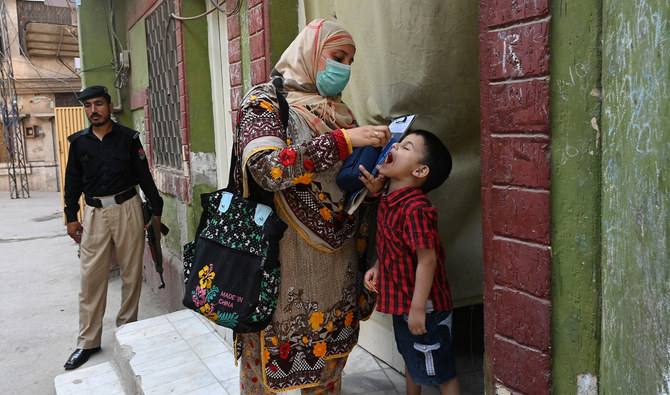
A health worker administers polio vaccine drops to a child during a vaccination campaign in Peshawar, Pakistan on May 22, 2023. (AFP/File)
Short Url
Updated 01 December 2023
Follow

Pakistan gunmen kill policeman guarding polio vaccination team 

  • The incident occurred in a tribal border region that was once a haven for Taliban militants 
  • Pakistan and neighboring Afghanistan are only two countries where polio remains endemic 

PESHAWAR: A Pakistani policeman was killed when militants attacked a polio vaccination team on Friday, police said, the latest casualty in the country’s long campaign against the crippling disease. 

Pakistan and neighboring Afghanistan are the only two countries where polio remains endemic and vaccination teams are frequently targeted by militants. 

The latest incident occurred in Malik Din Khel, part of the former tribal border region that was once a haven for Taliban militants. 

“Two gunmen riding a motorbike opened fire on policemen guarding a two-member polio vaccination team,” district police chief Saleem Khan Kulachi told AFP. 

“One policeman died at the scene while another sustained a minor injury,” he said. 

One of the gunmen was shot dead by police. 

Local police official Zahir Ahmed Afridi also confirmed the details, adding that the health care workers were unhurt. 

Pakistan initiated a week-long nationwide polio vaccination campaign on Monday, with the goal of inoculating more than 44 million children across much of the country. 

There was no immediate claim of responsibility for the attack but Islamist militants, including the Pakistani Taliban, have killed scores of polio vaccination workers and their security escorts in the past. 

Islamist opposition to inoculation grew after the US Central Intelligence Agency organized a fake vaccination drive to help track down Al-Qaeda’s former leader Osama bin Laden in the Pakistani garrison town of Abbottabad. 

Pakistan has reported five cases of polio this year, while 20 were reported last year, according to the Global Polio Eradication Initiative. 


Pakistan urges pilgrims to complete Saudi biometrics as Hajj preparations gain pace

Updated 30 January 2026
Follow

Pakistan urges pilgrims to complete Saudi biometrics as Hajj preparations gain pace

  • Government warns pilgrims biometric verification is required for Hajj visas
  • Step follows tighter oversight after last year’s Hajj travel disruptions

ISLAMABAD: Pakistan’s government on Friday urged aspiring pilgrims to complete mandatory Saudi biometric verification for Hajj visas, as preparations for the 2026 pilgrimage gather pace following stricter oversight of the Hajj process.

The announcement comes only a day after Pakistan’s Religious Affairs Minister Sardar Muhammad Yousuf said regulations for private Hajj operators had been tightened, reducing their quota following widespread complaints last year, when tens of thousands of pilgrims were unable to travel under the private Hajj scheme.

“Saudi biometric verification is mandatory for the issuance of Hajj visas,” the Ministry of Religious Affairs said in a statement, urging pilgrims to complete the process promptly to avoid delays.

“Hajj pilgrims should complete their biometric verification at home using the ‘Saudi Visa Bio’ app as soon as possible,” it added.

The statement said the pilgrims who were unable to complete biometric verification through the mobile application should visit designated Saudi Tasheer centers before Feb. 8, adding that details of the centers were available on Pakistan’s official Hajj mobile application.

Pakistan has been steadily implementing digital and procedural requirements for pilgrims ahead of Hajj 2026, including mandatory training sessions, biometric checks and greater use of mobile applications, as part of efforts to reduce mismanagement.

Saudi Arabia has allocated Pakistan a quota of 179,210 pilgrims for Hajj 2026, with the majority of seats reserved under the government scheme and the remainder allocated to private tour operators.