

In major step towards February elections, Pakistan polls regulator publishes final list of constituencies

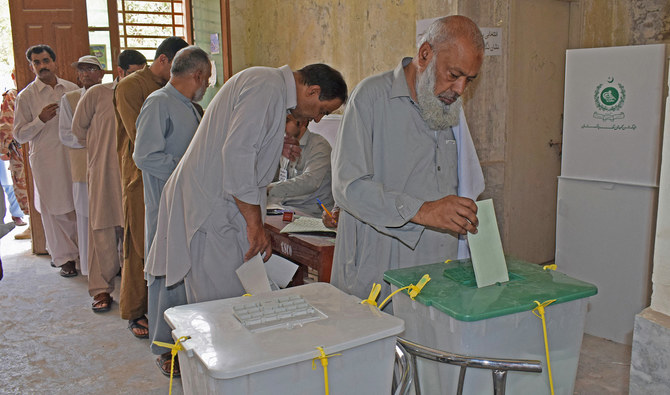
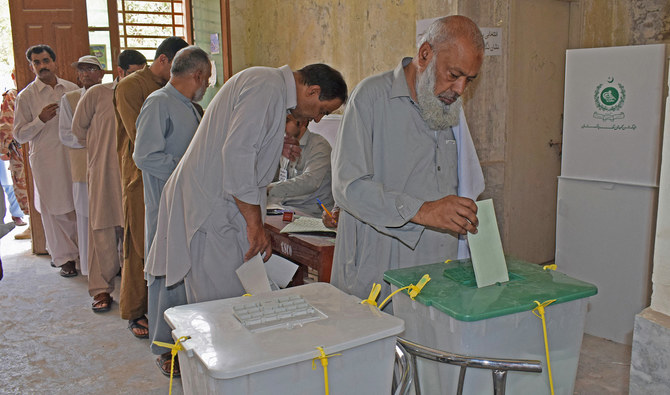
A Pakistani man casts his vote at a polling station during Pakistan's general election in Quetta on July 25, 2018. (AFP/File)
Short Url
Updated 01 December 2023
Follow

In major step towards February elections, Pakistan polls regulator publishes final list of constituencies

  • National Assembly has 336 seats: 266 general seats, 10 reserved seats for non-Muslims, 60 reserved seats for women
  • ECP notification comes amid widespread speculation in Pakistan that elections may be delayed even beyond February

ISLAMABAD: The Election Commision of Pakistan on Friday published the final list of constituencies for national and provincial assemblies, bringing the South Asian nation one step closer to general elections in February 2024.

The Commission announced last month the vote, originally expected in November and then scheduled for the last week of January, would instead take place on Feb. 8, a date chosen following consultations with the country’s President Dr Arif Alvi that were requested by the Supreme Court.

Pakistan's parliament was dissolved by the president on then Prime Minister Shehbaz Sharif's advice on Aug. 9, setting the stage for a national election amid political and economic crises. A caretaker administration subsequently took over with the constitutional mandate to hold new elections in 90 days.

However, as the outgoing Sharif government had approved the results of a new census in August, the election commission was constitutionally bound to first redraw hundreds of new constituency boundaries based on the fresh population count, before it could announce an election schedule, thereby delaying polls by several months.

“ECP publishes Final Delimitation-2023,” the regulator finally announced on Friday.


As per the new list, the National Assembly has a total number of 336 seats: 266 general seats, 10 reserved seats for non-Muslims and 60 reserved seats for women. Within the National Assembly, Balochistan province has a total of 20 seats, inc­lu­d­ing 16 general and four res­erved seats for women, Khyber Pakhtun­khwa has 45 general seats and 10 res­e­r­ved seats for women, Sindh has a total of 75 NA seats and of these, 61 are general and 14 are rese­rved for women, while Pun­jab, the province with the largest population, has 141 general seats and 32 seats reserved for women.

Among changes since the last delimitation, the number of National Assembly seats for Karachi South has increased from two to three, while Sanghar lost one of its three seats. Malir, Karachi East and Karachi Central gained one additional provincial assembly seat each, while Khairpur, Sanghar and Thatta lost one provincial seat each.

Khyber Pakhtunkhwa’s NA tally has increased from 39 to 45, with Bajaur, Mohmand, Khyber, North Waziristan, South Waziristan and Kurram gaining NA seats, while Tank’s separate seat has been merged with Dera Ismail Khan. The federal capital, Islamabad, has three general seats in the National Assembly with no reserved seat for women.

The ECP notification of final constituencies comes amid widespread speculation in Pakistan that elections may be delayed even beyond February. The opposition party led by former premier Imran Khan has been saying there are plans to delay polls as Khan's popularity, even from behind bars, grows.

But analysts have said any delay in the election could fuel public anger and add to uncertainty in the nuclear-armed nation.

The last general election in July 2018 was won by the party of the cricketer-turned-politician Khan, who was sworn in days later as prime minister for the first time.

Khan has been at the heart of political turmoil since he was ousted as prime minister in a no-confidence vote last year, raising concern about Pakistan's stability. He has since been convicted and jailed in a graft case, following which he has been barred from taking part in any election for five years.

Khan has accused the powerful military, which has ruled Pakistan intermittently since independence in 1947, of being responsible for his ouster. The military has denied the charge.

In addition to the legal issues that could crop up if the vote is delayed, the side-lining of Khan, the country's most popular leader according to polls, will cast doubt over the credibility of the elections, experts say.


Pakistan party calls Sindh resolution against new provinces ‘unconstitutional’

Updated 5 sec ago
Follow

Pakistan party calls Sindh resolution against new provinces ‘unconstitutional’

  • The development follows calls to separate Karachi from Sindh amid governance concerns intensified by a deadly mall fire last month
  • Muttahida Qaumi Movement-Pakistan calls for a referendum in urban areas of Sindh for the establishment of a new administrative unit

ISLAMABAD: The Muttahida Qaumi Movement-Pakistan (MQM-P) political party on Sunday criticized the Sindh provincial government for adopting a resolution in the provincial assembly against the creation of new provinces, describing it as “illegal, unconstitutional.”

The resolution was adopted on Saturday after fresh demands by the MQM-P and other voices to grant Karachi a provincial or federal status following governance challenges highlighted by a deadly mall fire earlier this year that killed 80 people.

Karachi, Pakistan’s largest city that is home to more than 20 million, is the country’s main commercial hub and contributes a significant share to the national economy.

Speaking at a press conference, MQM-P’s Khalid Maqbool Siddiqui said the Constitution of Pakistan provided procedure for establishing new provinces, but a province had “carried itself as if it were a separate country,” referring to Saturday’s resolution.

“Anything in contrast with the constitution cannot be adopted. This is illegal, unconstitutional, undemocratic,” he said, calling for a referendum in urban areas of Sindh for the establishment of a new administrative unit in the region.

Sindh Chief Minister Syed Murad Ali Shah had tabled the resolution in the assembly on Saturday, condemning what he described as “divisive statements” about breaking up Sindh or detaching Karachi.

“The province that played a foundational role in the creation of Pakistan cannot allow the fragmentation of its own historic homeland,” Shah told lawmakers, citing Article 239 of Pakistan’s 1973 Constitution, which requires the consent of not less than two-thirds of a provincial assembly to alter provincial boundaries.

“If any such move is attempted, it is this Assembly — by a two-thirds majority — that will decide,” he said.

The resolution reaffirmed that Karachi would “forever remain” an integral part of Sindh and directed the provincial government to forward the motion to the president, prime minister and parliamentary leadership for record.

Calls to alter Karachi’s status have periodically surfaced amid longstanding complaints over governance, infrastructure and administrative control in the megacity, though no formal proposal to redraw provincial boundaries has been introduced at the federal level.

Taha Ahmed Khan, a senior MQM-P member, acknowledged that his party had “presented its demand openly on television channels with clear and logical arguments” to separate Karachi from Sindh.

“It is a purely constitutional debate,” he told Arab News on Saturday. “We are aware that the Pakistan Peoples Party, which rules the province, holds a two-thirds majority and that a new province cannot be created at this stage. But that does not mean new provinces can never be formed.”