Ex-PM Khan’s court-ordered public trial scheduled to begin today in state secrets case

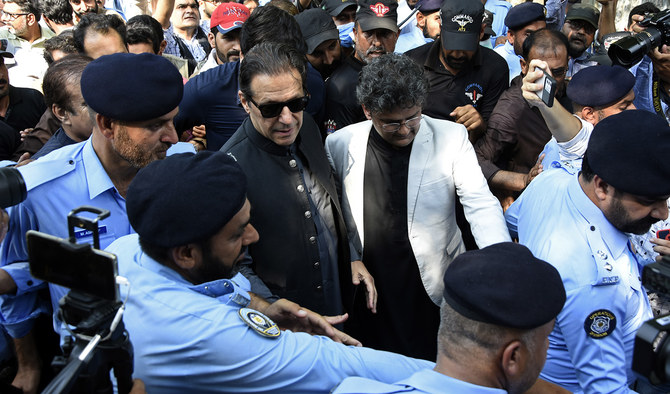
Former Pakistani Prime Minister Imran Khan, center, arrives to the Islamabad High Court surrounded by journalists and security in Islamabad, Pakistan, on September 8, 2022. (AP)
Short Url
Updated 02 December 2023
Follow

Ex-PM Khan’s court-ordered public trial scheduled to begin today in state secrets case

  • Case relates to cipher between Washington and Islamabad Khan says was proof that US orchestrated his ouster as PM
  • Case relates to cipher between Washington and Islamabad Khan says was proof that US orchestrated his ouster as PM

ISLAMABAD: The jail trial of former Pakistani Prime Minister Imran Khan, with media and members of the public allowed access for the first time, will begin today, Saturday, at Rawalpindi’s Adiala jail in a case in which the ex-premier is accused of leaking state secrets.
A special court established to hear what has popularly come to be called the cipher case had been conducting the trial inside the Adiala prison in Rawalpindi city since Khan was indicted on the charges last month and after the government said he could not be moved to a courtroom for hearings due to security reasons. However, the Islamabad High Court ruled last week that holding Khan’s trial inside jail premises on security concerns was illegal, and ordered it restarted in an open court.
The trial began afresh on Friday, but Khan and Shah Mahmood Qureshi, a close aide who has also been indicted in the case, were not produced before the special court when the hearing began because a law ministry notification sanctioning their trial had not been submitted until well into the hearing.
The proceedings broke for recess and when they resumed, the judge said the law ministry’s notification had arrived and adjourned the hearing till Saturday.
“Another blatant attempt to slow the process when [law ministry] notification could have been issued yesterday,” a PTI media manager told reporters on Friday.
Khan, who is the chairman of the Pakistan Tehreek-e-Insaf (PTI) party, is being held at Adiala jail where he is serving a three-year sentence in a separate case in which he was convicted in August of failing to disclose assets earned from the sale of state gifts while he was PM from 2018-2022.
Khan is also accused in a number of other cases, including the cipher case, which relates to an alleged diplomatic correspondence between Washington and Islamabad that Khan says was proof that his ouster as PM in a parliamentary vote of no-confidence in April 2022 was part of a US conspiracy to remove him. Washington has repeatedly denied Khan’s accusations.
Khan, arguably the most popular politician in the country, has not been seen in public since he was arrested in August. Prior to that, he regularly addressed his millions of followers via social media and held massive public rallies and protest marches.
Khan had also been appearing in courts prior to his August arrest protected by his personal security guards. But he has also sought exemptions from personal appearances, often citing threats to his safety.
The former premier says all cases against him are “politically motivated” and aimed at keeping him and his party out of politics ahead of general elections, due in February.


Pakistan says military operation concluded in Balochistan, 216 militants killed 

Updated 8 sec ago
Follow

Pakistan says military operation concluded in Balochistan, 216 militants killed 

  • Separatist BLA militant group claimed responsibility for coordinated attacks across Balochistan last week 
  • Military says 36 civilians, 22 law enforcement and security forces personnel have been killed in attacks 

PESHAWAR: Pakistani forces have concluded a security operation in the southwestern Balochistan province and killed 216 militants after a series of coordinated attacks by separatist militants last week, the military’s media wing said on Thursday. 

Separatist militant group Baloch Liberation Army (BLA) claimed responsibility for a series of attacks in Balochistan last Friday and Saturday in multiple districts across the province, one of the deadliest flare-ups in the area in recent years. 

Pakistan military’s media wing, the Inter-Services Public Relations (ISPR), said security forces launched operations in Panjgur and Harnai district’s outskirts on Jan. 29 based on intelligence confirming the presence of “terrorist elements,” killing 41 militants. 

It said the military launched a broader series of intelligence-based operations in multiple areas of the province after that to dismantle “terrorist sleeper cells,” referring to it as “Operation Radd-ul-Fitna-1.”

“As a result of these well-coordinated engagements and subsequent clearance operations, 216 terrorists have been sent to hell, significantly degrading the leadership, command-and-control structures and operational capabilities of terrorist networks,” the ISPR said in a statement.

The military said 36 civilians, including women and children, were killed by militants while 22 security forces and law enforcement personnel also lost their lives. 

The ISPR said a substantial cache of foreign-origin weapons, ammunition, explosives and equipment were also recovered during the counteroffensive operations. 

“Preliminary analysis indicates systematic external facilitation and logistical support to these extremist proxies,” the statement said. 

The military said Pakistan’s armed forces remain steadfast in their resolve to combat “terrorism,” vowing that counterterror operations will continue until militants are completely eliminated. 

“Operation Radd-ul-Fitna-1 stands as a testament to Pakistan’s and particularly Balochistan’s proud peoples’ unwavering commitment to always prefer peace over violence, unity over division and development over violence,” the ISPR said. 

Pakistan’s government has accused India of being behind the militant attacks in Balochistan, charges that New Delhi has rejected as “baseless.”

Balochistan, Pakistan’s largest province by land area, has long faced a separatist insurgency that has intensified in recent years. Militants frequently target security forces, government officials, infrastructure projects, foreigners and non-local workers.

The province holds vast reserves of minerals and hydrocarbons and is central to the multibillion-dollar China-Pakistan Economic Corridor (CPEC), a flagship component of China’s Belt and Road Initiative.

Separatist groups such as the BLA accuse Islamabad of exploiting Balochistan’s natural resources while denying locals a fair share. Pakistan’s civilian and military leadership reject the claim and say they are investing in the province’s development.