



KARACHI: Pakistan on Thursday became the first country in South Asia to launch a ‘gender bond’ to raise Rs2.5 billion ($8.7 million) for micro loan disbursement to an expected 30,000 women, mostly affected by devastating floods that wreaked havoc in the country in 2022.
The first “only-for-women bond” has been issued by Kashf Foundation, a Pakistani non-profit organization, in collaboration with InfraZamin Pakistan, for-profit credit enhancement facility funded from InfraCo. Asia Investments and Karandaaz Pakistan.
The Rs2.5 billion proceeds of the bond, raised through the country’s stock market, will be utilized to extend loans, mostly to women who were affected by the 2022 floods, according to the issuers.
“The idea behind this bond is to give loans to those women who were affected by the floods last year so that they can build resilience and protect themselves in the future,” Shahzad Iqbal, chief financial officer at Kashf Foundation, told Arab News on the sidelines of the bond’s launch at the Pakistan Stock Exchange (PSX).
“The bond size is Rs2.5 billion and the tenure of the bond is three years. This is only for women that is why it is called a gender bond.”
Within the three-year period, Iqbal believed, his lending institution would provide loans to around 30,000 women through micro-lending.
An InfraZamin official said the sole purpose of the bond’s issuance was financial inclusion of women by contributing toward small businesses led by women as well as the restoration of flood-affected homes for women.
“By creating such a structure, we have effectively targeted women and because of that, we have met the requirements for this to be a gender bond,” Maheen Rahman, chief executive of InfraZamin Pakistan, told Arab News.
“There are several (gender bonds) in the world, but in Pakistan this is the first gender bond. And in South Asia, this is the first gender bond to be issued,” said Rehman, whose company has guaranteed the bond.
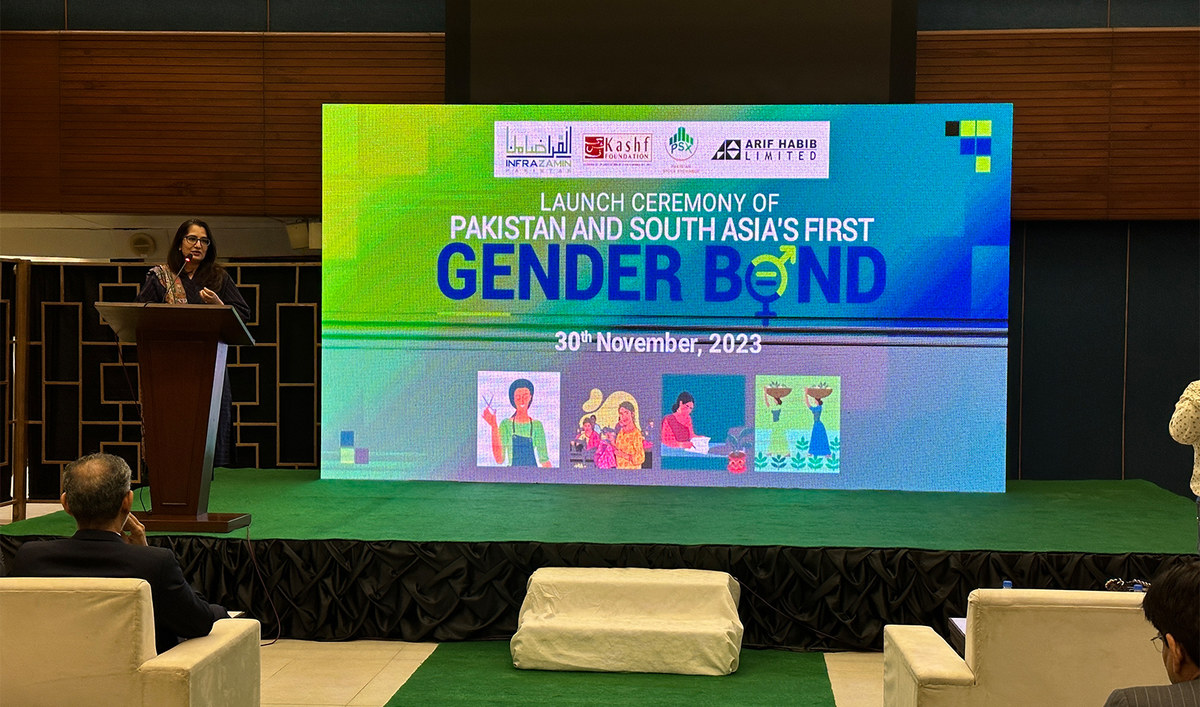
Maheen Rehman, chief executive of InfraZamin Pakistan, is addressing the launch ceremony of Pakistan's first "gender bond" in Karachi, Pakistan, on November 30, 2023. (AN photo)
The bond’s issuance follows the guidelines prescribed by the national financial regulatory agency, the Securities and Exchange Commission of Pakistan (SECP), while Arif Habib Limited, a leading Karachi-based brokerage house, has played a role of financial adviser and arranger for the bond.
Shahid Ali Habib, CEO, Arif Habib Limited (AHL), informed the bond would be traded at PSX’s over-the-counter (OTC) market.
“It will be listed in the OTC market and the issue is closed now,” Habib said. “This will be processed at the stock exchange in a month or one-and-a-half month time and then will be available for trading.”
Pakistan’s Caretaker Finance Minister Dr. Shamshad Akhtar, who spoke via video link, termed the launch of gender bond a “groundbreaking initiative.”
“The gender bond is a powerful tool for bridging the gender gap and empowering women,” Akhtar said. “As the demand for sustainable investment continues to grow, gender bonds are poised to play a significant role in driving positive social change and empowerment within Pakistan.”
To a question about lending to borrowers, the Kashf CFO said the minimum lending would be around Rs60,000 ($209) and the maximum would be around Rs500,000 ($1,748) per borrower, for which the procedure was very simple.
“They don’t need to provide us any kind of documentation or a guarantee. They simply need to provide us a copy of their CNIC (computerized national identity card) and a photograph, and then we do a valuation of their repayment behavior,” Iqbal said, adding it usually took around two to seven days to complete the loan process.
Rehman said the payback ratio among women borrowers was much better than men, with the lender incurring minimum losses.
“We found that women who borrow from such institutions (Kashf foundation) pay back far better than what we saw in other institutions that were catering to both men and women,” she said. “In fact, Kashf’s non-performing loan portfolio is only 0.5 percent of their total loan book.”
SECP Chairman Akif Saeed said such micro loans to women created a social impact that benefitted whole families.


