

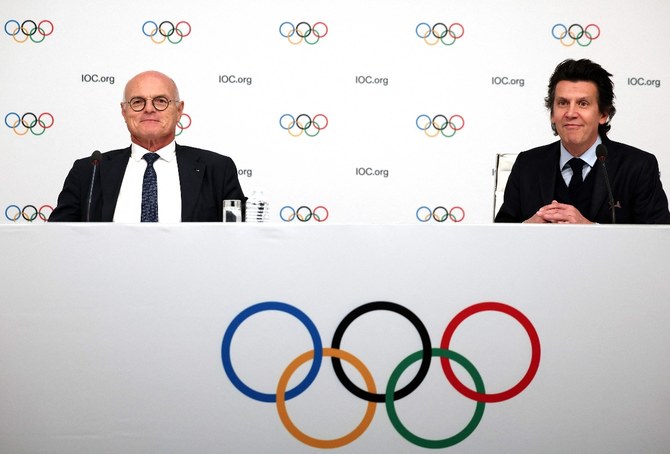

NEW YORK: Salt Lake City being preferred as a shoo-in to host the 2034 Winter Olympics was expected. The surprise was the IOC favoring the French Alps bid for the 2030 edition on Wednesday.
Aiming to finalize back-to-back Winter Games hosts next year, the International Olympic Committee executive board has decided to enter exclusive talks with Olympic officials in France and the US for Salt Lake City.
Salt Lake was alone in the 2034 race to bring the games back to Utah, which hosted the 2002 Winter Games, and the American bid’s support from all levels of government up to President Joe Biden was praised Wednesday.
“He would guarantee all the expenses,” said IOC member Karl Stoss, who chaired the Olympics panel assessing potential candidates, adding “and they stand really in a strong, strong status behind these games.”
A French bid uniting the snowy Alps region and the French Riviera resort Nice came together only in the past few months to compete with Sweden and Switzerland for the IOC’s support.
The IOC also has now pointed the Swiss bid toward the 2038 Olympics with “privileged dialogue” status.
By mapping out a Winter Olympics future for almost two decades, the next opportunity for Asia to host looks to be in 2042 — perhaps in Sapporo, Japan or even Saudi Arabia, which is creating the Trojena ski resort to stage the 2029 Asian Winter Games.
The IOC last month aimed to make a double award picking the 2030 and 2034 hosts together in July when about 100 members meet in Paris on the eve of the Summer Games.
France’s partial win Wednesday is a full victory for its national Olympic committee leader David Lappartient, the president of cycling’s governing body.
Lappartient worked to build close ties with IOC President Thomas Bach even before last year when he became one of the about 100 IOC members.
It would be the fourth time France has hosted a Winter Olympics, after Chamonix in 1924, Grenoble in 1968 and Albertville in 1992.
The modern way of picking Olympic hosts leaves IOC members to rubber stamp a single option presented by the executive board chaired by Bach.
The 2030 Winter Games is barely six years away, already making it the latest Olympic hosting decision taken in recent decades. A decision next July would be just over 5½ years before the scheduled opening ceremony.
Longtime 2030 favorite Sapporo faded then was formally withdrawn last month as Japan’s feeling for the Olympics soured amid investigations of bribery linked to preparing the Summer Games in Tokyo held in 2021.
Vancouver, the 2010 Winter Games host, also dropped out and Salt Lake City’s focus switched to 2034. That was to avoid a clash for the United States hosting back-to-back Olympics after the 2028 Los Angeles Summer Games.
With the IOC seeming to have few options in January, Swedish Olympic officials were approached about making a ninth bid for the Winter Games. The most recent loss was with Stockholm in 2019 when IOC members chose Italy’s Milan-Cortina d’Ampezzo for 2026.
That Stockholm bid was revived but an apparent caution in moving forward quickly left the door open for bids from France and Switzerland closer to the IOC’s home in Lausanne.
“I am incredibly disappointed,” Swedish bid leader Hans von Uthmann said in a statement. “We had a strong concept to stage the most sustainable games of all time, but are now not getting the chance to showcase that vision to the world.”
The IOC has declining options for Winter Games hosts because of climate change.
The Olympic body estimates only 15 countries on three continents can meet the criteria of having at least 80 percent of existing venues for snow sports and a “climate-reliable” outlook to stage events in future decades.
A longer-term IOC plan is a rotation policy for a small pool of regular Winter Games hosts, like Salt Lake City.
“For more than a decade, our state and community leaders have united toward this goal,” said Fraser Bullock, president and CEO of this Salt Lake City bid and also a senior official on the 2002 project.
The last time Salt Lake pursued the Olympics the city got caught in a bribery scandal that nearly derailed plans for those 2002 Winter Games and led to several IOC members being expelled and resigning.
The bid committee doled out $1 million in cash, scholarships, medical care, gifts and other favors to IOC members and their families. That included ski trips, NBA tickets, plastic surgery, knee replacements, violins and housing and salary for children of IOC members, according to report by an ethics panel.
Wide-ranging campaign reforms included stopping IOC voters from visiting bid candidates. Later, vote-buying scandals implicating back-to-back Summer Games hosts Rio de Janeiro and Tokyo led to further changes.
The 2026 Olympics were the last to have a traditional contested vote in 2019. The next Winter Games will be spread across northern Italy, focused on the city of Milan and ski resort Cortina d’Ampezzo, the 1956 Olympics host.
Those games are set to use an ice sliding track in neighboring Switzerland or Austria because Italy does not have a functioning venue.
That fits with the IOC’s modern insistence on Olympic hosts using existing or temporary venues to avoid construction costs that typically run over budget.
The reported $51 billion in spending by Russia on the 2014 Sochi Winter Games — including building new roads, a railway and much of a ski resort — scared off some potential bidders in Europe and forced another rethink of Olympic campaigning and hosting.


