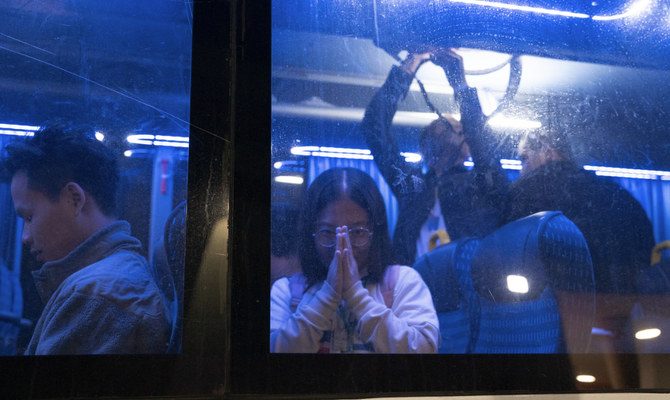
JERUSALEM: The Israeli military said 10 Israelis and four Thai nationals were released late Wednesday from captivity in the Gaza Strip.
The hostages crossed into Egypt and were to be transferred to Israel.
It was the sixth such release under a cease-fire between Israel and Hamas. Israel is to release 30 Palestinian prisoners later Wednesday.
The cease-fire is set to expire early Thursday. International mediators are trying to extend the deal to facilitate the release of additional hostages held by Hamas.
The militant group captured some 240 people in an Oct. 7 cross-border attack that triggered the war. Some 150 people are believed to remain in captivity.
A new swap of hostages held by Hamas for Palestinian prisoners in Israel got underway late Wednesday in the final hours of the current Gaza truce as international mediators raced to extend the halt of Israel’s air and ground offensive to allow further exchanges.
The Israeli military said a group of 10 Israeli women and children and four Thai nationals had been handed over by Hamas to the Red Cross in Gaza and were heading to exit the territory. Earlier, two Russian-Israeli women were freed by Hamas in a separate release. Israel was set to free 30 Palestinian prisoners in return.
Negotiators were working down to the wire to hammer out details for a further extension of the truce beyond its deadline of early Thursday. The talks appear to be growing tougher as most of the women and children held by Hamas are freed, and the militants are expected to seek greater releases in return for freeing men and soldiers.
International pressure has mounted for the cease-fire to continue as long as possible after nearly eight weeks of Israeli bombardment and a ground campaign in Gaza that has killed thousands of Palestinians, uprooted three quarters of the population of 2.3 million and led to a humanitarian crisis. Israel has welcomed the release of dozens of hostages in recent days and says it will maintain the truce if Hamas keeps freeing captives.
Still, Prime Minister Benjamin Netanyahu underscored on Wednesday that Israel will resume its campaign to eliminate Hamas, which has ruled Gaza for 16 years and orchestrated the deadly attack on Israel that triggered the war
“After this phase of returning our abductees is exhausted, will Israel return to fighting? So my answer is an unequivocal yes,” he said. “There is no way we are not going back to fighting until the end.”
He spoke ahead of a visit to the region planned this week by US Secretary of State Antony Blinken to press for further extensions of the truce and hostage releases.
In the West Bank, Israeli troops killed two Palestinian boys — an 8-year-old an a 15-year-old — during a raid on the town of Jenin, Palestinian health officials said. Security footage showed a group of boys in the street who start to run, except for one who falls to the ground, bleeding.
The Israeli military said its troops fired on people who threw explosives at them but did not specify it was referring to the boys, who are not seen throwing anything. Separately, the military said its troops killed two Islamic Jihad militants during the raid.
So far, the Israeli onslaught in Gaza seems to have had little effect on Hamas’ rule, evidenced by its ability to conduct complex negotiations, enforce the cease-fire among other armed groups, and orchestrate the release of hostages. Hamas leaders, including Yehya Sinwar, have likely relocated to the south.
With Israeli troops holding much of northern Gaza, a ground invasion south will likely bring an escalating cost in Palestinian lives and destruction.
Most of Gaza’s population is now crammed into the south. The truce has brought them relief from bombardment, but the days of calm have been taken up in a frenzied rush to obtain supplies to feed their families as aid enters in greater, but still insufficient, amounts.
United States, Israel’s main ally, has shown greater reticence over the impact of the war in Gaza. The Biden administration has told Israel that if it launches an offensive in the south, it must operate with far greater precision.
ISRAEL’S HOSTAGE DILEMMA
The plight of the captives and shock from the Oct. 7 attack have galvanized Israeli support for the war. But Netanyahu is under pressure to bring the hostages home and could find it difficult to resume the offensive if there’s a prospect for more releases.
Since the initial truce began on Friday, both sides have been releasing women and children in their exchanges. After Friday’s releases, Gaza militants still hold around 20 women, accordding to Israeli officials. IF the truce continues at the current rate, they would be out in a few days.
After that, keeping the truce going depends on tougher negotiations over the release of around 126 men Israel says are held captive – including several dozen soldiers.
For men — and especially soldiers — Hamas is expected to push for comparable releases of Palestinian men or prominent detainees, a deal Israel may resist.
An Israeli official involved in hostage negotiations said talks on a further extension for release of civilian males and soldiers were still preliminary, and a deal would not be considered until all the women and children are out. The official spoke on condition of anonymity because negotiations were ongoing.
With Wednesday’s releases, a total of 73 Israelis, including dual nationals, have been freed during the six-day truce, most of whom appear physically well but shaken. Another 24 hostages — 23 Thais and one Filipino — have also been released. Before the cease-fire, Hamas released four hostages, and the Israeli army rescued one. Two others were found dead in Gaza.
So far, most of the 180 Palestinians freed from Israeli prisons have been teenagers accused of throwing stones and firebombs during confrontations with Israeli forces. Several were women convicted by Israeli military courts of attempting to attack soldiers.
Palestinians have celebrated the release of people they see as having resisted Israel’s decades-long military occupation of lands they want for a future state.
The war began with Hamas’ Oct. 7 attack into southern Israel, in which it killed over 1,200 people, mostly civilians. The militants kidnapped some 240 people back into Gaza, including babies, children, women, soldiers, older adults and Thai farm laborers.
Israel’s bombardment and ground invasion in Gaza have killed more than 13,300 Palestinians, roughly two-thirds of them women and minors, according to the Health Ministry in Hamas-ruled Gaza, which does not differentiate between civilians and combatants.
The toll is likely much higher, as officials have only sporadically updated the count since Nov. 11 due to the breakdown of services in the north. The ministry says thousands more people are missing and feared dead under the rubble.
Israel says 77 of its soldiers have been killed in the ground offensive. It claims to have killed thousands of militants, without providing evidence.
TENSE CALM IN GAZA
For Palestinians in Gaza, the truce’s calm has been overwhelmed by the search for aid and by horror as they see the extent of destruction.
In the north, residents described entire residential blocks leveled to the ground in Gaza City and surrounding areas. The smell of decomposing bodies trapped under collapsed buildings fills the air, said Mohmmed Mattar, a 29-year-old resident of Gaza City who along with other volunteers searches for the dead under rubble or left in the streets.
They have found and buried 46 so far during the truce, he said. Most were unidentified. More bodies remain inside rubble but can’t be reached without heavy equipment, or are left on streets that are unapproachable because of Israeli troops nearby, Mattar said.
In the south, the truce has allowed more aid to be delivered from Egypt, up to 200 trucks a day. But aid officials say it is not enough, given that most now depend on outside aid. Overwhelmed UN-run shelters house more than 1 million displaced people, with many sleeping outside in cold, rainy weather.
At a distribution center in Rafah, large crowds line daily up for newly arrived bags of flour. But supplies run out quickly before many can get their share.
“We’ve been searching for bread for our children,” said one woman in line, Nawal Abu Namous. “Every day, we come here … we spend money on transportation to get here, just to go home with nothing.”
Some markets and shops have reopened, but prices for the few items in stock have skyrocketed. Winter clothes are unavailable. One clothes shop owner in Deir Al-Balah told The Associated Press that he hates opening his doors in the morning, knowing he’ll spend most of the day apologizing to customers for not having winter items.
The head of the World Health Organization, Tedros Adhanom Ghebreyesus, said some 111,000 people have respiratory infections and 75,000 have diarrhea, more than half of them under 5 years old. “More people could die from disease than bombings.”
“We are fed up,” said Omar Al-Darawi, who works at the overwhelmed Al-Aqsa Martyrs hospital in central Gaza. “We want this war to stop.”


![]()

Israeli military says 10 Israelis, four Thai nationals, have been released by Hamas
Short Url
https://arab.news/yzw5r
Israeli military says 10 Israelis, four Thai nationals, have been released by Hamas
- International pressure has mounted for the cease-fire to continue as long as possible after nearly eight weeks of Israeli bombardment and a ground campaign in Gaza


Latest updates




Recommended


© 2026 SAUDI RESEARCH & PUBLISHING COMPANY, All Rights Reserved And subject to Terms of Use Agreement.