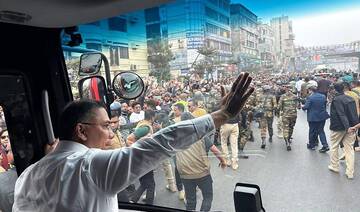
DHAKA: Bangladesh’s main opposition party said on Wednesday it would continue its anti-government protests despite what a rights group called an “autocratic crackdown” ahead of a general election in January.
The Bangladesh Nationalist Party, whose top leadership is either jailed or in exile, has already said it will boycott the election if Prime Minister Sheikh Hasina does not resign and allow a caretaker government to oversee the poll, to be held on Jan.7.
At least four people, including a policeman, have been killed and hundreds injured in violent protests across the country in the past few weeks, police said.
“Our peaceful and democratic protest programs will continue in spite of the government crackdown on BNP, until the fundamental voting rights of the people of Bangladesh are restored,” Abdul Moyeen Khan, a former minister and member of the BNP’s highest policymaking body, told Reuters.
Two people were injured in the capital, Dhaka, when a crude bomb exploded on Wednesday as a countrywide transport blockade called by the BNP was underway, police said.
Dozens of buses and vehicles have been set on fire over the past one month, authorities said.
“People have no civil rights, no guarantee of living in safety. In order to end this misrule and lawlessness, the ongoing movement must be accelerated and the victory of the people must be ensured,” senior BNP official Ruhul Kabir Rizvi said.
Hasina, seeking her fourth straight five-year term in office, has repeatedly ruled out handing power to a caretaker government and accused the BNP of “terrorism and hooliganism.”
BNP said four people have been killed and more than 5,330 people arrested since the election was announced on Nov. 15.
Police say they have arrested only those responsible for violence.
Human Rights Watch has accused the government of targeting opposition leaders and supporters.
“The government is claiming to commit to free and fair elections with diplomatic partners while the state authorities are simultaneously filling prisons with the ruling Awami League’s political opponents,” said Julia Bleckner, senior Asia researcher at Human Rights Watch.
“Diplomatic partners should make clear that the government’s autocratic crackdown will jeopardize future economic cooperation,” the rights group said in a statement quoting Bleckner.
It said it has found evidence that security forces are responsible for using excessive force, mass arbitrary arrests, enforced disappearances, torture, and extrajudicial killings in a recent spate of election-related violence, based on interviews with 13 witnesses and an analysis of videos and police reports.
The government denies the accusations but it is under pressure from Western countries to hold free and fair elections.
Hasina’s arch rival and two-time premier, BNP leader Khaleda Zia, is effectively under house arrest on what her party calls trumped-up corruption charges.