



RIYADH: Leaders and industry experts have gathered at the Global Healthspan Summit this week to turn a spotlight on promises to revolutionize views on aging, life expectancy, and healthspan science.
Issues related to chronic diseases and socioeconomic disparities because of inequalities and other factors will be among topics discussed at the event, organized by the Hevolution Foundation and being held in Riyadh until Thursday.
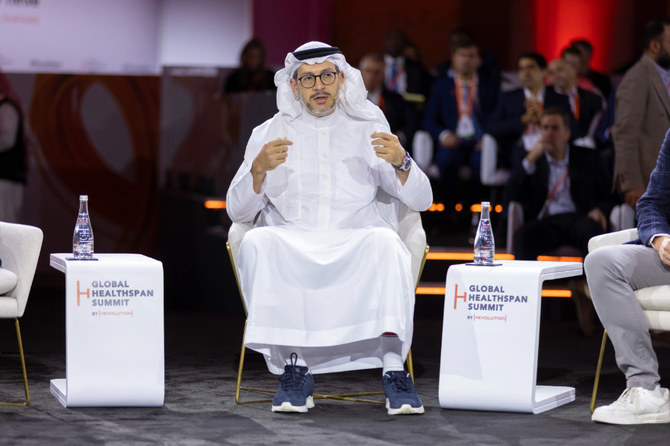
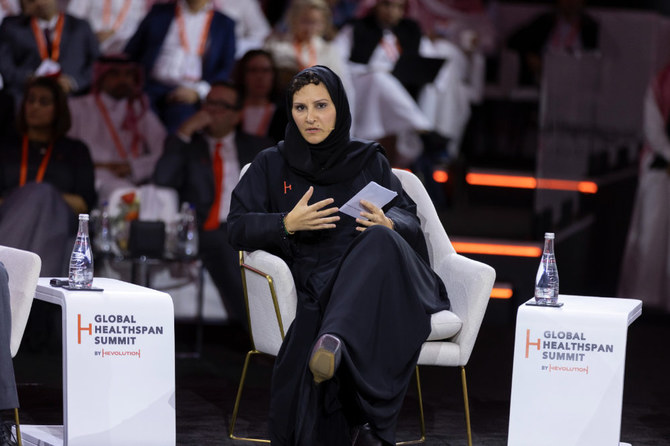
Princess Haya bint Khaled, the foundation’s vice president of strategy and development, was part of a first-day session titled “Making the Case for the Healthspanned Society — What Now, What Next.”
She was joined by Tareef Alaama, deputy minister of health for curative services, Peter Fedichev, co-founder of Gero, Henk Heidekamp, managing director of the European Research Institute for the Biology of Aging, and Jerry McLaughlin, CEO of Life Biosciences.
The talk was one of several aimed at fostering meaningful discussion and encouraging advancement, investment, and international cooperation.
Princess Haya said: “The foundation has a very simple, clear, and impactful message — (we are working to) extend healthy lifespan for the benefit of all humanity and develop breakthroughs or innovative tools to address diseases that we see increasing.”
On Saudi Arabia’s role in extending a healthy human lifespan, in line with Vision 2030, Alaama said: “The health of humans comes first under Vision 2030. Among the promises is to increase the life expectancy of individuals from what it used to be in 2016, which is (from) 74 to 80 years of age by 2030.
“To achieve that, we have developed a strategy that looks at scientific methods and data-driven methods … we utilize data, we collect statistics, we go to the nitty-gritty details, looking at variability aging among sectors and regions.”
Ultimately, this would mean interventions could be designed and implemented in ways most effective for increasing human life expectancy, he added.
Examples of those by the Ministry of Health included looking at modifiable risk factors and treating hypertension, both of which could add two years to life expectancy.
The panel also examined challenges faced by the health sector as it moved forward to expand lifespan. One such issue was the lack of funding for the biology of aging.
Heidekamp said: “In the Netherlands, we have the foundations for cancer research and Alzheimer’s research, but there’s no funding for aging.”
The Hevolution Foundation has committed to advancing age sciences by investing up to $1 billion annually in aging research and healthspan science.
It recently announced the selection of 11 Saudi researchers in the field of aging sciences to receive two-year grants worth SR10 million ($2.6 million), making the program one of the most impactful initiatives in the field of aging in the Kingdom.
The development of diagnostics and therapeutics together was identified as another challenge.
Mehmood Khan, the foundation’s CEO, said: “As a patient, as a consumer, to have your aging biology tested determines not just how old the body is but also how old the different organ systems in your body are.”
But he noted that aging was not so straightforward.
“Not everybody ages the same way. So, to go to a doctor and say, ‘just tell me how old I am,’ is way too simplistic.
“We all know people who, for example, have very young bodies but their minds are aged. We know others whose bodies are aged, but their minds are still very young.
“We are now evaluating the best technologies in the world, bringing them all under one roof to see what that looks like,” Khan added.


