

Pakistani father, three relatives held for ‘honor killing’ — police

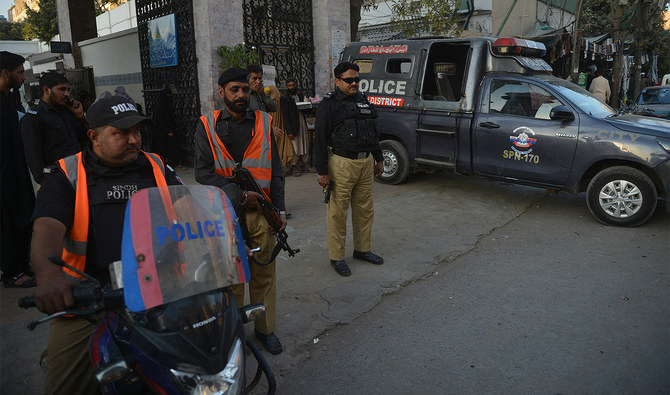
Policemen stand guard outside a mosque in Karachi, Pakistan on January 31, 2023. (AFP/File)
Short Url
Updated 29 November 2023
Follow

Pakistani father, three relatives held for ‘honor killing’ — police

  • Man killed his teenage daughter on instructions from family elders because she had appeared in social media photo
  • Relatives also called for killing of woman’s friend who appeared with her in the picture but she was rescued by police

PESHAWAR: Pakistani police have arrested four people, including a man who killed his teenage daughter on instructions from family elders because she had appeared in a picture on social media, police said on Wednesday.

The police said the 18-year-old woman was shot dead by her father last week in the northwestern Kolai-Palas valley near the Afghan border after her relatives advised him to do so.

The relatives also called for a so-called honor killing of the woman’s friend who appeared with her in the picture, but she had been rescued by the police, officials said.

The father, Arslan Mohsin, and three relatives have been arrested and produced before a court, police official Masood Khan told Reuters, adding that more arrests were pending.

Every year, hundreds of women in pre-dominantly Muslim Pakistan are victims of honor killings, carried out by relatives professing to be acting in defense of a family’s honor, rights group say, often in deeply conservative rural areas.

Public images of women are considered taboo in the tribal areas.

Reuters was unable to immediately reach for comment the women’s families or elders involved in the case.

Pakistani lawmakers have called for strict punishment for the alleged killers, and rights groups have expressed concerns over the country’s failure to stamp out such crimes.

Despite tighter laws and societal outrage in Pakistan, honor killings continue, with 384 instances reported by the Human Rights Commission of Pakistan in 2022 alone, said Nadia Rahman of South Asia regional office at Amnesty International.

“The government of Pakistan and law enforcement agencies are urged to provide protection to the survivors in this case and prosecute those involved without recourse to the death penalty,” she added.


Rating firm S&P says it won’t rush Iran war downgrades, sees risks for countries like Pakistan

Updated 12 March 2026
Follow

Rating firm S&P says it won’t rush Iran war downgrades, sees risks for countries like Pakistan

  • Agency says it is monitoring indebted energy importers as higher oil prices strain finances
  • Gulf economies seen better placed to weather shock, though Bahrain flagged as vulnerable

LONDON: S&P Global ‌said it would not make any knee-jerk sovereign rating cuts following the outbreak of war in the ​Middle East, but warned on Thursday that soaring oil and gas prices were putting a number of already cash-strapped countries at risk.

The firm’s top analysts said in a webinar that the conflict, which has involved US and Israeli strikes ‌against Iran and Iranian ‌strikes against Israel, ​US ‌bases ⁠and Gulf ​states, ⁠was now moving from a low- to moderate-risk scenario.

Most Gulf countries had enough fiscal buffers, however, to weather the crisis for a while, with more lowly rated Bahrain the only clear exception.

Qatar’s banking sector could ⁠also struggle if there were significant ‌deposit outflows in ‌reaction to the conflict, although there ​was no evidence ‌of such strains at the moment, they ‌said.

“We don’t want to jump the gun and just say things are bad,” S&P’s head global sovereign analyst, Roberto Sifon-Arevalo, said.

The longer the crisis ‌was prolonged, though, “the more difficult it is going to be,” he ⁠added.

Sifon-Arevalo ⁠said Asia was the second-most exposed region, due to many of its countries being significant Gulf oil and gas importers.

India, Thailand and Indonesia have relatively lower reserves of oil, while the region also had already heavily indebted countries such as Pakistan, Bangladesh and Sri Lanka whose finances would be further hurt by rising energy prices.

“We ​are closely monitoring ​these (countries) to see how the credit stories evolve,” Sifon-Arevalo said.