


SAO PAULO: With an estimated 20 million people of Arab descent, Latin America has a number of institutions dedicated to the dissemination of Arab culture.
They have been playing a central role in disseminating information and organizing protests throughout the Gaza conflict.
The Palestinian cause is central to these cultural centers, not only because there are significant Palestinian communities in some Latin American countries, but also as part of a project to build solidarity with Palestine among Arabs and non-Arabs in the region.
In recent weeks, such institutions have been active in denouncing the plight of the Palestinian people and disseminating information about the history of Israeli occupation and violence. Some of them are also helping organize marches and pressuring their governments.
Arabic teacher Agustin Dib, founder of the Argentinian Club de la Cultura Arabe, told Arab News that in recent weeks it has been fully dedicated to spreading information about the plight of the Palestinians.
“Given the seriousness of the current situation, we’ve been using all our resources to inform people about what’s happening, and to put pressure on the government of Argentina for a decisive stance regarding the genocide of the Palestinians,” he said.
The club has a website and a large presence on social media, where it distributes content about the Arab world in Spanish, something not very common online.
While some cultural institutions are connected to mosques or churches, the club has been established as a completely autonomous entity.
It all began with a group of students of Arabic who met in Buenos Aires to read poetry by Arab authors such as the late Palestinian poet Mahmoud Darwish.
These sessions, which had never happened before in Argentina’s capital, drew many people, and other events were promoted.
Although the club does not have a physical location and “doesn’t want to have one in the future,” many of its initiatives involve in-person participation, Dib said.
Among the initiatives are “green days,” when enthusiasts meet at a public park with their derbakes (Arabic drums) to play Arabic music and talk about culture.
Virtual Arabic-language classes have been a big hit since 2018, as have conferences and courses on Arab culture.
“We have followers in Argentina, Mexico, Spain, and even Brazil despite the linguistic difference,” Dib said.
The club has been working with other institutions over the years, including universities and Arab embassies. It is now planning to promote Arabic films.
“The dissemination of content that clarifies aspects of the Arab world traditionally seen with prejudice has been a relevant dimension of the club’s work,” Dib said.
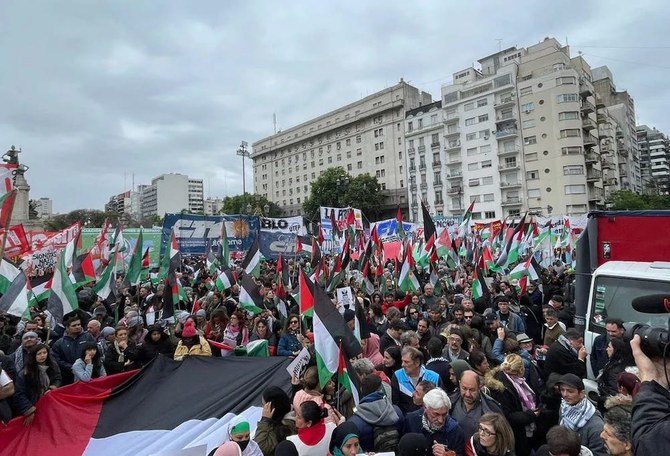
Since the start of the Gaza conflict, the club has been publishing content to explain the Palestinian situation, tackling rising Islamophobia in Argentina, working with other organizations and promoting protests with thousands of participants in Buenos Aires.
In the city of Barranquilla, the Institute of Arab Culture of Colombia has been making similar efforts since the conflict began.
Odette Yidi, who founded the institute with her father in 2017, told Arab News that most pro-Palestinian cultural and political initiatives are being promoted by non-Arab Colombians.
“A few weeks ago, we helped create the Colombian Committee of Solidarity with Palestine, which gathers 300 members. Only five of them are Palestinian or Arab,” she said.
The institute, along with other groups, has been organizing talks about the Palestinian cause, as well as music concerts and demonstrations.
“We’ve been disseminating letters from Palestinian organizations about the (Israeli) attacks. I constantly give interviews to the press and lectures in schools, and always mention them,” Yidi said.
Earlier this year, the institute bought a sculpture about Colombian solidarity with Palestinians to be installed in a park in Barranquilla.
The official inauguration ceremony will gather cultural activists and the city’s authorities on Nov. 29.
The institute is also working to translate Arabic content about the conflict into Spanish, and is promoting Arabic classes and cultural activities.
“Our dream is to set up a museum totally dedicated to Arab countries and the diaspora, in which we can safely keep and show the memory of Arab immigration to Colombia,” Yidi said.
In Chile — which has the largest Palestinian community outside the Middle East, with an estimated 600,000 people — there are several Arab and Palestinian cultural centers and social clubs nationwide.
Most of them, such as the Arab Center in the city of Concepcion, traditionally commemorate important dates for the Palestinian people with special events.
In May, for instance, they normally organize events to commemorate the Nakba — the displacement and expulsion of several hundred thousand Palestinians from their homeland when Israel was created in 1948.
“This year, the Palestinian ambassador to Santiago came to attend our event about the Nakba,” Gustavo Diban, the center’s president, told Arab News.
The organization has been promoting demonstrations since the Gaza conflict began. On Oct. 13, the center and other entities organized a vigil in honor of the deceased in Palestine.
On Nov. 18, a march in Concepcion gathered pro-Palestinian activists from all over the region.
Ricardo Marzuca, a Palestinian-Chilean professor at the University of Chile, told Arab News that a pro-Palestinian umbrella organization was recently created and gathers 40 groups, several of them dedicated to cultural activities.
“Last week, artistic groups organized at the National Theater in Santiago a pro-Palestinian cultural intervention with theater, poetry and music,” he said.
“Both on the streets and on the internet, culture has been playing a central role in the movement for Palestine.”
The 20-year-old Institute of Arab Culture in Brazil, known by the Portuguese acronym Icarabe, also has a special relation with the Palestinian cause.
Every year, it organizes an exhibit of Arabic movies, including at least one Palestinian production.
“That’s part of our political concerns. I think those movies should have a wider dissemination in Brazil. Film distributors should acquire their rights,” Arthur Jafet, Icarabe’s national relations director and the curator of this year’s exhibit, told Arab News.
The exhibit was concluded before the start of the Gaza conflict, so Jafet decided to publish a list of Palestinian films that can help Brazilians understand the roots of the conflict.
Icarabe was founded with the goal of working as an independent organization, without support from embassies or religious institutions. Over the years, it has gained a reputation for promoting high-quality cultural initiatives.
“It’s not easy to fund an autonomous center like ours. We don’t sell anything, we only want to publicize Arab culture,” Icarabe’s President Murched Taha told Arab News.
The institute established a few years ago a special chair, in partnership with the Federal University of Sao Paulo, named after the late Palestinian-American academic, literary critic and political activist Edward Said. One of its focuses is to study Middle Eastern society and culture.
Icarabe also organizes a program about Arab and Islamic contributions to mankind, which always draws many participants.
Other cultural activities are being discussed by its directors, many of whom have been taking part in protests in Sao Paulo in October and November that have gathered thousands.


