

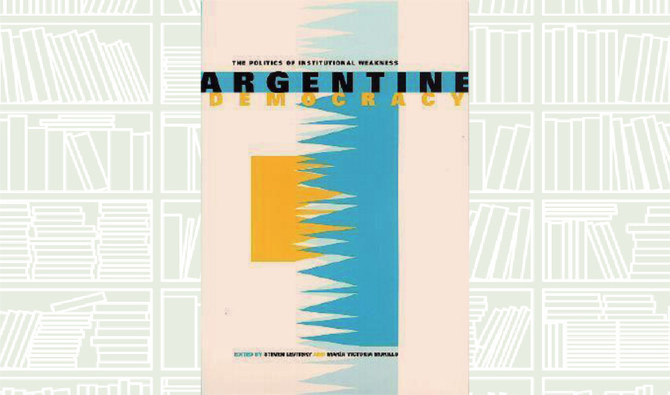
What We Are Reading Today: Argentine Democracy

Short Url
Updated 27 November 2023
Follow

What We Are Reading Today: Argentine Democracy

Author: Steven Levitsky

During the 1990s Argentina was the only country in Latin America to combine radical economic reform and full democracy. 

In 2001, however, the country fell into a deep political and economic crisis and was widely seen as a basket case. 

This book explores both developments, examining the links between the real and apparent successes of the 1990s and the 2001 collapse. 

Beyond its empirical analysis, the book contributes to several theoretical debates in comparative politics. Contemporary studies of political institutions focus almost exclusively on institutional design, neglecting issues of enforcement and stability. 


What We Are Reading Today: The Political Economy of Security by Stephen G. Brooks

Updated 1 min ago
Follow

What We Are Reading Today: The Political Economy of Security by Stephen G. Brooks

In this book, Stephen Brooks provides a systematic empirical and theoretical examination of how economic factors influence security affairs. Empirically, he analyzes how economic variables of all kinds affect interstate war, terrorism, and civil war; in total, 16 pathways are examined.

Brooks shows that the relationship between economic factors and conflict is complex and multifaceted; discrete economic factors—such as international trade, economic development, and globalized manufacturing, to name a few—are sometimes helpful for promoting peace and stability, but at other times are detrimental.

Brooks also develops a stronger theoretical foundation for guiding future research on the economics-security interaction. 

Drawing on Adam Smith, he provides a more complete range of answers to the three key conceptual questions analysts must consider: how economic goals relate to security goals; what economic factors to focus on; and how economic actors influence security policies.

Combining an innovative theoretical understanding with empirical rigor, Brooks’s account will reshape our understanding of the political economy of security.