

Pakistan shopping mall, where fire killed 11 people, had no safety equipment, emergency exit — report 

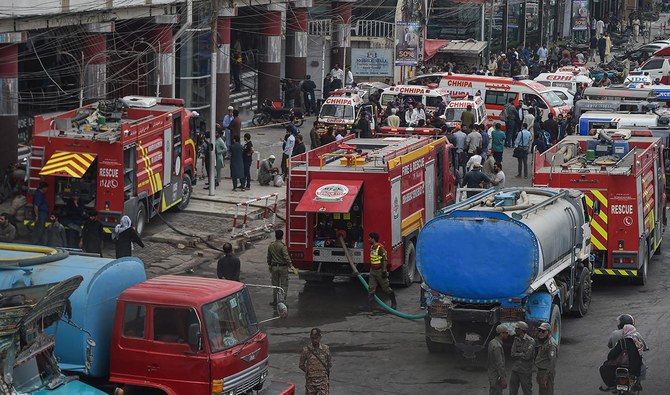
Firefighters douse the fire at a shopping mall in Karachi on November 25, 2023. (AFP/File)
Short Url
Updated 27 November 2023
Follow

Pakistan shopping mall, where fire killed 11 people, had no safety equipment, emergency exit — report 

  • Fire Department says its teams evacuated 45 people by smashing through doors of their offices amid raging flames in the mall 
  • Development comes day after Karachi police lodged case against the city’s power distributor, Fire Department over ‘negligence’ 

KARACHI: A shopping mall building in southern Pakistan, where a blaze killed 11 people last week, had no fire safety equipment and an emergency exit, the Fire Department said on Monday. 

The fire erupted at the multi-story RJ Mall, a commercial high-rise that also houses call centers and software firms, early Saturday in the port city of Karachi, known for its fragile firefighting system and poor safety controls. 

In its report released on Monday, the city’s Fire Department cited serious violations of fire safety rules by the mall management. 

“No any kind of public safety system was available in RJ mall including fire safety fighting equipment and emergency exit,” the report read. 

It said the fire brigade did not receive information about the blaze timely and when the firefighters arrived at the scene, 3rd and 4th floors of the building were already “burning severely.” 

“An intense smoke was gathered in complete mall due to which fire brigade’s staff faced difficulty in execution of firefighting operations,” the report read. 

The Fire Department said its firefighting teams safely evacuated around 45 people, who had been trapped inside their offices, by smashing through the doors. 

The report came a day after the Karachi police registered a case against K-Electric, the main power supply company in the city, and the Fire Department for their “criminal negligence” toward ensuring safety protocols at the mall. 

The police said substandard materials were used to construct the mall, with builders getting approvals from both K-Electric and the Fire Department despite glaring safety violations. 

Karachi Mayor Murtaza Wahab criticized the police for “wrongly implicating” the Fire Department of the city’s metropolitan corporation, which is headed by him. 

“Unfortunately, we do the work, and we are the ones who face criticism,” Wahab told reporters on Monday, adding the responsibility to ensure safety protocols lied with the Cantonment Board, one of several independent civic bodies, under whose jurisdiction the mall is situated. 

“The map of this building was not approved by the [Sindh] Building Control Authority or KMC [Karachi Metropolitan Corporation], and it was not regularized by them. Its map was passed by the Cantonment Board.” 

Arab News tried to reach the Cantonment Board for a comment on the matter, but did not get a response to its email or calls. 

The latest incident sheds light on violations of safety rules and complex governance system of Karachi, a sprawling megapolis of nearly 15 million people, where such incidents are not uncommon. 

Earlier this year in April, a fire tore through a garment factory killing four firefighters. The flames ripped through the building, eventually causing it to collapse. In August 2021, at least 10 people were killed in a fire at a chemical factory in the same city. 

In the deadliest such incident, 260 people were killed after being trapped inside a garment factory when a fire broke out in 2012. 


Government says Pakistan preparing Cyber Security Act as digital expansion raises risks

Updated 10 sec ago
Follow

Government says Pakistan preparing Cyber Security Act as digital expansion raises risks

  • The proposed legislation will create Cyber Security Authority to oversee the country's cyber defenses
  • IT minister warns misuse of genetic and digital data could enable targeted cyber and biological threats

ISLAMABAD: Pakistan is preparing a Cyber Security Act and a dedicated regulatory authority to strengthen defenses against rising digital threats as the country rapidly digitizes government services and economic systems, IT Minister Shaza Fatima said while addressing a ceremony in the federal capital on Wednesday.

The planned legislation is part of Islamabad’s broader “Digital Nation Pakistan” initiative, which aims to expand e-governance, a cashless economy and online public services while safeguarding national cyber infrastructure.

“The more we move toward digitization, with the kind of opportunities that are opening up for us, it is also bringing an equal, or even greater, set of challenges,” the minister said. “This does not mean that we stop digitization. It means that we must make our cybersecurity systems robust.”

She said Pakistan had already activated its National Computer Emergency Response Team (CERT) and provincial CERTs to detect and respond to cyber incidents, while a multi-agency digital monitoring framework known as the National Threat Intelligence System (NTIS) operates around the clock.

“We have a Cyber Security Act coming up, under which a Cyber Security Authority will be established.”

The minister said cybersecurity was not a “generic” concept and required multiple technical specializations as well as comprehensive monitoring and regulation. She warned that the rapid expansion of data-driven technologies was creating new risks even as it opened opportunities in areas such as health and biotechnology.

Referring to advances in genomics and precision medicine, she said the same technologies that help treat diseases could also pose security risks if sensitive biological data were misused. She warned that access to large-scale genetic data could potentially allow hostile actors to develop targeted viruses or other biological threats against populations.

The minister also highlighted Pakistan’s cyber defense capabilities, saying government and military systems remained secure during last year's war with India despite sustained cyber warfare attempts.

She said multiple institutions, including the IT ministry, the National Telecommunication Corporation (NTC), national cybersecurity teams and the armed forces’ cyber command structures, worked together to defend critical systems.

“Despite that massive war ... we did not face a single communication breakdown and we did not allow any penetration into our government systems,” she said, adding that the experience demonstrated the need to further strengthen cybersecurity coordination across institutions.