

Petition filed in Pakistan top court seeking removal of ‘biased’ President Alvi

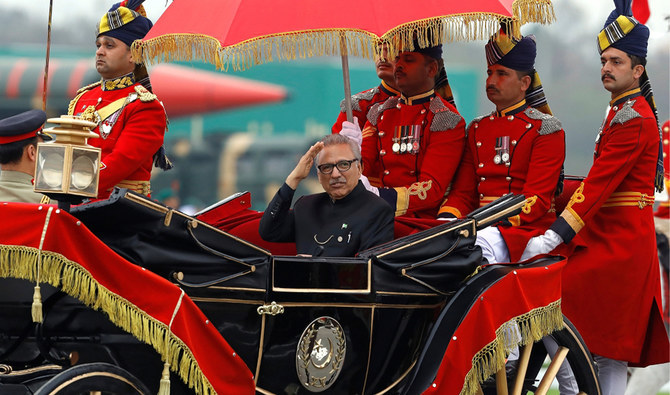
In this file photo, taken on March 23, 2019, Pakistani President Dr Arif Alvi gestures as he arrives in a horse-drawn carriage to attend the Pakistan Day military parade in Islamabad. (REUTERS/File)
Short Url
Updated 26 November 2023
Follow

Petition filed in Pakistan top court seeking removal of ‘biased’ President Alvi

  • President Alvi, whose term ended on Sept. 8, continues to hold the office in the absence of provincial and national assemblies
  • Petitioner cites controversial moves taken by the president, including the attempted dissolution of Pakistan parliament in April 2022

ISLAMABAD: A petition was filed in the Supreme Court of Pakistan on Saturday seeking removal of President Dr. Arif Alvi for “not acting in accordance with the responsibilities” of his office.

Alvi, who took oath as the 13th president of Pakistan in September 2018, completed his five-year constitutional term on September 8, this year. He, however, continues to hold the office under Article 44 of the Constitution of Pakistan, which allows a president to continue to stay in office in the absence of provincial and national assemblies that were respectively dissolved in January and August.

Some of his controversial decisions include an attempted dissolution of the National Assembly, the lower house of Pakistan parliament, ahead of a no-trust vote against his party leader and former premier, Imran Khan, sending a presidential reference against Supreme Court judge, Qazi Faez Isa, who is currently the chief justice of Pakistan, and his failure to announce a date for national elections.

In his petition against the president, Ghulam Murtaza Khan cited some controversial decisions made by Alvi and contended that he misused his powers by using his office to support ex-PM Khan’s Pakistan Tehreek-e-Insaf (PTI) party, which was “unconstitutional and biased” toward the nation.

“It is, therefore, respectfully prayed that by accepting the instant Constitution Petition, this Honourable Court may issue directions to investigate the matter and declare that the present President Mr. Arif Alvi, should not continue as President of Islamic Republic of Pakistan,” the petition read.

Major Pakistani political parties, including the Pakistan Muslim League-Nawaz (PML-N) and the Pakistan Peoples Party (PPP), have also repeatedly accused Dr. Alvi of being “biased” toward Khan’s party and acting as a “party member” instead of a head of the state.

The petitioner also said that Alvi contradicted with his position by giving controversial statements on various occasions, citing a controversy that arose from Alvi’s return of the Official Secrets Amendment Bill and Pakistan Army Amendment Bill without signing them.

In August, President Alvi announced via X messaging platform that he had asked staff to return the bills, granting widespread powers to the military, unsigned within the stipulated time to make them ineffective.

The development came amid a crackdown on Alvi’s party following attacks by its supporters on government and military installations to protest ex-PM Khan’s brief arrest in a graft case in May.

“These kind of acts have made the character of the President very distrustful for whole the nation,” the petitioner added.


Pakistan finance chief calls for change to population-based revenue-sharing formula

Updated 14 February 2026
Follow

Pakistan finance chief calls for change to population-based revenue-sharing formula

  • Muhammad Aurangzeb criticizes current NFC formula, says it is holding back development
  • Minister says Pakistan to repay $1.3 billion debt in April as economic indicators improve

ISLAMABAD: Pakistan’s Finance Minister Muhammad Aurangzeb said on Saturday the country’s revenue-sharing formula between the federal and provincial governments “has to change,” arguing that allocating the bulk of funds on the basis of population was holding back long-term development.

The revenue-sharing is done under the National Finance Commission (NFC) Award that determines how federally collected taxes are divided between the center and the provinces. Under the current formula, much of the distribution weight is based on population, with smaller weightages assigned to factors such as poverty, revenue generation and inverse population density.

“Under the NFC award, 82 percent allocation is done on the basis of population,” Aurangzeb said while addressing the Federation of Pakistan Chambers of Commerce & Industry’s regional office in Lahore. “This has to change. This is one area which is going to hold us back from realizing the full potential of this country.”

Economists and policy analysts have long suggested broadening the NFC criteria to give greater weight to tax effort, human development indicators and environmental risk, though any change would require political consensus among provinces, making reform politically sensitive.

Aurangzeb also highlighted the economic achievements of the country in recent years, saying Pakistan’s import cover had improved from roughly two weeks just a few years ago to about 2.5 months currently, adding that the government had repaid a $500 million Eurobond last year.

“The next repayment is of $1.3 billion in April,” he continued, adding that “we will pay these obligations, which are the obligations of Pakistan, as we go forward.”

The minister also noted that unlike in 2022, when devastating floods forced Pakistan to seek international pledges at a Geneva conference, the government did not issue an international appeal during more recent flooding, arguing that fiscal buffers had strengthened.

“This time, the prime minister and the cabinet decided that we do not need to go for international appeal because we have the means,” he said.

He reiterated the government was pursuing export-led growth to avoid repeating past boom-and-bust cycles driven by import-led expansion that quickly depleted foreign exchange reserves and pushed Pakistan back into International Monetary Fund programs.
