Digging to rescue 41 workers trapped in a collapsed tunnel in India halted after machine breaks

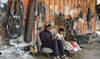
Though trapped, the workers have plenty of space in the tunnel, with the area inside 8.5 meters high and stretching about 2 km in length. (AFP)
Short Url
Updated 26 November 2023
Follow

Digging to rescue 41 workers trapped in a collapsed tunnel in India halted after machine breaks

  • A heavy earth digger was seen being taken up a specially cut track to the top of forested hill above the tunnel, to begin the dig

NEW DELHI: Attempts to reach 41 construction workers stuck in a collapsed tunnel in northern India for two weeks were again stymied Saturday.
The drilling machine broke down late Friday while making its way through the rubble, stones and metal, forcing the rescuers to work by hand to remove debris in hopes of reaching the stranded workers, but the whole operation has ground to a halt.
Arnold Dix, an international expert assisting the rescue team at the site in the mountainous Uttarakhand state, said that it was unclear when the drilling will start again.
“The machine is busted. It is irreparable,” he told reporters. “The mountain has once again resisted the auger (machine).”
Dix said the rescuers would need to pull out the entire drilling machine and replace it to restart the digging. He didn’t specify how much time that it would take.
The workers have been trapped since Nov. 12 when a landslide caused a portion of the 4.5-kilometer (2.8-mile) tunnel they were building to collapse about 200 meters (650 feet) from the entrance. The mountainous terrain in the area has proven to be a challenge for the drilling machine, which had earlier broken twice as rescue teams attempted to dig horizontally toward the trapped workers.
The machine stopped working after it had drilled about two meters (6.5 feet) of the last stretch of 12 meters (40 feet) of rock debris that would open a passage for the workers to come out from the tunnel.
Rescuers have inserted pipes into the dug-out channel and welded them together to serve as a passageway from where the men would be pulled out on wheeled stretchers. About 46 meters (151 feet) of pipe has been put in so far, according to Devendra Patwal, a disaster management officer.
Meanwhile, a new drilling machine used to dig vertically was brought to the site Saturday.
The vertical dig is seen as an alternative plan to reach the trapped men, and rescuers have already created an access road to the top of the hill. However, rescue teams will need to dig 103 meters (338 feet) downward to reach the trapped workers — nearly double the distance of the horizontal shaft.
Authorities have supplied the trapped workers with hot meals made of rice and lentils through a six-inch (15-centimeter) pipe after days when they survived on dry food sent through a narrower pipe. Oxygen is being supplied through a separate pipe, and more than a dozen doctors, including psychiatrists, have been at the site monitoring their health.
Most of the trapped workers are migrant laborers from across the country. Many of their families have traveled to the location, where they have camped out for days to get updates on the rescue effort and in hopes of seeing their relatives soon.
The tunnel the workers were building was designed as part of the Chardham all-weather road, which will connect various Hindu pilgrimage sites. Some experts say the project, a flagship initiative of the federal government, will exacerbate fragile conditions in the upper Himalayas, where several towns are built atop landslide debris.
Large numbers of pilgrims and tourists visit Uttarakhand’s many Hindu temples, with the number increasing over the years because of the continued construction of buildings and roadways.


Geoeconomic confrontation tops global risks in 2026: WEF report

Updated 4 sec ago
Follow

Geoeconomic confrontation tops global risks in 2026: WEF report

  • Also armed conflict, extreme climate, public polarization, AI
  • None ‘a foregone conclusion,’ says WEF’s MD Saadia Zahidi

DUBAI: Geoeconomic confrontation has emerged as the top global risk this year, followed by state-based armed conflict, according to a new World Economic Forum report.

The Global Risks Report 2026, released on Wednesday, found that both risks climbed eight places year-on-year, underscoring a sharp deterioration in the global outlook amid increased international competition.

The top five risks are geoeconomic confrontation (18 percent of respondents), state-based armed conflict (14 percent), extreme weather events (8 percent), societal polarization (7 percent) and misinformation and disinformation (7 percent).

The WEF’s Managing Director Saadia Zahidi said the report “offers an early warning system as the age of competition compounds global risks — from geoeconomic confrontation to unchecked technology to rising debt — and changes our collective capacity to address them.

“But none of these risks are a foregone conclusion.”

The report assesses risks across three timeframes: immediate (2026); short-to-medium term (next two years); and long term (next 10 years).

Economic risks show the largest overall increase in the two-year outlook, with both economic downturn and inflation jumping eight positions.

Misinformation and disinformation rank fifth this year but rise to second place in the two-year outlook and fourth over the 10-year horizon.

The report suggests this reflects growing anxiety around the rapid adoption of artificial intelligence, with adverse outcomes linked to AI surging from 30th place in the two-year timeframe to fifth in the 10-year outlook.

Uncertainty dominates the global risk outlook, according to the report.

Surveyed leaders and experts view both the short- and long-term outlook negatively, with 50 percent expecting a turbulent or stormy global environment over the next two years, rising to 57 percent over the next decade.

A further 40 percent and 32 percent, respectively, describe the outlook as unsettled across the two- and 10-year timeframes, while just 1 percent anticipate a calm global outlook in either period.

Environmental risks ease slightly in the short-term rankings. Extreme weather fell from second to fourth place and pollution from sixth to ninth. Meanwhile, critical changes to Earth systems and biodiversity loss dropped seven and five positions, respectively.

However, over the next decade, environmental threats re-emerge as the most severe, with extreme weather, biodiversity loss, and critical changes to Earth systems topping the global risk rankings.

Looking ahead over the next decade, around 75 percent of respondents anticipate a turbulent or stormy environmental outlook, making it the most pessimistic assessment across all risk categories.

Zahidi said that “the challenges highlighted in the report underscore both the scale of the potential perils we face and our shared responsibility to shape what comes next.”

Despite the gloomy outlook, Zahidi signaled a positive shift in global cooperation.

 “It is also clear that new forms of global cooperation are already unfolding even amid competition, and the global economy is demonstrating resilience in the face of uncertainty.”

Now in its 21st year, the Global Risks Report highlights a core message: global risks cannot be managed without cooperation.

As competition intensifies, rebuilding trust and new forms of collaboration will be critical, with the report stressing that today’s decisions will shape future outcomes.

The report was released ahead of WEF’s annual meeting, which will be held in Davos from Jan. 19 to 23.