

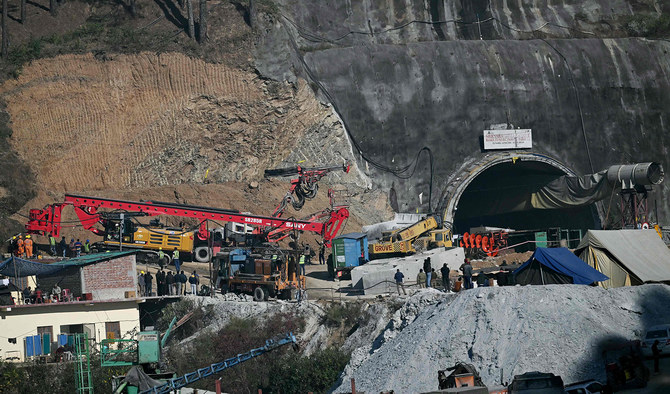

SILKYARA TUNNEL: Indian rescuers began digging a vertical shaft Saturday to free 41 workers trapped inside a collapsed road tunnel for two weeks, after efforts through another route hit snags just meters from freeing the men.
In the latest setback in attempts to rescue the increasingly desperate workers, engineers driving a metal pipe horizontally through 57 meters (187 feet) of rock and concrete ran into metal rods and construction vehicles buried in the earth.
A giant earth-boring machine snapped just nine meters from breaking through.
Thick metal girders in the rubble are blocking the route, and using cutting tools to clear them is tricky from inside the confined pipe, only wide enough for a man to crawl through.
Ambulances are on standby and a field hospital has been prepared to receive the men, who have been trapped since a portion of the under-construction Silkyara tunnel in the northern state of Uttarakhand caved in on November 12.
Uttarakhand chief minister Pushkar Singh Dhami confirmed that vertical drilling had begun to dig 89 meters downwards, a risky route above the men in an area that has already suffered a collapse.
AFP reporters saw a heavy earth digger being taken up a specially cut track to the top of forested hill above the tunnel, to begin the dig.
At the same time, a special superheated plasma cutter was being brought to the remote mountain location to remove the broken drill and metal blocking the horizontal route. Digging will then continue by hand.
“We will proceed manually,” Dhami told reporters, adding he had spoken to the trapped men.
“They are in good spirits. They said: ‘Take as many days as you require, don’t worry about us.’“
The workers were seen alive for the first time on Tuesday, peering into the lens of an endoscopic camera sent by rescuers down a thin pipe through which air, food, water and electricity are being delivered.
Though trapped, they have plenty of space in the tunnel, with the area inside 8.5 meters high and stretching about two kilometers in length.
Rescue teams have stretchers fitted with wheels ready to pull the exhausted men through 57 meters of pipe, if it can be driven through the final section of rubble blocking their escape.
Efforts have been painfully slow, complicated by falling debris as well as repeated breakdowns of crucial heavy drilling machines, with the air force having to twice airlift new kit.
Since Wednesday, officials have said repeatedly they were optimistic of a breakthrough within hours, but a government statement warned the rescue was “subject to change due to technical glitches, the challenging Himalayan terrain, and unforeseen emergencies.”
Arnold Dix, president of the International Tunnelling and Underground Space Association, who is advising the rescue on site, said he remained optimistic as there were “many ways” to reach the men.
“I am confident that the 41 men are coming home,” he said.
Work has also begun from the far side of the road tunnel, a much longer third route estimated to be around 480 meters.
Syed Ata Hasnain, a senior rescue official and retired general, said their efforts were “exactly like war.”
“We have to have some patience, we need to understand that a very difficult operation is going on,” he told reporters.
“I feel everyone has their attention on this as to when this operation will be over, but you need to see that this operation is getting even more complex,” he added.
“We have never given you the timeline. I have experienced that when you do something with mountains, you cannot predict anything. This situation is exactly like war.”
The Silkyara tunnel is part of Prime Minister Narendra Modi’s infrastructure project aimed at cutting travel times between some of the most popular Hindu temples in the country.
The 4.5-kilometer (2.7-mile) passage is meant to connect Uttarkashi and Yamunotri, two of the holiest sites.


