European delegation’s visit to Pakistan next week raises hope for lifting PIA’s flight ban

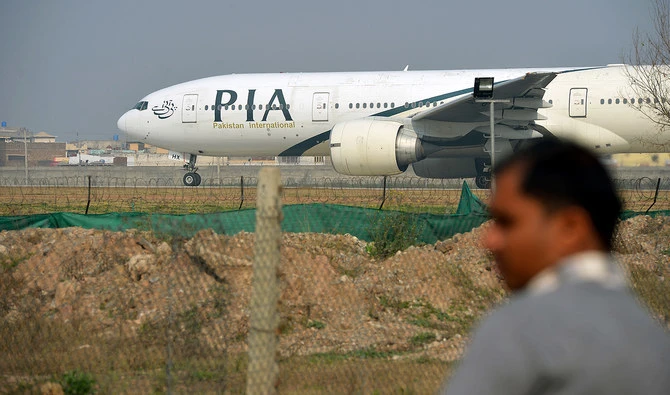
In this file photo, taken on February 8, 2016, a Pakistani man looks on as a Pakistan International Airline (PIA) plane taxis on the runway in Islamabad. (AFP/File)
Short Url
Updated 25 November 2023
Follow

European delegation’s visit to Pakistan next week raises hope for lifting PIA’s flight ban

  • The ban was instituted after PIA air crash in May 2020 which was followed by a fake license scandal
  • The visiting delegation is expected to conduct an on-site assessment of PCAA’s safety measures

KARACHI: A delegation of the European Commission and European Aviation Safety Agency (EASA) is scheduled to visit Pakistan next week, the agency’s spokesperson confirmed on Friday, raising hopes that a ban imposed on Pakistan International Airlines (PIA) flights to the continent may ultimately be lifted.

The ban, instituted after the May 2020 air crash in Karachi, was linked to a licensing issue when the country’s former aviation minister, Ghulam Sarwar Khan, said over 30 percent of Pakistani pilots held “dubious” flying permits that were obtained through fraudulent means. While he later retracted the statement, EASA decided to extend the ban indefinitely.

The visit of the four-member European delegation next week will focus on the on-site assessment of the national airline, which is one of the requirements of the European Commission and the aviation agency as part of the safety protocol.

“We can confirm that a joint mission of the European Commission and EASA to Pakistan will take place next week,” the EASA spokesperson, Vera Tavares, told Arab News over email, declining to share further details.

Speaking on condition of anonymity, a Pakistan Civil Aviation Authority (PCAA) official confirmed the on-site evaluation would be the visiting delegation’s crucial agenda item.

“An on-site assessment of the safety measures of Civil Aviation Authority and PIA is on the agenda of four-member delegation,” he said.

In January last year, EASA declined to lift the ban, referencing an audit by the International Civil Aviation Organization (ICAO) that highlighted significant degradation in the PCAA certification and oversight capabilities.

However, a few months later in July, EASA said that constructive discussions were underway with civil aviation officials in Pakistan over the issue.

PIA is already in the throes of a severe financial crisis, resulting in widespread flight suspensions and an escalated push for privatization by the current interim administration of the country.
Islamabad steps up vehicle checks to boost security as 166,000 cars get electronic tags

Updated 4 sec ago
Follow

Islamabad steps up vehicle checks to boost security as 166,000 cars get electronic tags

  • Authorities say over 3,000 vehicles registered in past 24 hours as enforcement intensifies
  • Extended service hours introduced to push full compliance with digital monitoring system

ISLAMABAD: Authorities in the Pakistani capital have intensified enforcement against vehicles without mandatory electronic tags with more than 166,000 cars now registered, according to data released on Sunday evening, as Islamabad moves to strengthen security and digital monitoring at key entry and exit points.

The Islamabad Capital Territory (ICT) administration introduced the electronic tagging system late last year as part of a broader effort to regulate traffic, improve record-keeping and enhance surveillance in a city that hosts the country’s main government institutions, foreign missions and diplomatic enclaves.

Under the system, vehicles are fitted with electronic tags that can be read automatically by scanners installed at checkpoints across the capital, allowing authorities to identify unregistered vehicles without manual inspections. Vehicles already equipped with a motorway tag, or m-tag, are exempt from the requirement.

“A total of 166,888 vehicles have successfully been issued M-Tags so far, including 3,130 vehicles in the last 24 hours,” the ICT administration said, according to the Excise Department.

Officials said readers installed at checkpoints across Islamabad are fully operational and are being used to stop vehicles still without tags, as enforcement teams carry out checks across the city.

To facilitate compliance, authorities have expanded installation facilities and extended operating hours. The Excise Department said m-tag installation is currently available at 17 booth locations, while select centers have begun operating beyond normal working hours.

According to Director General Excise Irfan Memon, m-tag centers at 26 Number Chungi and 18 Meel are providing services round the clock, while counters at Kachnar Park and F-9 Park remain open until midnight to accommodate motorists unable to visit during daytime hours.

Officials said the combination of enforcement and facilitation was aimed at achieving full compliance with minimal disruption, adding that operations would continue until all vehicles operating in the capital are brought into the system.

The enforcement drive builds on a wider push by the federal government to integrate traffic management, emergency response and security monitoring through technology-driven “safe city” initiatives. Last month, Interior Minister Mohsin Naqvi reviewed Islamabad’s surveillance infrastructure and said reforms in monitoring systems and the effective use of technology were the “need of the hour.”

Authorities have urged motorists to obtain electronic tags promptly to avoid delays and penalties at checkpoints as enforcement continues across the capital.