

‘Breathing smoke’: Ex-minister wants more than administrative measures to address Lahore’s hazardous pollution

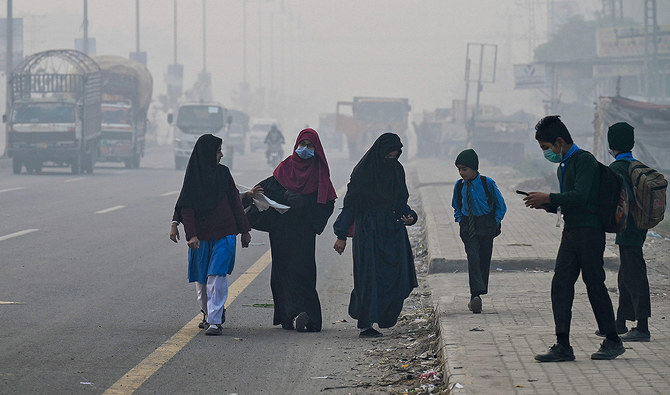
Students wear face masks as they walk to school amid dense smog in Lahore on November 24, 2023. (AFP)
Short Url
Updated 24 November 2023
Follow

‘Breathing smoke’: Ex-minister wants more than administrative measures to address Lahore’s hazardous pollution

  • Senator Sherry Rehman says lockdowns and school closures are insufficient to address the enduring environmental crisis
  • She asks provincial authorities to take decisive action on the basis of the National Clean Air Policy adopted last year

ISLAMABAD: Senator Sherry Rehman, Pakistan’s former climate change minister, expressed concern on Friday about Lahore’s air pollution, saying it had reached a point where residents were “breathing smoke,” though the authorities were still relying on administrative measures such as lockdowns and school closures that were insufficient to address the crisis.

Earlier in the day, Lahore topped the list of most polluted cities in the world once again, with its Air Quality Index (AQI) level hovering around 490.

The AQI is a standardized tool measuring air pollutants like particulate matter and ozone, serving as a crucial barometer for public health. An AQI over 300 is considered “hazardous,” meaning the air poses serious health risks to all residents, not just vulnerable groups.

“Lahore continues to reign as the world’s most polluted city today, holding the top spot on the air quality index,” Rehman said in a social media post. “This extreme level of pollution, far exceeding the safe limit of 300, means that Lahore’s citizens are essentially breathing in smoke, posing a significant threat to their health and well-being.”

Located in the Punjab region of Pakistan, Lahore faces severe air pollution during winter as farmers burn crop stubble, contributing to smog compounded by emissions from low-grade diesel.

The pervasive smog forced schools in the province at the outset of this month to notify parents via text message to provide their children with face masks.

The province’s interim chief minister, Mohsin Naqvi, also announced four holidays in an effort to address the problem, as the Lahore High Court instructed the provincial authorities to declare “smog emergency” to tackle its underlying causes and mitigate impact.

Rehman pointed out that a National Clean Air Policy had been in place since last year, adding that the provincial authorities should take decisive action based on it instead of announcing lockdowns and closures.

“While school closures and lockdowns may provide temporary relief, they are not sustainable solutions,” she added. “Instead, concrete measures must be taken to address the root causes of Lahore’s air pollution crisis, ensuring a healthier and cleaner environment for its residents.”

The Punjab provincial authorities have stated that the government is actively penalizing farmers who burn crop residue and is closely monitoring the situation.

Pakistani officials also attribute Lahore’s smog to environmental conditions in nearby New Delhi, India.


Pakistan, UK sign £35 million Green Compact to strengthen climate resilience

Updated 21 December 2025
Follow

Pakistan, UK sign £35 million Green Compact to strengthen climate resilience

  • Pakistan ranks among nations most vulnerable to climate change and has seen erratic changes in its weather patterns
  • UK will help Pakistan mobilize climate finance, strengthen regulatory frameworks and develop bankable climate projects

ISLAMABAD: Pakistan and the United Kingdom (UK) have formalized a comprehensive climate partnership with the launch of a Green Compact that aims to enhance climate resilience, accelerate clean energy transition and scale up nature-based solutions, including mangrove conservation, Pakistani state media reported on Sunday.

The agreement, signed in Islamabad by Federal Minister for Climate Change and Environmental Coordination Dr. Musadik Malik and UK Minister for International Development Jennifer Chapman, unlocks £35 million in targeted support for green development and long-term climate action, according to Radio Pakistan broadcaster.

Pakistan ranks among nations most vulnerable to climate change and has seen erratic changes in its weather patterns that have led to frequent heatwaves, untimely rains, storms, cyclones, floods and droughts in recent years. In 2022, monsoon floods killed over 1,700 people, displaced another 33 million and caused over $30 billion losses, while another 1,037 people were killed in floods this year.

Mohammad Saleem Shaikh, a spokesperson for Pakistan’s Ministry of Climate Change, described the compact as a “decisive move toward action-oriented climate cooperation,” noting that its implementation over the next decade will be critical for Pakistan which regularly faces floods, heatwaves and water stress.

“The Compact is structured around five core pillars: climate finance and investment, clean energy transition, nature-based solutions, innovation and youth empowerment, and adaptation and resilience,” the report read.

“Under the agreement, the UK will work with Pakistan to mobilize public and private climate finance, strengthen regulatory frameworks for green investment, and develop bankable climate projects.”

Clean energy forms a central component of Pakistan’s transition, with Islamabad planning to expand solar and wind generation to reduce fossil fuel dependence, improve energy security and stabilize power costs, according to Shaikh.

“Renewable energy is now economically competitive, making the transition both environmentally and financially viable,” he was quoted as saying.

“Nature-based solutions, particularly large-scale mangrove restoration, will protect coastal communities from storm surges and erosion while enhancing biodiversity and carbon sequestration.”

Under the Compact, technical support, mentoring and access to investors will be provided to climate-smart startups and young innovators, reflecting Pakistan’s recognition of youth-led initiatives as central to future climate solutions.

On the occasion, Chapman, on her first official visit to Pakistan, underscored the urgency of climate action, highlighting the UK’s support for renewable energy, mangrove and ecosystem restoration, early-warning systems, climate budgeting and international investment flows into Pakistan.

Shaikh described the Green Compact as “a strategic turning point” in Pakistan–UK relations on climate change, saying its effective implementation is essential for Pakistan to meet its national climate targets.