


ISLAMABAD: The CEO of the National Disaster Risk Management Fund (NDRMF), a public body that funds disaster risk reduction in Pakistan, said on Thursday Pakistan’s first carbon market would “largely” work under the cap-and-trade model in which companies in regulated sectors will have emissions limits.
Earlier this week, the Prime Minister’s Office said the government was drafting a “comprehensive policy framework” for the formation of its first carbon credits market. Carbon markets are becoming an indispensable tool in the global climate fight, with carbon pricing instruments now covering over 20 percent of global greenhouse gas (GHG) emissions, generating $53 billion in revenue at the end of 2021, according to the Carbon Pricing Leadership Coalition.
“Carbon pricing is kind of an umbrella term. It can have taxation, it can have levies, different kinds of levies into it, or it can have a cap-and-trade system,” NDRMF CEO Bilal Anwar told Arab News when asked about the salient features of the Pakistani carbon market policy.
A cap-and-trade system limits aggregate emissions from a group of emitters by setting a cap on maximum emissions and is characterized as a market-based policy to reduce overall emissions of pollutants and encourage business investment in fossil fuel alternatives and energy efficiency.
“Pakistan’s carbon market is going to be largely based on a cap-and-trade system because that’s what is most appropriate and feasible for Pakistan.”
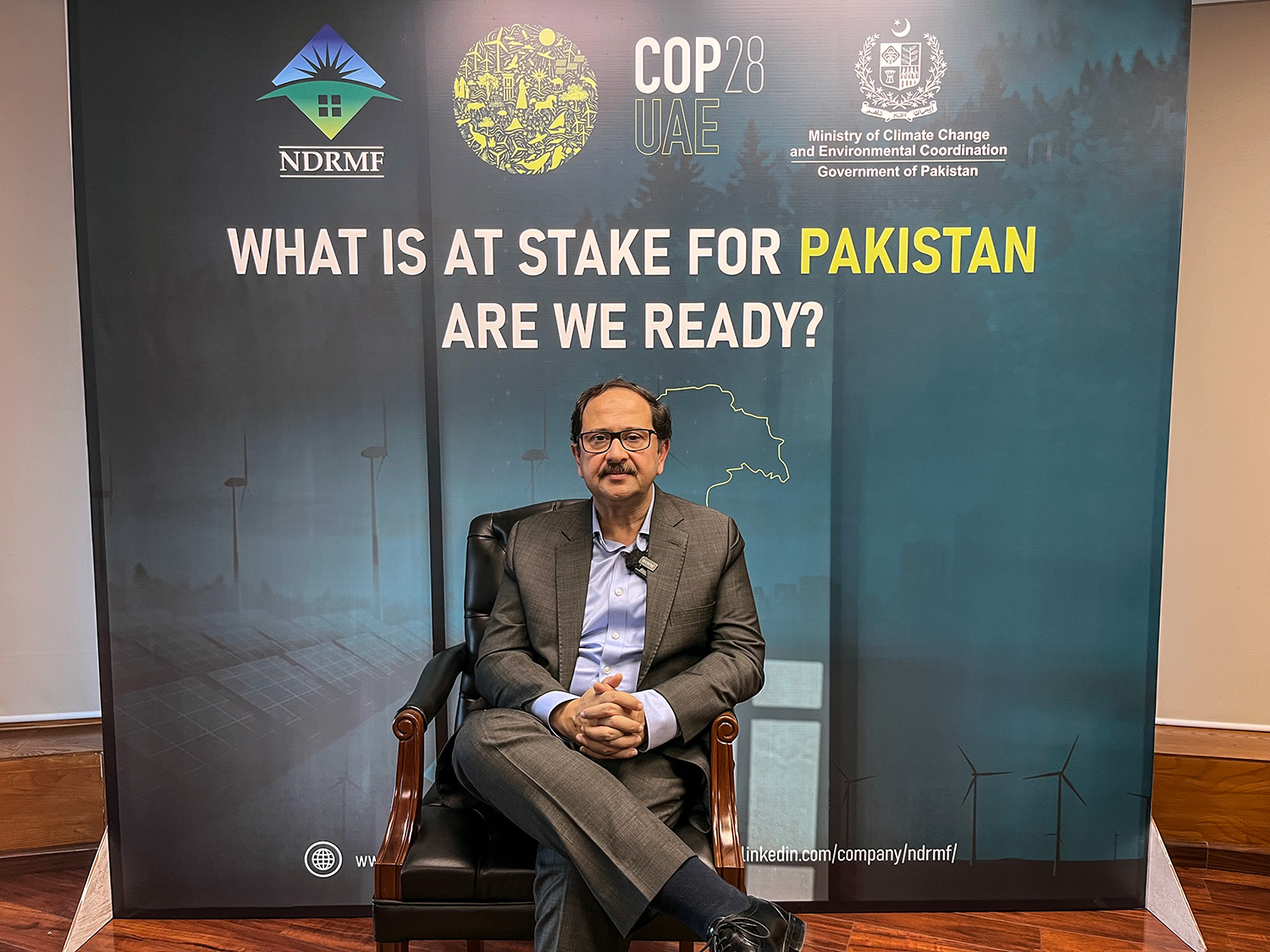
National Disaster Risk Management Fund CEO Bilal Anwar speaks to Arab News in Islamabad, Pakistan on November 23, 2023. (AN photo)
Anwar said the power and agriculture sectors and industries would be key target areas for the carbon emissions trading system, while export-oriented industries were already taking voluntary initiatives.
When asked if the government was considering imposing a carbon levy on fuel importers, he said, “No, I don’t think so.”
To a question on mandatory carbon trading for coal power plants to boost renewable energy in the coming decades, Anwar said:
“There is no need for Pakistan to take all these kinds of very hardcore kind of measures at least at this stage, which can actually somehow adversely impact our economic growth prospects …There is no compliance obligation on Pakistan because our emissions are less than 1 percent. So, even with all the industrial development and economic growth aspirations which we have, our emission levels are going to remain pretty low as compared to many other countries.”
LOSS AND DAMAGE FUND
Anwar will head next week to the 2023 United Nations Climate Change Conference or Conference of the Parties of the UNFCCC, more commonly referred to as COP28, being held in Dubai from November 30-December 12. Last year’s summit in Egypt, which came on the heels of record floods in Pakistan, ended with a deal to establish a new fund to help vulnerable countries pay their rising costs of climate damage from wilder weather and rising seas.
The details on how the fund would operate and where it would source money from were to be worked out by a transitional committee in the coming year. The fifth meeting of the committee took place in Abu Dhabi earlier this month and submitted a list of recommendations for implementing the “loss and damage fund” that will be taken up at COP28.
“The transitional committee have come up with a set of recommendations which they have put forward for the approval of COP28,” Anwar said, adding that he doubted the loss and damage fund would become operational “very soon.”
“Based on my own experience from COP28 and the UN process, I think this is going to take maybe another year and a year and half at least when we basically [are] going to start seeing the funding actually coming out.”
At COP28, climate leaders will need to address questions around the operational mechanism of the fund such as eligibility criteria, capitalization of the loss and damage fund and assessment validation of the damages. There is no agreement yet over what should count as “loss and damage” caused by climate change, which could include damaged infrastructure and property, as well as harder-to-value natural ecosystems or cultural assets.
Pakistan’s focus at COP28, Anwar said, would be issues such as adaptation to climate changes, financing adaptation measures and investment in climate technologies.
RISK MODELING
The NDRMF is also currently working on setting up Pakistan’s first-ever data center to provide “scientific-based information,” or climate and disaster risk modeling, for flood protection to all government agencies, allowing Pakistan to determine and evaluate where exactly it needs to implement projects and make interventions “to get the best value out our every dollar investment,” Anwar said.
The first phase of the application, developed by SUPARCO, Pakistan’s Space & Upper Atmosphere Research Commission, for about $2.5 million, would become operational from January 2024.
“Right now, we are designing a very specialized dashboard for each [government] institution,” the NDRMF CEO said.
“Each institution has a different set of needs when it comes to risk modeling. We are engaged with them, we are seeking their inputs.”




