

Turkiye’s central bank raises interest rate to 40% to tame rising inflation

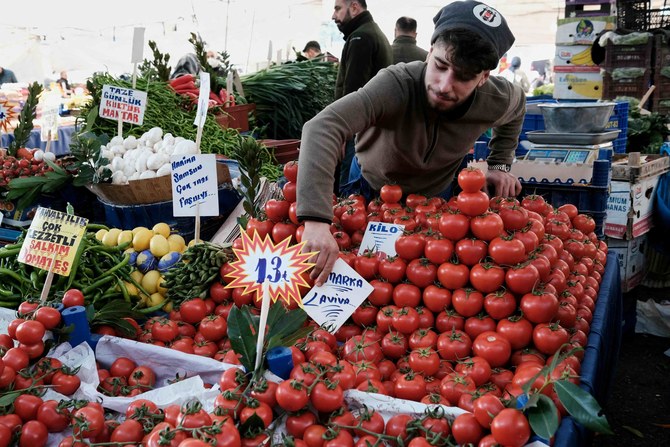
Based on the most recent data released by the Turkish Statistical Institute, Turkiye’s annual inflation decreased slightly to 61.36 percent in October, down from the nine-month peak of 61.53 percent recorded in September. Reuters/File
Short Url
Updated 23 November 2023
Follow

Turkiye’s central bank raises interest rate to 40% to tame rising inflation

RIYADH: For the 6th consecutive time, Turkiye’s central bank has raised the one-week repo rate to 40 percent, signaling the conclusion of its tightening cycle.  

In a bid to address persisting inflationary pressures and ensure sustained price stability, the Turkish Monetary Policy Committee announced in a statement on Thursday its decision to raise the interest rate from 35 percent to 40 percent. 

The move came as headline inflation experienced a slight decline in October. 

Based on the most recent data released by the Turkish Statistical Institute, Turkiye’s annual inflation decreased slightly to 61.36 percent in October, down from the nine-month peak of 61.53 percent recorded in September. 

During its October meeting, the central bank responded to these inflationary pressures by raising its policy interest rate, commonly referred to as the one-week repo auction rate, to 35 percent. 

Despite this positive development, the MPC highlighted in its statement concerns related to the existing level of domestic demand, the persistence of services inflation, and ongoing geopolitical risks that continue to exert upward pressure on inflation.

The committee also noted improvements in inflation expectations and pricing behavior, emphasizing that the current level of monetary tightness is approaching the necessary threshold to establish a disinflationary trajectory.  

“Accordingly, the pace of monetary tightening will slow down and the tightening cycle will be completed in a short period of time,” it said.

It said it is committed to maintaining monetary tightness as long as required to ensure sustained price stability and improve the micro - and macroprudential framework.  

While lending rates are considered to be in line with the targeted financial tightness, the committee anticipated that regulations promoting Turkish lira deposits, coupled with ongoing monetary tightening, will fortify the transmission mechanism and improve the funding composition of the banking system. 

Beyond policy rate adjustments, the MPC is set to employ quantitative tightening decisions to support the overall monetary policy stance.

Considering the cumulative and lagged effects of monetary tightening, the committee will determine policy decisions to create the necessary financial conditions for a sustained decline in the underlying inflation trend, aiming to reach the 5 percent inflation target in the medium term.


Saudi POS spending jumps 28% in final week of Jan: SAMA

Updated 06 February 2026
Follow

Saudi POS spending jumps 28% in final week of Jan: SAMA

RIYADH: Saudi Arabia’s point-of-sale spending climbed sharply in the final week of January, rising nearly 28 percent from the previous week as consumer outlays increased across almost all sectors. 

POS transactions reached SR16 billion ($4.27 billion) in the week ending Jan. 31, up 27.8 percent week on week, according to the Saudi Central Bank. Transaction volumes rose 16.5 percent to 248.8 million, reflecting stronger retail and service activity. 

Spending on jewelry saw the biggest uptick at 55.5 percent to SR613.69 million, followed by laundry services which saw a 44.4 percent increase to SR62.83 million. 

Expenditure on personal care rose 29.1 percent, while outlays on books and stationery increased 5.1 percent. Hotel spending climbed 7.4 percent to SR377.1 million. 

Further gains were recorded across other categories. Spending in pharmacies and medical supplies rose 33.4 percent to SR259.19 million, while medical services increased 13.7 percent to SR515.44 million. 

Food and beverage spending surged 38.6 percent to SR2.6 billion, accounting for the largest share of total POS value. Restaurants and cafes followed with a 20.4 percent increase to SR1.81 billion. Apparel and clothing spending rose 35.4 percent to SR1.33 billion, representing the third-largest share during the week. 

The Kingdom’s key urban centers mirrored the national surge. Riyadh, which accounted for the largest share of total POS spending, saw a 22 percent rise to SR5.44 billion from SR4.46 billion the previous week. The number of transactions in the capital reached 78.6 million, up 13.8 percent week on week. 

In Jeddah, transaction values increased 23.7 percent to SR2.16 billion, while Dammam reported a 22.2 percent rise to SR783.06 million. 

POS data, tracked weekly by SAMA, provides an indicator of consumer spending trends and the ongoing growth of digital payments in Saudi Arabia.  

The data also highlights the expanding reach of POS infrastructure, extending beyond major retail hubs to smaller cities and service sectors, supporting broader digital inclusion initiatives.  

The growth of digital payment technologies aligns with Saudi Arabia’s Vision 2030 objectives, promoting electronic transactions and contributing to the Kingdom’s broader digital economy.