Pakistan firmly supports two-state solution to Palestine issue, President Alvi tells Imam-e-Kaaba 

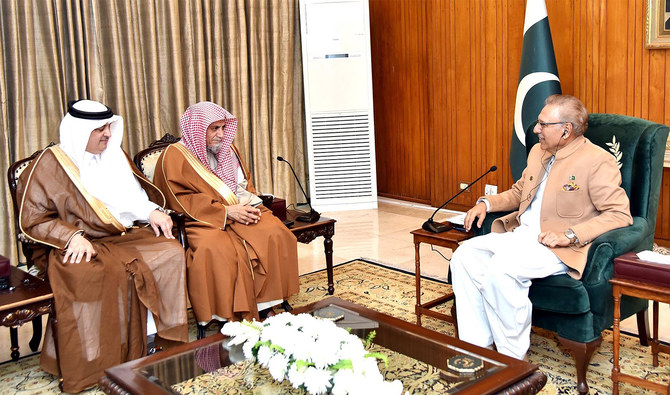
Pakistan’s President Dr. Arif Alvi (left) meets Imam-e-Kaaba Sheikh Saleh bin Humaid (second from left) in Islamabad, Pakistan on November 23, 2023. (PID)
Short Url
Updated 23 November 2023
Follow

Pakistan firmly supports two-state solution to Palestine issue, President Alvi tells Imam-e-Kaaba 

  • Imam-e-Kaaba says ongoing war in Gaza marks ‘one of darkest periods in human history’ 
  • Sheikh Saleh stresses joint efforts by the Muslim world to stop Israeli atrocities in Palestine 

ISLAMABAD: Pakistan’s President Dr. Arif Alvi, in his meeting with Imam-e-Kaaba Sheikh Saleh bin Humaid on Thursday, reiterated his country’s firm support for a just and peaceful resolution of the Palestine issue, based on the two-state solution. 

The meeting came during a four-day visit of Sheikh Saleh, an adviser to the Kingdom’s Royal Court, to Islamabad, which is aimed at enhancing brotherly ties between Pakistan and Saudi Arabia. 

The Imam-e-Kaaba is scheduled to lead Friday prayers at Islamabad’s iconic Faisal Mosque and meet top Pakistani officials during the visit. 

“Pakistan strongly supports a just and peaceful solution to the Palestinian issue based on the two-state solution,” Alvi was quoted as saying in a statement issued by his office. 

“The world should realize the suffering of the Palestinian people and play its role to stop Israeli atrocities in Gaza.” 

Pakistan, which does not recognize the state of Israel, has historically supported an independent Palestinian state based on “internationally agreed parameters” and the pre-1967 borders, with Al-Quds Al-Sharif as its capital. 

The two figures held discussions on the Gaza situation, Islamophobia and other challenges faced by the Muslim world at the meeting, which was also attended by Saudi Arabia’s ambassador to Pakistan, Nawaf bin Said Al-Malki, according to the statement. 

The Pakistan president stressed the need for unity and solidarity to deal with common challenges facing the Muslim world. He expressed his gratitude to Saudi Arabia for various development projects in Pakistan and helping the South Asian country in difficult economic times. 

During the meeting, the statement read, the Imam-e-Kaaba emphasized the need for joint efforts to end Israeli atrocities in Palestinian territories. 

“Joint efforts of the Muslim world, humanitarian and diplomatic assistance are needed to stop the ongoing atrocities in Palestine,” he was quoted saying. 

In a separate statement, the Pakistani army also expressed its support for the people of Palestine and the two-state solution. It came after a meeting of the army's Formation Commanders Conference, presided over by Army Chief General Asim Munir.

"The forum expressed unequivocal diplomatic, moral and political support to the people of Palestine and reiterated Pakistan's principled stance supporting the two-state solution, based on pre-1967 borders with Al-Quds Al-Sharif as the capital of Palestine.

Additionally, Pakistan's Caretaker Religious Affairs Minister Aneeq Ahmed also met with the Imam-e-Kaaba and discussed with him unity among the Muslim world and other important affairs. 

“Pakistan is an important country and the Muslim world looks toward it with hope,” the Pakistani religious affairs ministry quoted Sheikh Saleh as saying. 

Earlier in the day, the Imam-e-Kaaba said the ongoing massacre of innocent people in Gaza marked “one of the darkest periods in human history” and called on global powers to intervene and halt crimes against humanity in Palestine. 

He expressed these views while addressing the fourth international conference on the protection of human life in Shariah and law, jointly organized by International Islamic University Islamabad and International Islamic Fiqh Academy Jeddah. 

“Allah has sworn to protect human life, and those who unjustly take a life face the promise of hell,” he said.


Pakistan, global crypto exchange discuss modernizing digital payments, creating job prospects 

Updated 05 December 2025
Follow

Pakistan, global crypto exchange discuss modernizing digital payments, creating job prospects 

  • Pakistani officials, Binance team discuss coordination between Islamabad, local banks and global exchanges
  • Pakistan has attempted to tap into growing crypto market to curb illicit transactions, improve oversight

ISLAMABAD: Pakistan’s finance officials and the team of a global cryptocurrency exchange on Friday held discussions aimed at modernizing the country’s digital payments system and building local talent pipelines to meet rising demand for blockchain and Web3 skills, the finance ministry said.

The development took place during a high-level meeting between Finance Minister Muhammad Aurangzeb, Pakistan Virtual Assets Regulatory Authority (PVARA) Chairman Bilal bin Saqib, domestic bank presidents and a Binance team led by Global CEO Richard Teng. The meeting was held to advance work on Pakistan’s National Digital Asset Framework, a regulatory setup to govern Pakistan’s digital assets.

Pakistan has been moving to regulate its fast-growing crypto and digital assets market by bringing virtual asset service providers (VASPs) under a formal licensing regime. Officials say the push is aimed at curbing illicit transactions, improving oversight, and encouraging innovation in blockchain-based financial services.

“Participants reviewed opportunities to modernize Pakistan’s digital payments landscape, noting that blockchain-based systems could significantly reduce costs from the country’s $38 billion annual remittance flows,” the finance ministry said in a statement. 

“Discussions also emphasized building local talent pipelines to meet rising global demand for blockchain and Web3 skills, creating high-value employment prospects for Pakistani youth.”

Blockchain is a type of digital database that is shared, transparent and tamper-resistant. Instead of being stored on one computer, the data is kept on a distributed network of computers, making it very hard to alter or hack.

Web3 refers to the next generation of the Internet built using blockchain, focusing on giving users more control over their data, identity and digital assets rather than big tech companies controlling it.

Participants of the meeting also discussed sovereign debt tokenization, which is the process of converting a country’s debt such as government bonds, into digital tokens on a blockchain, the ministry said. 

Aurangzeb called for close coordination between the government, domestic banks and global exchanges to modernize Pakistan’s payment landscape.

Participants of the meeting also discussed considering a “time-bound amnesty” to encourage users to move assets onto regulated platforms, stressing the need for stronger verifications and a risk-mitigation system.

Pakistan has attempted in recent months to tap into the country’s growing crypto market, crack down on money laundering and terror financing, and promote responsible innovation — a move analysts say could bring an estimated $25 billion in virtual assets into the tax net.

In September, Islamabad invited international crypto exchanges and other VASPs to apply for licenses to operate in the country, a step aimed at formalizing and regulating its fast-growing digital market.