

Pakistan applies for BRICS membership in 2024, says won’t support anti-Russia sanctions

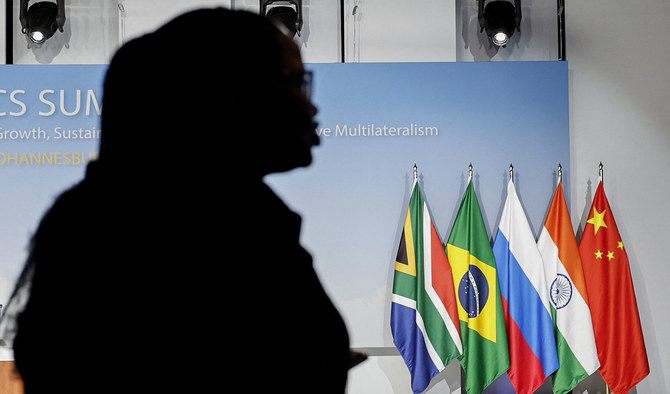
A woman stands near the flags of South Africa, Brazil, Russia, India and China during the 2023 BRICS Summit at the Sandton Convention Centre in Johannesburg on August 24, 2023. (AFP/File)
Short Url
Updated 23 November 2023
Follow

Pakistan applies for BRICS membership in 2024, says won’t support anti-Russia sanctions

  • Newly appointed ambassador to Russia says Pakistan’s imports from Russia grew by 154% in 2023 compared to previous year
  • Says Pakistan was ready for talks with Russia about the use of the Mir Russian card payment system for electronic fund transfers

ISLAMABAD: Pakistan has filed an application to join the BRICS group of nations in 2024, Islamabad's newly appointed ambassador to Moscow Muhammad Khalid Jamali has told state-owned news agency TASS in an interview, adding that Islamabad would not support anti-Russia sanctions.

The BRICS group of major emerging economies comprises Brazil, Russia, India, China and South Africa. The bloc, whose creation was initiated by Russia, was founded as an informal club in 2009 to provide a platform for its members to challenge a world order dominated by the United States and its Western allies. The group is not a formal multilateral organisation like the United Nations, World Bank or the Organisation of the Petroleum Exporting Countries (OPEC) but heads of state and government of the member nations convene annually with each nation taking up a one-year rotating chairmanship of the group.

Countries like Pakistan who want to join BRICS see it as an alternative to global bodies viewed as dominated by the traditional Western powers and hope membership will unlock benefits including development finance, and increased trade and investment.

"Pakistan would like to be part of this important organization and we are in process of contacting member countries for extending support to Pakistan’s membership in general and Russian Federation in particular," Jamali told TASS on Wednesday, confirming that Islamabad had already applied and planned to join the group under Russia’s presidency in 2024.

Russian Deputy Foreign Minister Sergey Ryabkov said in early October BRICS planned to agree on a list of candidates for partner-state status ahead of the upcoming summit in Kazan in 2024. During Russia’s BRICS chairmanship, he said, special attention would be paid to expand the “circle of BRICS friends,” including in Latin America.

Relations between Pakistan and Russia have improved in recent years, with the South Asian nation snapping up crude oil that Moscow has discounted after its exports were banned from European markets over Russia's invasion of Ukraine. Pakistan's first crude oil cargo, imported by the government, arrived in June.

“It is not in Pakistan’s economic interests to join anti-Russian sanctions because our bilateral trade is growing,” Jamali told TASS. “Pakistan’s imports from Russia this year grew by 154% compared to the previous year, which is a remarkable figure.”

The ambassador said Pakistan was ready for talks with Russia about the use of the Mir card payment system for electronic funds transfers. Jamali said Pakistan would also consider trading in national currencies.

“Switching to national currencies in mutual settlements is a matter, which is being discussed not only bilaterally but also at the level of multilateral organizations such as the SCO [Shanghai Cooperation Organisation] and Pakistan is ready to consider all available options that can help make settlements faster and give impetus to our trade,” the diplomat said. 

“The same applies to the Mir cards … We are open to all proposals from our Russian colleagues, which are beneficial for both sides.”


UN says 270,000 Afghans have returned from Iran, Pakistan this year

Updated 10 March 2026
Follow

UN says 270,000 Afghans have returned from Iran, Pakistan this year

  • UNHCR says 110,000 Afghans returned from Iran while 160,000 returned from Pakistan since start of 2026
  • Return numbers seem to have risen since Gulf war erupted on Feb. 28, says UNHCR official in Afghanistan

GENEVA: Some 270,000 Afghans have returned to their country from Pakistan and Iran so far this year, the UN said Tuesday, warning that the escalating Middle East war risked pushing the numbers higher.

UNHCR, the United Nations’ refugee agency, said that 110,000 Afghans had returned from Iran and another 160,000 had returned from Pakistan since the start of 2026.

And the numbers seem to have risen since the Middle East erupted on February 28, with the United States and Israel unleashing a barrage of strikes on Iran, and Tehran responding with drone and missile strikes on Israeli and US interests across the region.

Since then, there have been some 1,700 returns from Iran to Afghanistan each day, Arafat Jamal, UNHCR’s representative in Afghanistan, told reporters in Geneva.

Speaking from Islam Qala, on the Afghan-Iranian border, he said the situation there was “deceptively calm.”

“Returns are orderly but freighted with tension and apprehension,” he said, adding that with the hostilities elsewhere escalating, “I do fear there is more to come.”

“We are preparing for massive returns.”

He pointed out that Afghanistan was “facing the ramifications of what is happening with Iran,” while clashes have erupted along the Afghan border with Pakistan.

The new Middle East war, he warned, was “layering itself on top of an existing war on another frontier,” Jamal said.

UNHCR highlighted that the latest crises came after returns to Afghanistan had already been “exceptionally high” in recent years.

More than five million Afghans had returned from neighboring countries in the past two years, including 1.9 million returning from Iran last year alone.

Jamal warned that “many Afghan families are now facing cycles of displacement: first forced to flee Afghanistan, later displaced again inside Iran due to conflict, and now returning once more to Afghanistan.”

“And upon return in Afghanistan, the triply-displaced enter a spiral of precarity and uncertainty.”
Returns from Pakistan had meanwhile stabilized in recent weeks, as the main crossing point at Torkham remained closed due to the tensions there, Jamal said.

But he warned that “movements could increase sharply once the border reopens.”

UNHCR and the UN children’s agency UNICEF said Tuesday they were working to strengthen their capacity to operate at the borders and within Afghanistan.

But “given the scale of returns and the financial constraints facing humanitarian operations, additional support will be needed if arrivals increase,” UNHCR said, without specifying the amount needed.