

‘Gallows of waiting’: Pakistan uses biometrics to identify unclaimed bodies, provide closure to families

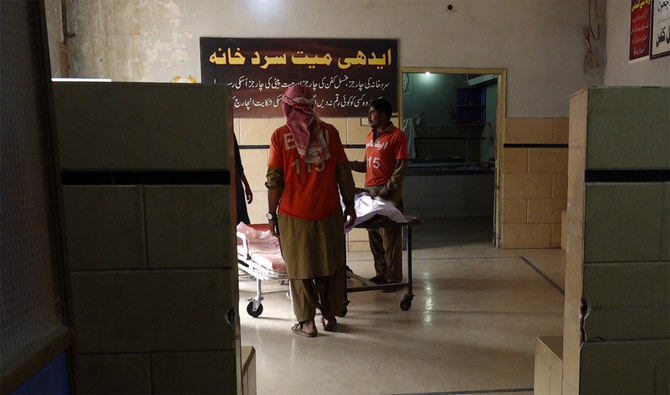
Charity workers seen at the Edhi Morgue in Karachi, Pakistan, on November 21, 2023. (AN photo)
Short Url
Updated 23 November 2023
Follow

‘Gallows of waiting’: Pakistan uses biometrics to identify unclaimed bodies, provide closure to families

  • NADRA initiative launched in 2016 has helped identify thousands of bodies that turn up each year at Edhi Foundation's Karachi mortuary
  • Number of unidentified bodies received by Edhi has gone down to 1,512 per year from 2,750 since the biometric project was started

KARACHI: As the ambulance arrived at the entrance of a mortuary in Karachi’s Ancholi neighborhood, four attendants jumped into action, quickly pulling a stretcher out of the vehicle and pushing it inside to a window where an official used a biometric scanner to take the fingerprint of the dead man wrapped in a white shroud.

The man’s print will next be sent to be matched against the vast archive of the National Database and Registration Authority (NADRA), a government body that maintains identity records of all citizens of Pakistan.

The initiative, launched in 2016, has helped to identify thousands of bodies that turn up each year at the mortuary run by the Edhi Foundation, a charity that operates the largest network for the burial of unclaimed corpses in Pakistan.

The morgue has received 82,500 unclaimed bodies from when it was set up in 1986 until 2016, or an average of 2,750 bodies per year over the course of three decades. Since the implementation of the NADRA system, this number has gone down to 1,512 annually. 

“When the bodies arrive from Karachi, we take biometrics, and they are identified, we send their details [thumb impression] to NADRA to determine their status and on the second day, we receive the status and all details,” said Zulfiqar Ali, an official at the Citizens Police Liaison Committee, which works with the Edhi Foundation.

“The body is then identified, and we provide all information to the family.”

The identities of nearly 80 percent of cases can now be traced, Ali added.

Before the technology, thousands more bodies were buried namelessly at Karachi’s Mochko Graveyard, where most headstones carry numbers instead of names. The tombstone of an unidentified man buried at the cemetery just earlier this week had the simple identifier, 94,600.

“Thousands of unclaimed dead bodies are buried in the graveyard,” Noman Masood, the supervisor of the Edhi Foundation mortuary, told Arab News. “Perhaps their family members are still hanging on the gallows of waiting, hoping that they are still alive and will be found somewhere.”

Muhammad Riaz Baloch, who drives an Edhi ambulance, said unclaimed bodies were discovered throughout the sprawling metropolis of Karachi, Pakistan's largest city, with a population of nearly 18 million by most estimates. 

“Some of the deceased have gunshot wounds, while others are drug addicts found in drains, trash, or under a bridge, so we pick them up,” he said, adding that bodies were retrieved by Edhi after an entry was made with the police station that had jurisdiction. 

Asked what happened when bodies could not be identified through the NADRA system, Edhi’s Masood said the mortuary used “old practices” for cases where exact matches were not possible due to disfigured fingers or if the deceased was a minor.

In such cases, the body was buried after around eight days, but was first photographed and a record added to a file under the burial number of the deceased. 

Edhi kept the photos on file in case relatives showed up searching for them.

“When people come to us looking for their loved ones and find their body, their suffering ends,” Masood said, “and they find some solace even if they find them dead.”


Pakistan offers Kyrgyzstan Arabian Sea access as two states sign 15 cooperation accords

Updated 5 sec ago
Follow

Pakistan offers Kyrgyzstan Arabian Sea access as two states sign 15 cooperation accords

  • Pakistan and Kyrgyzstan sign MOUs spanning trade, energy, agriculture, ports, education, security cooperation
  • Kyrgyz president is on first visit to Pakistan in 20 years as both sides push connectivity and CASA-1000 power links

ISLAMABAD: Pakistan on Thursday offered Kyrgyzstan the shortest and most economical route to the Arabian Sea as the two countries signed 15 agreements and memoranda of understanding aimed at boosting cooperation across trade, energy, agriculture, education, customs data-sharing and port logistics.

The accords were signed during a visit to Islamabad by President Sadyr Zhaparov, the first by a Kyrgyz head of state to Pakistan in two decades, and part of Islamabad’s renewed push to link South Asia with landlocked Central Asian economies through ports, power corridors and transport routes.

For Pakistan, Kyrgyzstan offers access to hydropower through CASA-1000, a $1.2 billion regional electricity transmission project designed to carry surplus summer electricity from Kyrgyzstan and Tajikistan through Afghanistan into Pakistan. For Bishkek, Pakistan provides overland access to warm-water ports on the Arabian Sea, creating a shorter commercial route to global markets.

“President Asif Ali Zardari has reiterated Pakistan’s readiness to offer Kyrgyzstan the shortest and most economical route to the Arabian Sea,” Radio Pakistan reported after Zhaparov met the Pakistani president. 

The two leaders also discussed expanding direct flights to deepen business, tourism and people-to-people ties.

Zardari welcomed Kyrgyzstan’s completion of its segment of the CASA-1000 project and “reaffirmed Pakistan’s commitment to completing its part of the project, which is now at an advanced stage,” the state broadcaster said. 

Zhaparov thanked Islamabad for supporting Bishkek’s candidacy for a non-permanent UN Security Council seat and invited Zardari to visit Kyrgyzstan at a time of his convenience. Both sides expressed satisfaction with progress under the Quadrilateral Traffic in Transit Agreement, designed to facilitate road movement between Pakistan, Kyrgyzstan, Kazakhstan and China.

Earlier, both governments exchanged 15 sectoral cooperation documents covering commerce, mining, geosciences, power, agriculture, youth programs, the exchange of convicted persons, customs electronic data systems and a sister-city linkage between Islamabad and Bishkek.

According to APP, the MOUs were signed by ministers representing foreign affairs, commerce, economy, energy, power, railways, interior, culture, health and tourism. Agreements also covered cooperation between Pakistan’s Foreign Service Academy and the Diplomatic Academy of Kyrgyzstan, as well as collaboration between universities, youth ministries and cultural institutions.

“Our present mutual trade, comprising of about $15–16 million will be enhanced to $200 million in the next two years,” Prime Minister Shehbaz Sharif said after the agreements were signed, calling them “a framework for structured, result-oriented engagement and closer institutional linkages.”

Sharif said Pakistan was ready to serve as a maritime outlet for the landlocked Central Asian republic, offering access to Karachi, Port Qasim and Gwadar to help Kyrgyz goods reach regional and global markets.