

Pakistani man rides cross-country on horseback to raise awareness about glacial melt

Pakistani retired army soldier and polo player Musa Ali receives a warm reception from the locals during his journey in the Skardu district of Gilgit-Baltistan, Pakistan on November 18, 2023. (AN photo)
Short Url
Updated 22 November 2023
Follow

Pakistani man rides cross-country on horseback to raise awareness about glacial melt

  • 40-year-old Musa Ali started journey on Nov. 13 and hopes to be in Islamabad for International Mountain Day on Dec. 11
  • Over 3,000 lakes had formed by 2018 due to melting glaciers in Pakistan’s Gilgit-Baltistan and Khyber Pakhtunkhwa regions

SKARDU, Gilgit-Baltistan: Musa Ali started his 900-kilometer-long journey on Nov. 13 and has a “unique” goal: to ride on horseback from his village in Pakistan’s remote mountainous north to the national capital, Islamabad, to raise awareness about glacial melt.

Outside the polar region, Pakistan is the country with the highest number of glaciers in the world. However, a combination of climate change and air pollution has significantly contributed to the rapid melting of the South Asian nation’s glaciers, causing devastating floods that last year killed over 1,700 people and caused billions in losses to Pakistan’s economy.

According to the United Nations Development Program (UNDP), over 3,000 lakes had formed by 2018 due to melting glaciers in the northern Gilgit-Baltistan and northwestern Khyber Pakhtunkhwa regions of Pakistan. At least 33 of these lakes are considered at risk of flooding, posing a serious threat to over seven million people residing downstream.

To raise alarm about the situation, 40-year-old Ali, a polo player and retired army soldier, set out on horseback from his hometown of Gulshan-e-Kabir, a village near the Siachen border, traveling on the Juglot-Skardu Road and Karakoram Highway and covering up to 40 kilometers daily to be able to reach Islamabad in time for International Mountain Day on December 11.

“No one travels [on horse nowadays], maybe our grandfather had done this. So, just for a reminder and to give a message to the future generation, I decided to travel on horseback,” Ali told Arab News, explaining his mission.

“Due to the air pollution in the city and due to the smoke of vehicles and factories, our glaciers are melting. That’s why I decided to ride on horseback, so on the eve of International Mountain Day, I will give the message in Islamabad that GB has the potential of tourism but is vulnerable to climate change impacts.”
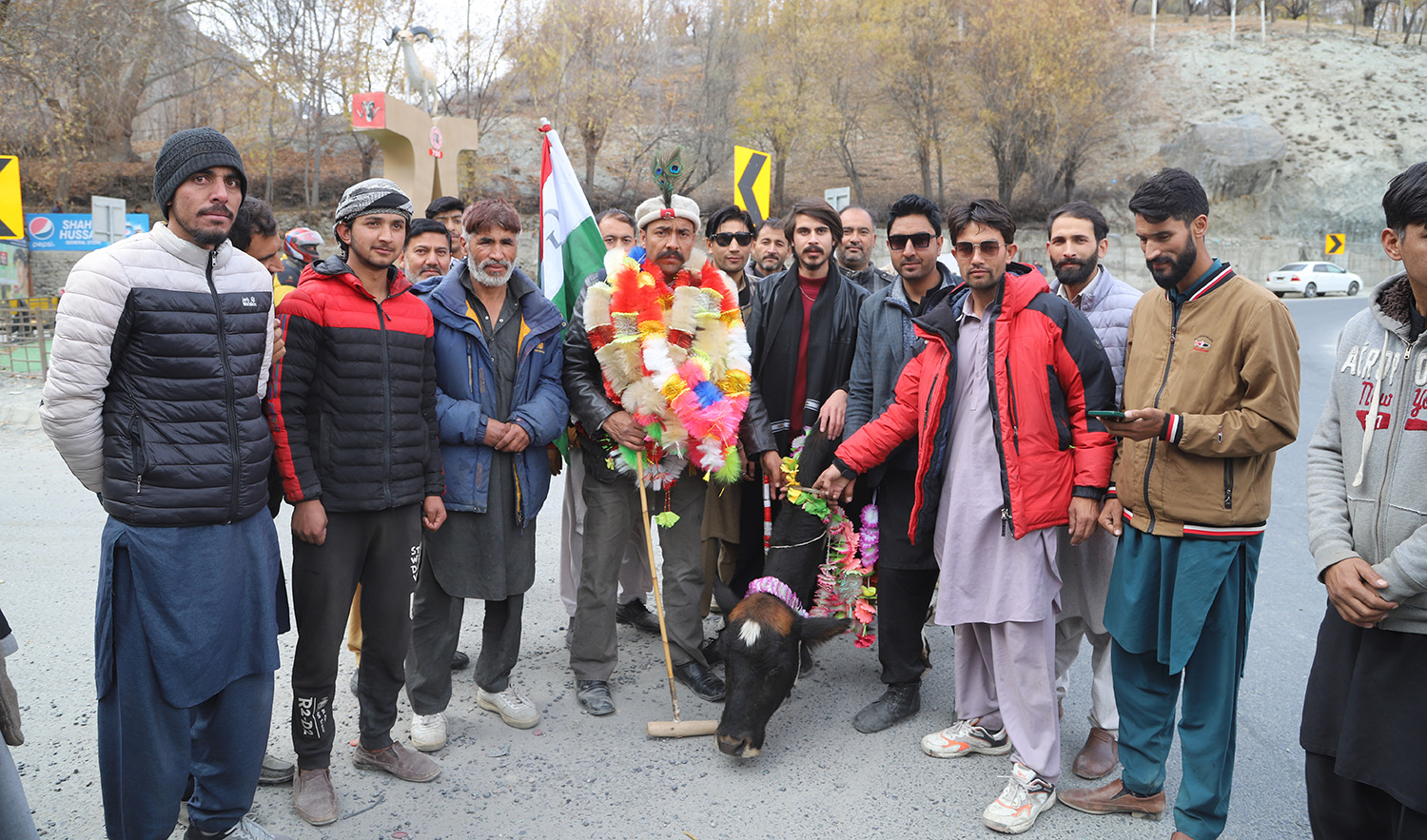


Pakistani retired army soldier and polo player Musa Ali poses for a group photograph at JSR junction near Kachura village of Skardu, Gilgit-Baltistan, Pakistan on November 18, 2023. (AN photo)

On his journey, Ali has crossed Khaplu Valley, passing by some of the most breathtaking landscapes in the northern region and a mosque that is believed to be 700 years old. He said he had covered meandering routes shrouded with autumn leaves and was now traversing a path along the mighty Indus River, surrounded by lofty mountains.

“I met different people during this week, including politicians, social activists, shopkeepers and businessmen,” he said. “Many of these people stopped me to take photographs.”

Ali said he had not received any support from the government to carry out his novel venture.

“Only a few people have contributed some cash to help me cover the expense of my journey,” the polo player added.

Along the way, Ali, who also wants to promote tourism in his picturesque Gilgit-Baltistan, said he was warmly received by people in bazaars, hotels and on the roadsides.

“People at different places have also offered me free meals and hotel owners have not been charging me for my stay,” he said. 

“I can’t believe the love shown by the people. I am thankful to every person.”


Pakistan orders four-day workweek, shuts schools to save fuel amid Middle East oil crisis

Updated 09 March 2026
Follow

Pakistan orders four-day workweek, shuts schools to save fuel amid Middle East oil crisis

  • The development comes as ongoing US-Israeli strikes on Iran disrupt oil supplies in Strait of Hormuz, push prices past $119 a barrel
  • Islamabad bans government purchases, cuts fuel allocation for vehicles as well as workforce in public and private offices by 50 percent

ISLAMABAD: Prime Minister Shehbaz Sharif on Monday announced austerity measures, including a four-day work week, cuts in government expenditures and closure of schools, to offset the impact of rising global oil prices due to an ongoing conflict in the Middle East.

Global fuel supply lines have been disrupted in the Strait of Hormuz, which supplies nearly a fourth of world oil consumption, after Tehran blocked it following United States-Israeli strikes on Iran and counterattacks against US interests in the Gulf region.

Oil prices surged more than 25 percent globally on Monday to $119.50 a barrel, the highest levels since mid-2022, as some major producers cut supplies and fears of prolonged shipping disruptions gripped the market due to the expanding US-Israeli war with Iran.

In his televised address on Sunday night, Sharif said global oil prices were expected to rise again in the coming days but vowed not to let the people bear their brunt, announcing austerity measures to lessen the impact of fuel price hikes.

“Fifty percent staff in public and private entities will work from home,” he announced, adding this would not be applicable to essential services. “Offices will remain open for four days a week. One-day additional off is being given to conserve oil, but it would not be applicable to banks.”

Sharif didn’t specify working days of the week and the government was likely to issue a notification in this regard.

He said a decrease of 50 percent was being made in fuel allocation for government vehicles immediately for the next two months, but they would not include ambulances and public buses.

“Cabinet members, advisers and special assistants will not draw salaries for the next two months, 25 percent salaries of parliamentarians are being deducted, two-day salaries of Grade 20 and above officers, or those who are paid Rs300,000 ($1,067) a month, are being deducted for public relief,” he said.

Similarly, there will be 20 percent reduction in public department expenses and a complete ban on the purchase of cars, furniture, air conditioners and other goods, according to the prime minister.

Foreign trips of ministers and other government officials will also be banned along with government dinners and iftar buffets, while teleconferences and online meetings will be given priority.

“All schools will be off for two weeks, starting from the end of this week, and all higher education institutions should immediately begin online classes,” he said.

Sharif’s comments were aired hours after Pakistani authorities said the country had “comfortable levels” of petroleum stocks and the supply chains were functioning smoothly, despite intensifying Middle East conflict.

Petroleum Minister Ali Pervaiz Malik said three oil shipments were due to reach Pakistan this week, state media reported.

Meanwhile, Pakistan Navy (PN) launched ‘Operation Muhafiz-ul-Bahr’ to safeguard national energy shipments, the Pakistani military said on Monday, amid disruptions to critical sea lanes due to the conflict.

The navy is conducting escort operations in close coordination with the Pakistan National Shipping Corporation (PNSC), according to the Inter-Services Public Relations (ISPR), the military’s media wing. It is fully cognizant of the prevailing maritime situation and is actively monitoring and controlling the movement of merchant vessels to ensure their safe and secure transit.

“With approximately 90 percent of Pakistan’s trade conducted via sea, the operation aims to ensure that vital sea routes remain safe, secure, and uninterrupted,” the ISPR said on Monday. “Currently, PN ships are escorting 2 x Merchant Vessels, one of which is scheduled to arrive Karachi today.”