KARACHI: The UN refugee agency on Tuesday expressed concern over widespread distress in large Afghan refugee communities across Pakistan where authorities are conducting searches to round up and expel undocumented foreigners.
Islamabad last month announced it would expel over a million undocumented refugees, mostly Afghans, amid a row with Kabul over charges it harbors anti-Pakistan militants. Over 370,000 Afghans have fled Pakistan since Oct. 1.
Pakistan says documented refugees are exempt, but the UN High Commission for Refugees (UNHCR) said even those with the right documents were being targeted.
“The announcement and follow-up actions, including reports of intimidation by local authorities and evictions by landlords, have created a sense of panic,” UNHCR’s Pakistan representative, Philippa Candle, said at a briefing in Geneva, according to a statement from the agency.
She reiterated that the return of Afghans should be voluntary and that Pakistan should identify vulnerable individuals who need international protection.
Pakistan says harassment of documented refugees is rare and it is taking action against perpetrators. But it has continued a search operation in various cities to verify the status of refugees, many of whom have lived in the country for decades.
In the southern port city of Karachi, where hundreds of thousands of Afghans live, police carried out door-to-door searches in refugee settlements along with officials of the national database authority.
In one area on the outskirts of the city, a slum settlement of hundreds of small houses, officials knocked on the doors and asked residents to provide identification, which was cross checked by electronic tablets.
Reluctant and visibly distressed residents allowed a female police officer into their homes to verify the identification of women and children as well. None of the families wanted to speak to Reuters journalists present at the site.
There was no resistance and search parties did not have to use force and returned documents of those whose documents checked out.
Thousands of Afghans have gone underground in Pakistan fearing deportation, saying they feared for their lives if they returned to Afghanistan, which is now run by the Islamist Taliban movement following the hasty and chaotic withdrawal of US-led western forces in 2021.
The International Organization for Migration (IOM) said in a press note that the sudden arrival of hundreds of thousands of Afghans had created a fresh crisis in Afghanistan where the returnees needed aid and shelter as winter sets in.
“With over six million people already internally displaced throughout the country, Afghans returning from Pakistan face a precarious, uncertain future,” IOM said.


Deportation drive sparks ‘sense of panic’ among Afghan refugees in Pakistan — UNHCR

https://arab.news/nn4jf
Deportation drive sparks ‘sense of panic’ among Afghan refugees in Pakistan — UNHCR

- Pakistan says the harassment of documented refugees is rare and it is taking strict action against perpetrators
- Thousands of Afghans have gone underground in Pakistan fearing deportation and concern for their lives in Afghanistan
Pakistan reports current account surplus in Jan. owing to improved trade, remittances
- Pakistan’s exports crossed the $3 billion mark in Jan. as the country received $3.5 billion in remittances
- Last month, IMF urged Pakistan to accelerate pace of structural reforms to strengthen economic growth
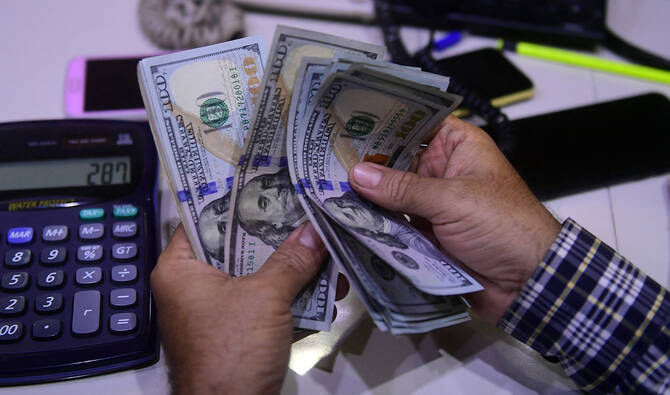
ISLAMABAD: Pakistan recorded a current account surplus of more than $120 million in January, the country’s finance adviser said on Tuesday, attributing it to improved trade balance and remittance inflows.
Pakistan’s exports rebounded in January 2026 after five months of weak performance, rising 3.73 percent year on year and surging 34.96 percent month on month, according to data released by the country’s statistics bureau.
Exports crossed the $3 billion mark for the first time in January to reach $3.061 billion, compared to $2.27 billion in Dec. 2025. The country received $3.5 billion in foreign remittances in Jan. 2026.
Khurram Schehzad, an adviser to the finance minister, said Pakistan reported a current account surplus of $121 million in Jan., compared to a current account deficit of $393 million in the same month last year.
“Improved trade balance in January 2026, strong remittance inflows, and sustained momentum in services exports (IT/Tech) continue to reinforce the country’s external account position,” he said on X.
Pakistan has undergone a difficult period of stabilization, marked by inflation, currency depreciation and financing gaps, and international rating agencies have acknowledged improvements after Islamabad began implementing reforms such as privatizing loss-making, state-owned enterprises (SOEs) and ending subsidies as part of a $7 billion International Monetary Fund (IMF) loan program.
Late last month, the IMF urged Pakistan to accelerate the pace of these structural reforms to strengthen economic growth.
Responding to questions from Arab News at a virtual media roundtable on emerging markets’ resilience, IMF’s director of the Middle East and Central Asia Jihad Azour said Islamabad’s implementation of the IMF requirements had been “strong” despite devastating floods that killed more than 1,000 people and devastated farmland, forcing the government to revise its 4.2 percent growth target to 3.9 percent.
“What is important going forward in order to strengthen growth and to maintain the level of macroeconomic stability is to accelerate the structural reforms,” he said at the meeting.
Azour underlined Pakistan’s plans to privatize some of the SOEs and improve financial management of important public entities, particularly power companies, as an important way for the country to boost its capacity to cater to the economy for additional exports.
“This comes in addition to the effort that the authorities have made in order to reform their tariffs, which will allow the private sector of Pakistan to become more competitive,” the IMF official said.


