

Saudi aid chief reinforces need for collective action to reduce global food insecurity

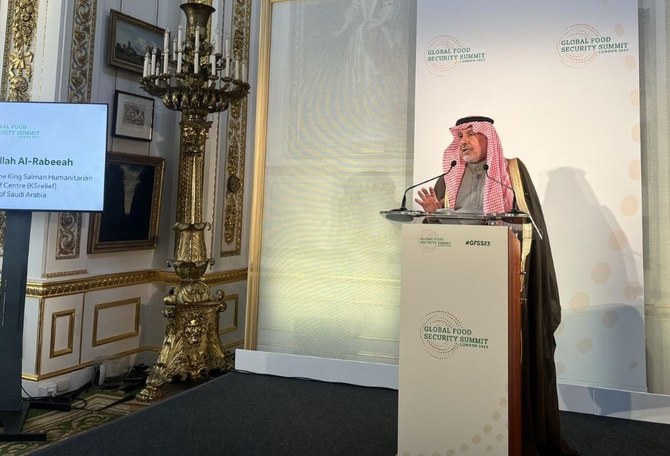
KSrelief Supervisor General Dr. Abdullah Al-Rabeeah speaking at the Global Food Security Summit in London. (KSrelief)
Short Url
Updated 21 November 2023
Follow

Saudi aid chief reinforces need for collective action to reduce global food insecurity

  • Gaza crisis further impacts on malnutrition situation, says Abdullah Al-Rabeeah
  • Al-Rabeeah was speaking at the Global Food Security Summit in London

RIYADH: Abdullah Al-Rabeeah, the adviser at the Royal Court and supervisor general of the Saudi aid agency KSrelief, has reinforced the need for collective action to reduce global food insecurity and malnutrition.

Al-Rabeeah was speaking at the Global Food Security Summit which was held in London and attended by British Prime Minister Rishi Sunak; British Foreign Secretary David Cameron; Somalia’s President Hassan Sheikh Mohamud; and a number of ministers from several countries, and representatives from the UN leadership, regional and international bodies, civil society, and relevant stakeholders.

The summit, which was co-hosted by the UK, the UAE, and Somalia, focused international attention on the deepening global food security crisis and discussed ways to boost efforts to achieve zero hunger and end malnutrition.

Al-Rabeeah, in his speech at a session called “Towards Eliminating Hunger and Malnutrition,” said: “I am not sure that we will achieve the Sustainable Development Goals by 2030 as there are globally more than 52 million children suffering from malnutrition. Many have recently lost their lives or been deprived of nutrition due to current crises, such as we are witnessing in Gaza.”

Interventions by KSrelief helped to address issues of food security and nutrition by adopting a strategy of integrating nutrition programs with food security, water, sanitation, and health interventions, said a statement by the organization to Arab News.

To save the lives of children at risk, in partnership with international organizations and nongovernmental bodies, KSrelief had provided more than $2 billion in food security projects, and $179 million in nutrition-related activities, it added.

Al-Rabeeah said that to meet the growing needs related to child malnutrition, the Saudi aid agency worked closely with governments and organizations to unify efforts and implement projects around the world, noting that partnerships with the British Foreign, Commonwealth and Development Office, and others, were promising and could become a role model.

He also stressed the importance of enabling countries and communities to obtain sustainable food resources and modern agricultural methods, and the necessity of lifting restrictions imposed on food trade, and the transfer of knowledge in the field of agriculture, the food industry and health.

He added the importance of women’s health which would result in the birth of healthy babies.

Al-Rabeeah called for a focus on the common goal of ensuring a safe and prosperous life for all children, while working together to prevent malnutrition.

Mohammed Shamsul Ola, an associate professor of nutritional biochemistry at King Saud University, Riyadh, told Arab News: “International action to alleviate food insecurity is required to combat global hunger and malnutrition, by collaborating with governments, organizations, and communities worldwide.

“Working together is needed to address the underlying causes of global food insecurity. With collective efforts, we can get the SDGs back on track and hope to deliver a world of zero hunger.

"Tackling the multidimensional challenges of food insecurity involves strategic investments in agricultural infrastructure, research, and technology transfer to empower local farmers.

“In addition, global food wastage is a significant issue that needs to be addressed internationally.

“By mitigating food insecurity and food wastage, the global community can create a more food secure and nourished world, ensuring that every individual has the opportunity to lead a healthy life.”

Al-Rabeeah met UK Minister of State at the Foreign, Commonwealth and Development Office Andrew Mitchell on the sidelines of the summit and discussed the agenda, as well as developments related to humanitarian and relief affairs.

He reminded Mitchell of the difficult humanitarian conditions in the Gaza Strip and ways to facilitate the entry of humanitarian aid.

Mitchell praised the efforts made by the Kingdom through KSrelief to provide assistance to people all over the world, and Saudi Arabia’s active participation at the summit.


Saudi Arabia plans Riyadh-Jeddah railway by 2034

Updated 5 sec ago
Follow

Saudi Arabia plans Riyadh-Jeddah railway by 2034

  • Saudi Railway Co. CEO speaks to media on future transport plans

JEDDAH: Saudi Railway Co. CEO Bashar Al-Malik announced that a new railway linking Riyadh and Jeddah is planned to be completed in phases by 2034.

In an interview with Rotana Khalejia broadcaster Abdullah Al-Mudaifer, Al-Malik discussed the Kingdom’s rail network, its history, and major current and future projects. 

He confirmed that the Riyadh-Jeddah line forms part of the Saudi Landbridge project, one of the most ambitious transport initiatives in the Kingdom.

Minister of Transport and Logistics Saleh Al-Jasser had said in an interview in 2022 that the Landbridge is being developed with an international consortium led by a Chinese company. He estimated the project could be completed within five to seven years.

According to Al-Jasser, the route, cost, and seven logistics hubs have already been identified. The railway will extend from Yanbu to King Abdullah Economic City, then to Jeddah and Riyadh, before linking with the Eastern Railway and the Northern Railway. 

The project includes upgrading the existing Riyadh–Eastern Province line to meet modern technical standards. The total cost could reach SR100 billion ($26.67 billion), making it a transformative project for the Kingdom’s logistics sector.

Al-Malik said contracts have not yet been signed, emphasizing that the railway company will proceed only once an agreement is reached that fully meets Saudi Arabia’s needs and ambitions. A ministerial committee has been formed to oversee the project, which is scheduled for completion by 2034.

The railway project connecting Riyadh and Jeddah will be implemented in phases and is expected to be completed before 2034. (X/@almodifer)

Al-Malik also highlighted the proposed Riyadh-Doha railway, describing it as the region’s first high-speed rail link between two neighboring countries. 

The 785 km network will serve Riyadh, Hofuf, Dammam, and Doha, with five stations in total, including two in the Qatari capital. Trains are expected to operate at speeds of at least 300 kph.

He added that Saudi Arabia aims to increase rail’s share of transport to 30 percent following completion of the Landbridge and future GCC-wide rail connections. 

Under the National Transport and Logistics Strategy, railways are receiving the largest share of investment through 2030.

After a long pause in railway development after the opening of the Riyadh-Dammam line in 1950, the Kingdom now operates about 4,000 km of railways and plans to add at least 2,000 km more.

Currently, SAR trains serve ports in Dammam, Ras Al-Khair, Jubail (commercial and industrial), and the Riyadh Dry Port. Future plans include extending rail connections to Jeddah Islamic Port, King Abdullah Economic City Port, and Yanbu Port. 

Al-Malik said up to 10 additional trains could be added to the Northern Railway, which currently operates six trains and is considered among the world’s most advanced rail routes. The tender is expected in the third quarter of this year. 

Discussing the Haramain High-Speed Railway, Al-Malik described it as “a unique, passenger-only system” connecting Islam’s two holiest cities. 

The service operates at speeds of up to 300 kph, making it one of the world’s 10 fastest trains. It runs 35 trains and links Makkah with stations in Jeddah, King Abdulaziz International Airport, King Abdullah Economic City, and Madinah.

Responding to user feedback, Al-Malik said the railway company will launch a new unified mobile application before the end of the year, providing a single platform for all intercity train services in the Kingdom.

He also highlighted training programs for high-speed train drivers, noting strong participation from Saudi women — a rare trend globally — and praising their outstanding performance.