Pakistani industries threaten ‘no export’ days thrice a week against sharp hike in gas prices

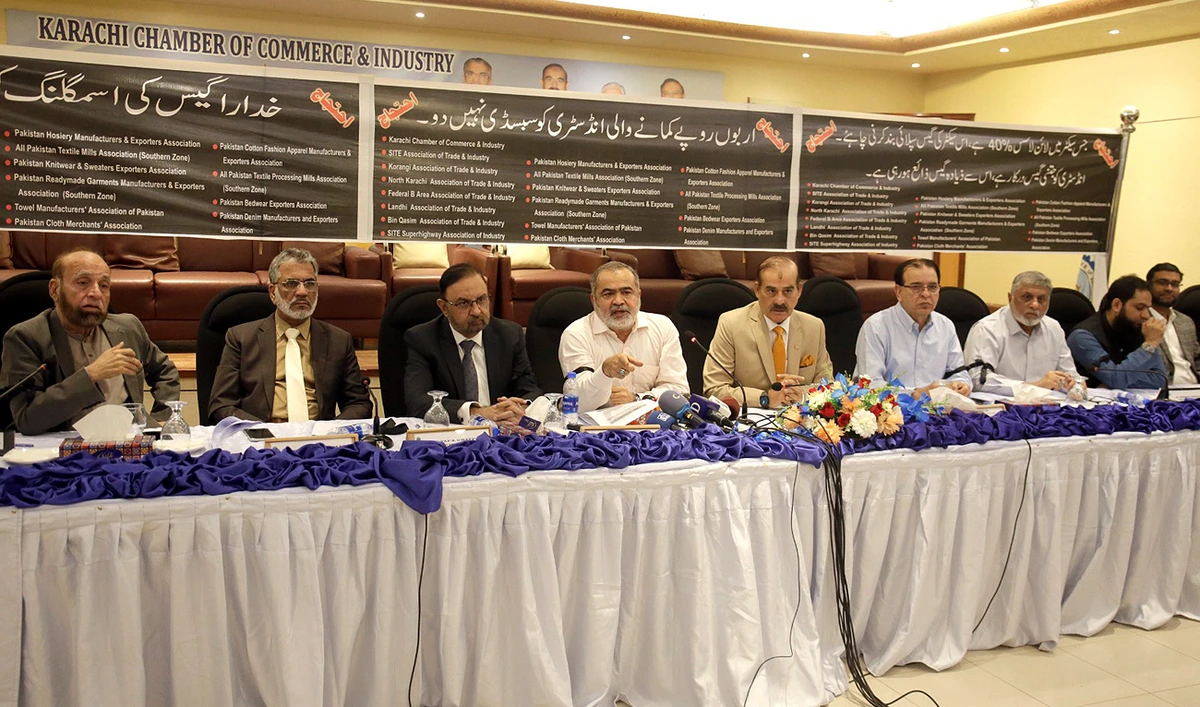
Pakistani businessman, Jawed Bilwani (4th left), speaks during a press conference along with Karachi Chamber of Commerce & Industry President Iftikhar Ahmed Sheikh (5th left) in Karachi on November 21, 2023. (AN Photo)
Short Url
Updated 21 November 2023
Follow

Pakistani industries threaten ‘no export’ days thrice a week against sharp hike in gas prices

  • On Oct. 31, Pakistan announced hike in natural gas prices for most households and industry ahead of IMF review
  • Industry leaders say gas tariffs for industry increased to about Rs2,600 per MMBtu, call for Rs1,350 per MMBtu

KARACHI: Pakistani industrialists in the country’s commercial hub of Karachi warned on Tuesday they would observe a “no export day” up to three times a week from next month to protest a hike in gas prices, saying it posed a “threat to the survival” of their businesses and could lead to the collapse of the industrial sector.
On Oct. 31, Pakistan announced a sharp increase in the price of natural gas for most households and industry ahead of the cash-strapped country’s first review of a $3 billion International Monetary Fund (IMF) bailout.
Addressing a press conference, officials from the Karachi Chamber of Commerce and Industry (KCCI) along with representatives from the Industrial Town and Value-Added Textile Associations said gas tariffs for industry had increased to about Rs2,600 per Metric Million British Thermal Unit (MMBtu), appealing to the government to bring it down to Rs1,350 per MMBtu, determined as the 100 percent cost of gas by the regulator.
“If the government fails to pay attention to the business community’s demand, we will intensify our protests by displaying protest banners all over the city and observe a ‘no export day’ twice and even thrice a week,” Jawed Bilwani, vice chairman of the ruling Businessmen Group (BMG) at KCCI, warned, saying the new tariffs were a way to “terribly penalize the industrial sector of the country.”
KCCI President Iftikhar Ahmed Sheikh said the government needed to find ways to increase its gas supplies, instead of re-prioritizing existing gas supplies, switching from one set of consumers to the other and raising the tariffs “to completely unabsorbable and unbearable level, which was purely against the spirit of Pakistan’s constitution.”
Sheikh said the gas tariff hike would lead to the closure of industries, trigger lay-offs and cause a huge retrenchment of the labor force which “might result in serious law and order situation, steep rise in street crimes and bankruptcy of manufacturing units.”
Last month, while announcing the hike in gas tariffs, Energy Minister Muhammad Ali said the tariff increase would generate nearly 400 billion rupees ($1.42 billion), adding that the state-run gas sector would from now on face no losses.
Energy sector debt has been the main issue that the IMF has highlighted in tackling the fiscal deficit and it has been recommending measures to deal with it.
Pakistan condemns Sudan attack that killed Bangladeshi UN peacekeepers, calls it war crime

Updated 14 December 2025
Follow

Pakistan condemns Sudan attack that killed Bangladeshi UN peacekeepers, calls it war crime

  • Six peacekeepers were killed in a drone strike in Kadugli as fighting between Sudan’s army and the RSF grinds on
  • Pakistan, a major troop contributor to the UN, says perpetrators of the attack must be identified, brought to justice

ISLAMABAD: Pakistan on Sunday extended condolences to the government and people of Bangladesh after six United Nations peacekeepers from the country were killed in a drone strike in southern Sudan, condemning the attack and describing it as a war crime.

The attack took place amid a full-scale internal conflict that erupted in April 2023 between the Sudanese Armed Forces (SAF) and the Rapid Support Forces (RSF), a powerful paramilitary group, following a power struggle after the collapse of Sudan’s post-Bashir political transition.

Omar Al-Bashir, who ruled Sudan for nearly three decades, was ousted by the military in 2019 after months of mass protests, but efforts to transition to civilian rule later faltered, plunging the country back into violence that has since spread nationwide.

The drone strike hit a logistics base of the United Nations Interim Security Force for Abyei (UNISFA) in Kadugli, the capital of South Kordofan state, on Saturday, killing the Bangladeshi peacekeepers. Sudan’s army blamed the RSF for the attack, though there was no immediate public claim of responsibility.

“Pakistan strongly condemns the attack on @UNISFA in Kadugli, resulting in the tragic loss of 6 Bangladeshi peacekeepers & injuries to several others,” the country’s permanent mission to the UN said in a social media message. “We honor their supreme sacrifice in the service of peace, and express our deepest condolences to the government and people of #Bangladesh.”

“Such heinous attacks on UN peacekeepers amount to war crimes,” it added. “Perpetrators of this horrific attack must be identified and brought to justice. As a major troop-contributing country, we stand in complete solidarity with all Blue Helmets serving the cause of peace in the perilous conditions worldwide.”

According to Pakistan’s UN mission in July, the country has deployed more than 235,000 peacekeepers to 48 UN missions across four continents over the past eight decades.

Pakistan also hosts one of the UN’s oldest peacekeeping operations, the United Nations Military Observer Group in India and Pakistan (UNMOGIP), and is a founding member of the UN Peacebuilding Commission.

More than 180 Pakistani peacekeepers have lost their lives while serving under the UN flag.

Pakistan and Bangladesh have also been working in recent months to ease decades of strained ties rooted in the events of 1971, when Bangladesh — formerly part of Pakistan — became independent following a bloody war.

Relations have begun to shift following the ouster of former Bangladeshi prime minister Sheikh Hasina last year amid mass protests.

Hasina later fled to India, Pakistan’s neighbor and arch-rival, creating space for Islamabad and Dhaka to rebuild their relationship.