

Oil Updates – crude retreats on caution ahead of OPEC+ meeting

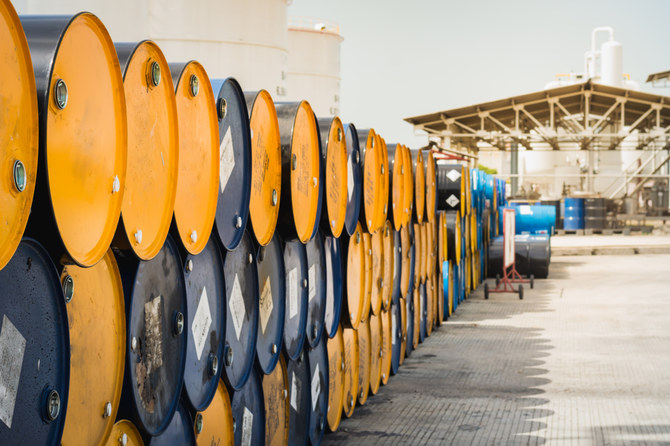
Brent crude futures fell 51 cents, or 0.6 percent, to $81.81 a barrel by 10:46 a.m. Saudi time. Shutterstock.
Short Url
Updated 21 November 2023
Follow

Oil Updates – crude retreats on caution ahead of OPEC+ meeting

SINGAPORE: Oil futures fell on Tuesday as investors turned cautious ahead of a meeting of the Organization of the Petroleum Exporting Countries and its allies, known as OPEC+, this Sunday when the producer group may discuss deepening supply cuts due to slowing global growth, according to Reuters.

Brent crude futures fell 51 cents, or 0.6 percent, to $81.81 a barrel by 10:46 a.m. Saudi time, while US West Texas Intermediate crude futures were at $77.32 a barrel, down 51 cents, or 0.7 percent.

Both contracts climbed about 2 percent on Monday after three OPEC+ sources told Reuters that the group was set to consider whether to make additional oil supply cuts when it meets on Nov. 26.

Those gains were trimmed on Tuesday.

Short-term speculators took profit on WTI after several indicators were overbought on technical charts, Singapore-based OANDA analyst Kelvin Wong said.

“Market participants have started to price in an extension of the current quantum oil supply cut into 2024 or even deeper cuts in the upcoming OPEC+ meeting,” he added.

OPEC+ is likely to extend or even deepen oil supply cuts into next year, eight analysts have predicted.

RBC Capital analyst Helima Croft said: “We see some scope for the group to do a deeper reduction, but we would anticipatoe that Saudi Arabia would seek additional barrels from other members to share the burden of the adjustment.”

Reopening the quota agreements reached in June could prove challenging and could lead to protracted negotiations, and hence the leadership may look for more voluntary adjustments from individual producers, she added in a note.

Oil prices have dropped about 16 percent since late September as crude output in the US, the world’s top producer, held at record highs, while the market was concerned about demand growth, especially from the world’s largest oil importer, China.

Traders were also watching for signs of demand destruction from a possible US recession in 2024 and considering last week’s warning about possible deflation from Walmart, the largest US retailer.

US crude and gasoline stockpiles likely rose last week, while distillates inventories were seen dropping, a preliminary Reuters poll showed on Monday.

Weekly stockpile reports from the American Petroleum Institute and the Energy Information Administration are due later on Tuesday and Wednesday, respectively. 


Record $14.4bn rise in Saudi holdings of US Treasuries

Updated 17 sec ago
Follow

Record $14.4bn rise in Saudi holdings of US Treasuries

RIYADH: Saudi Arabia increased its holdings of US Treasuries by 10.71 percent in November in what was the largest increase since data tracking began in 1974, according to the latest official data,

The Kingdom’s US Treasury portfolio stood at $148.8 billion in the month, up $14.4 billion from October.

Following the increase, Saudi Arabia moved up one place to 17th place among the largest foreign holders of US Treasuries.

Countries including Saudi Arabia invest in US Treasuries for their perceived safety, liquidity, diversification benefits, and alignment with economic ties to the US. 

The Kingdom’s holdings were 17.25 percent higher in November compared with January 2025.

The allocation highlights Saudi Arabia’s preference for longer-dated US government debt as part of its foreign reserve strategy, focused on capital preservation, liquidity, and diversification amid global market volatility. 

Saudi Arabia’s holdings included $106.8 billion in long-term securities, accounting for 72 percent of the total, while short-term holdings stood at $42 billion, or 28 percent. 

Globally, Japan remained the largest foreign holder of US Treasury securities at $1.2 trillion, followed by the UK at $888.5 billion, mainland China at $682.6 billion, and Belgium at $481 billion. 

Canada ranked fifth with holdings of $472.2 billion, followed by the Cayman Islands and Luxembourg in sixth and seventh positions, with portfolios valued at $427.4 billion and $425.6 billion, respectively. 

France placed eighth with $376.1 billion, followed by Ireland at $340.3 billion and Taiwan at $312.5 billion. 

Other countries included in the top 20 list include Switzerland, Singapore, Hong Kong, and Norway, as well as India and Brazil. 

The trade relationship between Saudi Arabia and the US remains strong, with the Kingdom exporting SR5.20 billion ($1.39 billion) worth of non-oil goods in October, data from the General Authority of Statistics showed.

Speaking to Arab News in October, Nasser Saidi, founder and president of economic and financial advisory services firm Nasser Saidi & Associates and a former minister of economy and trade in Lebanon, said US Treasuries are a critical pillar of stability.

“Holding treasuries allows Saudi Arabia to meet its international payment obligations — finance imports, service external debt, portfolio, and capital flows — provide a buffer against oil revenue shocks, while also generating a steady, low-risk stream of income,” he said.