Soldier killed in IED blast, three militants killed in separate attacks

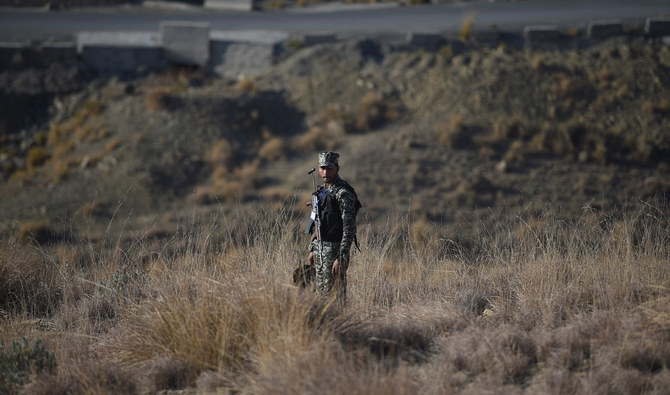
A Pakistani army soldier stands guard near a border terminal in Ghulam Khan, a town in North Waziristan, on the border between Pakistan and Afghanistan, on January 27, 2019. (AFP/File)
Short Url
Updated 21 November 2023
Follow

Soldier killed in IED blast, three militants killed in separate attacks

  • Pakistan has witnessed an uptick in militant violence in its northwestern region bordering Afghanistan
  • Its forces regularly carry out intelligence-based operations in the region to eliminate militant presence

ISLAMABAD: Security forces killed three militants and lost one soldier in separate incidents in Pakistan’s northwestern region bordering Afghanistan, which has witnessed an uptick in extremist violence in recent months, said the army’s media wing, ISPR, in a statement on Tuesday.

The Pakistani forces launched an intelligence-based operation (IBO) in the general area of Kulachi in Dera Ismail Khan district on Monday where two militants were killed after an intense exchange of fire.

A separate operation was also carried out in South Waziristan’s Kot Azam area where another militant was killed.

“Weapons and ammunition were recovered from all three killed terrorists, who remained actively involved in numerous terrorist activities against security forces as well as innocent civilians,” the ISPR said.

Meanwhile, a 26-year-old soldier, Sepoy Shahzeb, lost his life in North Waziristan tribal district after an improvised explosive device went off.

“Sanitization operations are being carried out to eliminate any terrorists present in the area as the security forces of Pakistan are determined to wipe out the menace of terrorism and such sacrifices of our brave soldiers further strengthen our resolve,” the ISPR added.

Pakistan’s top officials have frequently blamed militant networks hiding in Afghanistan for launching cross-border attacks against its security personnel and civilian population.

Caretaker Prime Minister Anwaar-ul-Haq Kakar expressed his disappointment with the Taliban administration in Kabul earlier this month for not clamping down on militants operating from Afghan territory and even accused it of facilitating some of these attacks.

Kakar also said that militant violence had increased in Pakistan by 60 percent and suicide bombings had shot up by 500 percent since the formation of the interim Afghan administration two years ago.

Pakistan has started deporting unregistered Afghans and other foreign nationals, following accusations of their involvement in suicide bombings and combat against Pakistan’s counterterrorism forces.


Anti-fuel smuggling drive boosts Pakistan revenues 82%, PM office says

Updated 9 sec ago
Follow

Anti-fuel smuggling drive boosts Pakistan revenues 82%, PM office says

  • Crackdown targets illegal petroleum trade using GPS tracking and pump registration
  • July–November gains cited as government intensifies tax, customs enforcement

ISLAMABAD: The Pakistani prime minister’s office said on Friday revenues from petroleum products rose 82% between July and November 2025 after a nationwide crackdown on fuel smuggling, as the government steps up enforcement to curb tax evasion and losses that have long strained public finances.

The increase was cited during a weekly performance review of the Federal Board of Revenue (FBR), where Prime Minister Shehbaz Sharif directed authorities to accelerate action against smuggling and tax evasion, according to a statement issued by the PM’s Office.

Fuel smuggling has been a persistent problem in Pakistan, where subsidised or untaxed petroleum products are often trafficked across borders or sold through unregistered pumps, depriving the state of revenue and distorting domestic energy markets. Successive governments have blamed the practice for billions of rupees in annual losses, while international lenders have repeatedly urged tighter enforcement as part of broader fiscal reforms.

“Every year the nation loses billions due to smuggling,” Sharif was quoted as saying in a statement, praising customs authorities for successful operations and noting that revenues from petroleum products increased by 82% from July to November 2025 compared with the same period last year.

The PM said stricter enforcement had brought several goods back into the formal economy, adding that there would be “no leniency” toward those involved in tax evasion or illegal trade.

Officials briefed the prime minister that Pakistan Customs has rolled out a nationwide enforcement framework, including GPS tracking of petroleum product transportation, registration of fuel stations through a digital monitoring system, and legal action against illegal machinery under updated petroleum laws.

The government has also instructed provincial administrations to cooperate fully with federal authorities in shutting down illegal petrol pumps, the statement said.

Sharif said enforcement efforts would continue until smuggling networks were dismantled and tax compliance improved, as the government seeks to strengthen revenues amid ongoing economic reforms.

Pakistan has struggled for years with weak tax collection and a narrow revenue base, forcing repeated bailouts from the International Monetary Fund. Smuggling of fuel, cigarettes, electronics and consumer goods has been identified by policymakers as a major obstacle to improving revenues and stabilising the economy.

Independent research shows that Pakistan loses an estimated Rs750 billion (about $2.7 billion) annually in tax revenue due to illicit trade and smuggling across sectors such as petroleum, tobacco and pharmaceuticals. Broader analyzes suggest total tax revenue losses linked to the informal economy and smuggling may reach as high as Rs3.4 trillion (around $12.1 billion) a year, roughly a quarter of the government’s annual tax targets.

Smuggled petroleum products alone are thought to cost the state about Rs270 billion (around $960 million) a year in lost revenue, underscoring why authorities have focused recent enforcement efforts on fuel tracking and pump registration.