

Soldier killed in IED blast, three militants killed in separate attacks

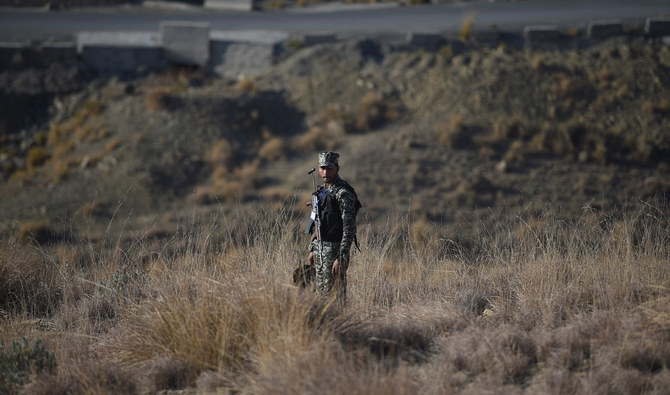
A Pakistani army soldier stands guard near a border terminal in Ghulam Khan, a town in North Waziristan, on the border between Pakistan and Afghanistan, on January 27, 2019. (AFP/File)
Short Url
Updated 21 November 2023
Follow

Soldier killed in IED blast, three militants killed in separate attacks

  • Pakistan has witnessed an uptick in militant violence in its northwestern region bordering Afghanistan
  • Its forces regularly carry out intelligence-based operations in the region to eliminate militant presence

ISLAMABAD: Security forces killed three militants and lost one soldier in separate incidents in Pakistan’s northwestern region bordering Afghanistan, which has witnessed an uptick in extremist violence in recent months, said the army’s media wing, ISPR, in a statement on Tuesday.

The Pakistani forces launched an intelligence-based operation (IBO) in the general area of Kulachi in Dera Ismail Khan district on Monday where two militants were killed after an intense exchange of fire.

A separate operation was also carried out in South Waziristan’s Kot Azam area where another militant was killed.

“Weapons and ammunition were recovered from all three killed terrorists, who remained actively involved in numerous terrorist activities against security forces as well as innocent civilians,” the ISPR said.

Meanwhile, a 26-year-old soldier, Sepoy Shahzeb, lost his life in North Waziristan tribal district after an improvised explosive device went off.

“Sanitization operations are being carried out to eliminate any terrorists present in the area as the security forces of Pakistan are determined to wipe out the menace of terrorism and such sacrifices of our brave soldiers further strengthen our resolve,” the ISPR added.

Pakistan’s top officials have frequently blamed militant networks hiding in Afghanistan for launching cross-border attacks against its security personnel and civilian population.

Caretaker Prime Minister Anwaar-ul-Haq Kakar expressed his disappointment with the Taliban administration in Kabul earlier this month for not clamping down on militants operating from Afghan territory and even accused it of facilitating some of these attacks.

Kakar also said that militant violence had increased in Pakistan by 60 percent and suicide bombings had shot up by 500 percent since the formation of the interim Afghan administration two years ago.

Pakistan has started deporting unregistered Afghans and other foreign nationals, following accusations of their involvement in suicide bombings and combat against Pakistan’s counterterrorism forces.


EU, Pakistan sign €60 million loan agreement for clean drinking water in Karachi

Updated 17 December 2025
Follow

EU, Pakistan sign €60 million loan agreement for clean drinking water in Karachi

  • Project will finance rehabilitation, construction of water treatment facilities in Karachi city, says European Investment Bank
  • As per a report in 2023, 90 percent of water samples collected from various places in city was deemed unfit for drinking

ISLAMABAD: The European Investment Bank (EIB) and Pakistan’s government on Wednesday signed a €60 million loan agreement, the first between the two sides in a decade, to support the delivery of clean drinking water in Karachi, the EU said in a statement. 

The Karachi Water Infrastructure Framework, approved in August this year by the EIB, will finance the rehabilitation and construction of water treatment facilities in Pakistan’s most populous city of Karachi to increase safe water supply and improve water security. 

The agreement was signed between the two sides at the sidelines of the 15th Pak-EU Joint Commission in Brussels, state broadcaster Radio Pakistan reported. 

“Today, the @EIB signed its first loan agreement with Pakistan in a decade: a €60 million loan supporting the delivery of clean drinking water for #Karachi,” the EU said on social media platform X. 

Radio Pakistan said the agreement reflects Pakistan’s commitment to modernize essential urban services and promote climate-resilient infrastructure.

“The declaration demonstrates the continued momentum in Pakistan-EU cooperation and highlights shared priorities in sustainable development, public service delivery, and climate and environmental resilience,” it said. 

Karachi has a chronic clean drinking water problem. As per a Karachi Water and Sewerage Corporation (KWSC) study conducted in 2023, 90 percent of water from samples collected from various places in the city was deemed unsafe for drinking purposes, contaminated with E. coli, coliform bacteria, and other harmful pathogens. 

The problem has forced most residents of the city to get their water through drilled motor-operated wells (known as ‘bores’), even as groundwater in the coastal city tends to be salty and unfit for human consumption.

Other options for residents include either buying unfiltered water from private water tanker operators, who fill up at a network of legal and illegal water hydrants across the city, or buying it from reverse osmosis plants that they visit to fill up bottles or have delivered to their homes.

The EU provides Pakistan about €100 million annually in grants for development and cooperation. This includes efforts to achieve green inclusive growth, increase education and employment skills, promote good governance, human rights, rule of law and ensure sustainable management of natural resources.