

British citizens in Gaza criticize government over repatriation rule

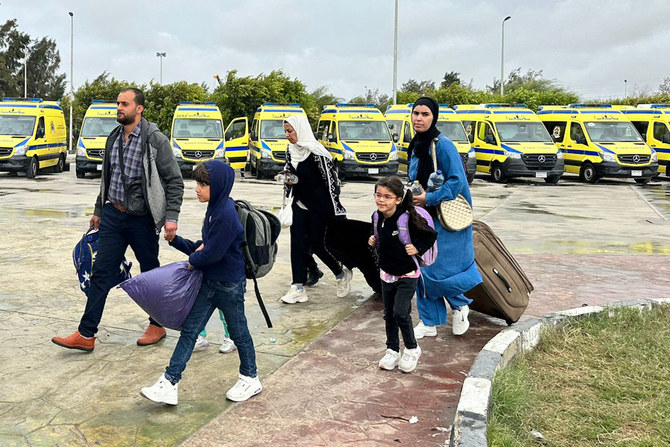
Passengers fleeing the war-torn Gaza Strip arrive to the Egyptian side of the Rafah border crossing with the Palestinian territory. (File/AFP)
Short Url
Updated 20 November 2023
Follow

British citizens in Gaza criticize government over repatriation rule

  • NHS surgeon’s family ‘shocked’ when told they would have to split up temporarily
  • ‘They didn’t have a plan,’ Dr. Ahmad Abou-Foul says

LONDON: Relatives of British citizens recently evacuated from Gaza, as well as those awaiting repatriation, have criticized the government’s repatriation guidelines.

Ahmad Abou-Foul, a National Health Service surgeon, and members of his family crossed from Gaza into Egypt on Nov. 3. But he said they were shocked when UK immigration officers in Cairo advised those with British passports to return to the UK with their children and once there begin the reunification process for their Palestinian spouses.

“They were asking us to split a four-month-old from his mother, and a one-year-old and two-year-old,” he told The Guardian.

“We were shocked. Probably they didn’t have a plan. This is what we felt.”

Abou-Foul paid £16,000 ($20,000) for visas for three adults and two children. The family was given no guidance or information about fee waivers and told to arrange their return at their own expense, he said.

In some repatriation cases, individuals have had their visa fees waived, The Guardian reported.

After weeks of Israeli bombardment that has killed more than 12,000 civilians, the family asked why their evacuation had been treated differently to those escaping from Sudan, Ukraine and Afghanistan. Abou-Foul said the family was told that each situation was different.

The Rafah crossing first opened on Nov. 1 to allow foreign nationals and the seriously injured to leave. In the following days, more than half of the British nationals in Gaza had escaped to Egypt.

According to The Guardian, British nationals and their dependents are provided with transport to Cairo and two nights’ accommodation.

While flights home are not paid for, nationals can apply for loans in exchange for the temporary exchange of their passports.

“It’s not easy to afford the cost of the four tickets,” said a British national in Cairo, who asked to remain anonymous.

“I can’t think how I am going to pay back the loan while my medical center is closed, maybe damaged, and we left everything in Gaza.”

For six weeks, the family moved from northern Gaza to Khan Younis, where tens of thousands of people have been forcibly displaced by the Israeli attacks.

The family extended their stay in Egypt after evacuating from Gaza last week while waiting for a visa to be processed for a family member who does not have a British passport.

“Our client and her British family, who were living in Gaza, have fled a war zone where they have survived desperate conditions and witnessed unspeakable violence,” Tessa Gregory, a human rights team partner with Leigh Day, said.

“In these circumstances, the British government should be doing everything within its power to get the family back to the UK as quickly as possible so they can start to rebuild their lives.

“We hope the Foreign Office will now reconsider its policy and cover the costs of flights for this family.”

A government spokesperson told The Guardian: “The safety of British nationals remains a top priority.

“We are working at pace to support British families who have crossed the border into Egypt, making sure any dependents who need a visa can apply for one and that appropriate checks are carried out in a timely manner.”


Bitter pill: Taliban govt shakes up Afghan medicine market

Updated 3 sec ago
Follow

Bitter pill: Taliban govt shakes up Afghan medicine market

  • Afghanistan’s decision to overhaul its medicine market was meant to improve quality and boost domestic production, but industry specialists say the swift changes have led to a litany of problems
KABUL: Afghanistan’s decision to overhaul its medicine market was meant to improve quality and boost domestic production, but industry specialists say the swift changes have led to a litany of problems.
The Taliban authorities announced in November that the decades-long dependency on medicine imports from Pakistan would soon end, a step taken after deadly border clashes with their neighbor.
After the ban came into effect this month, finance ministry spokesman Abdul Qayoom Naseer told AFP that the government urged all importers to find “alternative and legal” sources to replace Pakistani supplies.
Despite a three-month grace period to end existing contracts and clear customs, the shift presents a huge challenge for a country which had imported more than half its medicine from Pakistan.
“Some of the prices have increased, some of them are short (unavailable), it has created a lot of problems for people,” said Mujeebullah Afzali, a pharmacist in the capital, Kabul.
Drugs now have to come from elsewhere, increasing transit time and transport costs, and adding logistical complexities.
The pharmacist said he had begun importing medicine through the Islam Qala crossing on the Iranian border, “which increased the transportation fee 10 to 15 percent.”
Transport costs used to account for six to seven percent of total spending on medicine, but this has now risen to 25 to 30 percent, said a person directly involved in the pharmaceutical industry, speaking to AFP on condition of anonymity due to security concerns.
He estimated that the overall losses to business owners had already reached millions of dollars.
“If a medicine was short in the market before, a call was made to Pakistan, and the medicine was delivered in two to three days,” he said.
Whether legally or not, it was “delivered quickly,” he added.
‘Fill the gap’
The illicit trade in pharmaceuticals was a key driver for the overhaul, according to the health ministry.
“The biggest problem with Pakistani medicine was that we used to receive counterfeit and fake medicines,” ministry spokesman Sharafat Zaman told AFP.
He acknowledged it will take some time to shift the market, saying that officials were working with Iran, India, Bangladesh, Uzbekistan, Turkiye, China and Belarus to source medicine.
“India was second in the market, which means that now, through Indian medicines, we can cover the percentage needed,” Zaman said.
And domestic production of 600 medicines has “solved the problems” of many patients, he said.
Afghanistan already produces a variety of serums including antibiotics, according to manufacturer Milli Shifa Pharmaceutical.
The company makes 100,000 bottles daily and “can double the capability” if demand merits, CEO Nasar Ahmad Taraki told AFP.
While Afghanistan has significantly expanded its pharmaceutical sector, domestic output still only meets a small fraction of the overall demand.
The industry source told AFP that the need to import raw materials, the high energy costs and limited infrastructure mean the country cannot be entirely self-sufficient in medicine production.
“If we are provided with the facilities, then we would be able to fill the gap created by Pakistan’s situation,” he said.
Shortages and higher costs
But reshaping an industry nationwide takes more than three months.
Some drugs made in Afghanistan have proven more expensive than those imported from Pakistan, which over the years have gained consumers’ trust.
Some people believe that “if they use Pakistani medicine, they will be cured” — but not if it came from India “or any other country,” the industry source said.
Physicians, meanwhile, are also struggling, a health care provider in Kabul told AFP.
Doctors “must change prescriptions, find suitable alternatives, and spend additional time adjusting treatment plans,” he said, requesting anonymity for security reasons.
The shake-up, which ultimately is meant to end reliance on Pakistan, is complicating care in the short term and could delay treatment, he warned.
“Patients face medicine shortages, frequent switches to alternative products, and sometimes higher costs.”
