

British citizens in Gaza criticize government over repatriation rule

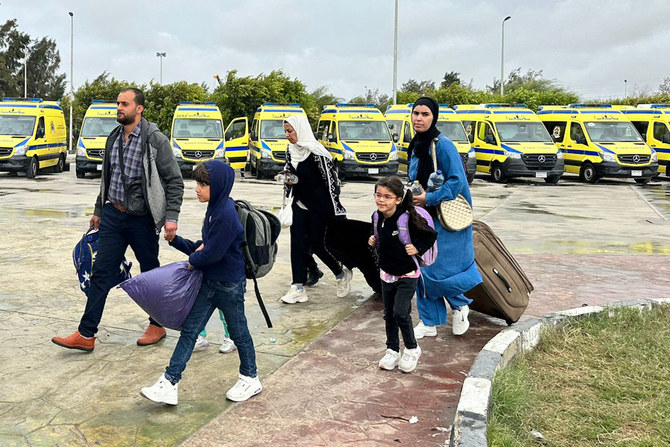
Passengers fleeing the war-torn Gaza Strip arrive to the Egyptian side of the Rafah border crossing with the Palestinian territory. (File/AFP)
Short Url
Updated 20 November 2023
Follow

British citizens in Gaza criticize government over repatriation rule

  • NHS surgeon’s family ‘shocked’ when told they would have to split up temporarily
  • ‘They didn’t have a plan,’ Dr. Ahmad Abou-Foul says

LONDON: Relatives of British citizens recently evacuated from Gaza, as well as those awaiting repatriation, have criticized the government’s repatriation guidelines.

Ahmad Abou-Foul, a National Health Service surgeon, and members of his family crossed from Gaza into Egypt on Nov. 3. But he said they were shocked when UK immigration officers in Cairo advised those with British passports to return to the UK with their children and once there begin the reunification process for their Palestinian spouses.

“They were asking us to split a four-month-old from his mother, and a one-year-old and two-year-old,” he told The Guardian.

“We were shocked. Probably they didn’t have a plan. This is what we felt.”

Abou-Foul paid £16,000 ($20,000) for visas for three adults and two children. The family was given no guidance or information about fee waivers and told to arrange their return at their own expense, he said.

In some repatriation cases, individuals have had their visa fees waived, The Guardian reported.

After weeks of Israeli bombardment that has killed more than 12,000 civilians, the family asked why their evacuation had been treated differently to those escaping from Sudan, Ukraine and Afghanistan. Abou-Foul said the family was told that each situation was different.

The Rafah crossing first opened on Nov. 1 to allow foreign nationals and the seriously injured to leave. In the following days, more than half of the British nationals in Gaza had escaped to Egypt.

According to The Guardian, British nationals and their dependents are provided with transport to Cairo and two nights’ accommodation.

While flights home are not paid for, nationals can apply for loans in exchange for the temporary exchange of their passports.

“It’s not easy to afford the cost of the four tickets,” said a British national in Cairo, who asked to remain anonymous.

“I can’t think how I am going to pay back the loan while my medical center is closed, maybe damaged, and we left everything in Gaza.”

For six weeks, the family moved from northern Gaza to Khan Younis, where tens of thousands of people have been forcibly displaced by the Israeli attacks.

The family extended their stay in Egypt after evacuating from Gaza last week while waiting for a visa to be processed for a family member who does not have a British passport.

“Our client and her British family, who were living in Gaza, have fled a war zone where they have survived desperate conditions and witnessed unspeakable violence,” Tessa Gregory, a human rights team partner with Leigh Day, said.

“In these circumstances, the British government should be doing everything within its power to get the family back to the UK as quickly as possible so they can start to rebuild their lives.

“We hope the Foreign Office will now reconsider its policy and cover the costs of flights for this family.”

A government spokesperson told The Guardian: “The safety of British nationals remains a top priority.

“We are working at pace to support British families who have crossed the border into Egypt, making sure any dependents who need a visa can apply for one and that appropriate checks are carried out in a timely manner.”


Ugandan opposition denounces ‘military state’ ahead of election

Updated 5 sec ago
Follow

Ugandan opposition denounces ‘military state’ ahead of election

KAMPALA: As dark clouds gathered overhead, young and old members of Uganda’s long-embattled opposition gathered for prayers at the home of an imprisoned politician — the mood both defiant and bleak.
The mayor of Kampala, Erias Lukwago, told the gathering on Sunday that this week’s election was a “face off” between ordinary Ugandans and President Yoweri Museveni.
“All of you are in two categories: political prisoners and potential political prisoners,” he said.
Museveni is widely expected to extend his 40-year rule of the east African country in Thursday’s election, thanks to his near-total control of the state and security apparatus.
The 81-year-old came to power as a bush fighter in the 1980s and has maintained a militarised control over the country, brutally cracking down on challengers.
The latest campaign has seen hundreds of opposition supporters arrested and at least one killed, with the police claiming they are confronting “hooligans.”
The main opposition candidate Bobi Wine, real name Robert Kyagulanyi, is rarely seen in public without his flak jacket and has described the campaign as a “war.”
He has been arrested multiple times in the past and tortured in military custody.
The only other significant opposition leader, Kizza Besigye, was kidnapped in Kenya in 2024 and secretly smuggled to a Ugandan military prison to face treason charges in a case that has dragged on for months.
His wife, UNAIDS director Winnie Byanyima, hosted Sunday’s prayer meeting at their home. She said Uganda has only a “thin veneer” of democracy.
“We are really a military state,” she told AFP. “There’s total capture of state institutions by the individual who holds military power, President Museveni.”

Police ‘not neutral’

“The police officers I have met have never looked at themselves as neutral,” said Jude Kagoro, a researcher at the University of Bremen who has spent more than a decade studying African police.
Most officers view it as their duty to support the incumbent power, he said, and often require no explicit order to use brute force on opposition rallies.
Museveni’s regime has used many strategies to infiltrate and divide opposition groups, including through handouts to different ethnic groups.
Under a system informally known as “ghetto structures,” security officials recruit young people in opposition areas who “work for the police to disorganize opposition activities, and also to spy,” said Kagoro.
The government was taken by surprise when Wine burst on to the political scene ahead of the 2021 election, becoming the voice of the urban youth, and responded with extreme violence.
Similarly, Tanzania’s authoritarian government was caught unawares when protests broke out over rigging in last October’s election, and security forces responded by killing hundreds.
The Ugandan government is better prepared now.
“For the last four-plus years, they have been building an infrastructure that can withstand any sort of pressure from the opposition,” said Kagoro.
“We are used to the military and the police on the streets during elections.”

‘Too dangerous’

Still, the authorities are not taking any chances. Citizens are being told to vote and return home immediately.
“The regime wants to make people very scared so they don’t come out to vote,” said David Lewis Rubongoya, secretary-general of Wine’s National Unity Platform.
There has been a spate of arrests and abductions targeting the opposition — a tactic also increasingly used in neighboring Kenya and Tanzania — with rights groups accusing the east African governments of coordinating their repression.
The violence makes it hard for opposition groups to organize.
“The price people have to pay for engaging in political opposition has become very high,” said Kristof Titeca, a Uganda expert based at Antwerp University.
“What’s left is a group of core supporters. Is there a grassroots opposition? No, there isn’t. It’s way too dangerous.”