NAIROBI, Kenya: Heavy fighting Sunday in a disputed region claimed by both Sudan and South Sudan killed at least 32 people, including a UN peacekeeper, authorities said.
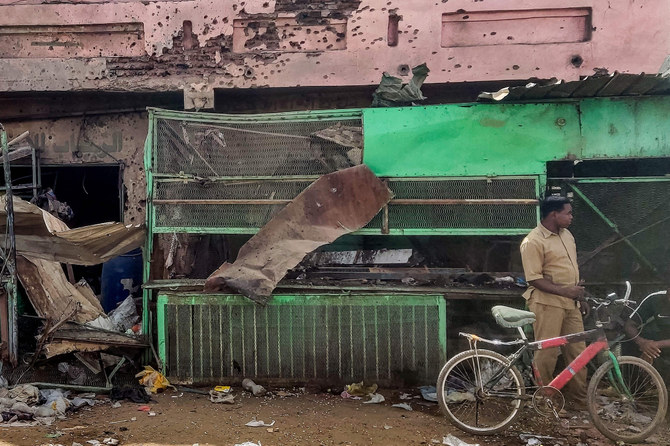
The civilians and a Ghanaian soldier serving with a peacekeeping force died when unknown gunmen attacked two villages in the southern part of the Abyei administrative region, local media reported.
A South Sudanese radio station, Eye Radio Juba, quoted Abyei information minister Bolis Kuoch as saying 32 people were killed and 20 others wounded, “but the clashes have now stopped and the situation calmed down.”
Inter-communal and cross-border clashes have escalated since South Sudan deployed its troops to the contested territory in March. The peacekeeping mission there condemned the troop deployment, saying it would create “untold suffering and humanitarian concerns” for civilians.
International solders were sent to Aleel and Rum Ameer counties as part of the UN Interim Security Force for Abyei to help quell the growing conflict.
The Security Council last week voted unanimously to renew UNIFSA’s mandate until Nov. 15, 2024.
Earlier this month, the UN special envoy for the Horn of Africa, Hanna Serwaa Tetteh warned that the “unprecedented” 7-month war between Sudan’s army and a rival paramilitary force was getting closer to South Sudan and the Abyei region.
The UN says more than 9,000 people have been killed since the conflict erupted in mid-April, displacing millions of people within Sudan and into neighboring countries.
Sudan and South Sudan have disagreed over control of the oil-rich Abyei region since South Sudan gained independence from Sudan after a 2005 peace deal ended decades of civil war between Sudan’s north and south.
The deal called for both sides to settle the final status of Abyei through negotiations, but it has never been implemented.


32 killed in an attack in disputed Abyei region in Sudan
https://arab.news/ncknb
32 killed in an attack in disputed Abyei region in Sudan

- Unknown gunmen attacked two villages in the southern part of the Abyei administrative region


UN humanitarian chief’s fresh funding call as Sudan crisis passes 1,000 days amid famine, mass displacement
- ‘Today we are signaling that the international community will work together to bring this suffering to an end,’ Tom Fletcher tells fundraising event in Washington
- Sudan is a central pillar of the UN’s global humanitarian plan for 2026, which aims to save 87m lives worldwide, he adds
NEW YORK CITY: The UN on Tuesday launched a renewed appeal for funding and the political backing to address what it described as the catastrophic humanitarian crisis in Sudan, which has now been locked in civil war for more than 1,000 days.
Speaking at a fundraising event for Sudan in Washington, organized by the US Institute for Peace, the UN under-secretary-general for humanitarian affairs, Tom Fletcher, said the scale of the suffering in Sudan had reached intolerable levels marked by famine, mass displacement and widespread sexual violence against women and girls.
“The horrific humanitarian crisis in Sudan has endured more than 1,000 days — too long,” he said. “Too many days of famine, of brutal atrocities, of lives uprooted and destroyed.”
The global community was now united in its desire to halt the suffering and ensure life-saving aid reaches those most in need, Fletcher said.
“Today we are signaling that the international community will work together to bring this suffering to an end,” he added.
Sudan is a central pillar of the UN’s global humanitarian plan for 2026, which aims to save 87 million lives worldwide, Fletcher explained as he thanked donors, including the US, the EU and the UAE, for stepping forward.
“Sudan is the most important component of that plan,” he said, noting that humanitarian operations there have been chronically underfunded and plagued by danger. “We have lost hundreds of colleagues in Sudan, colleagues of incredible courage.”
The UN plans to provide food, medicine, water and sanitation services to more than 14 million people across Sudan this year, as well as protection for vulnerable groups, Fletcher said.
He stressed that funding alone would not be sufficient, however, and called for stronger measures to protect civilians and aid workers, secure humanitarian access and support a temporary truce between the warring factions.
“The money is not enough,” he said. “We need the air assets, the security, the medical support for our teams, and the mediation work that has to underpin the access.”
The UN will work, through the Sudan Humanitarian Initiative, with the so-called “Quad” group of international partners (the US, Egypt, Saudi Arabia and the UAE) and others to identify priority areas for urgent action and remove obstacles to the delivery of aid, Fletcher said.
He added that the UN seeks visible progress toward a humanitarian truce in Sudan within the next few weeks, and called for those guilty of any violations in the country to be held accountable.
“We have set a target date of the beginning of Ramadan to make visible progress on this work,” Fletcher said. Ramadan is expected to begin on or around Feb. 17 this year.
Quoting UN Secretary-General Antonio Guterres, he added that the urgency of ending the conflict was growing as the third anniversary of its outbreak on April 15, 2023, approaches.
“The guns must fall silent and a path to peace must be charted,” Fletcher said, adding that the UN fully supports efforts to secure a humanitarian truce and rapidly scale up aid across Sudan.
“Today, we’re saying, ‘Enough.’ Let today be the signal that the world is uniting in solidarity for practical impact.”