

Philippines’ Marcos says Myanmar a difficult problem for ASEAN

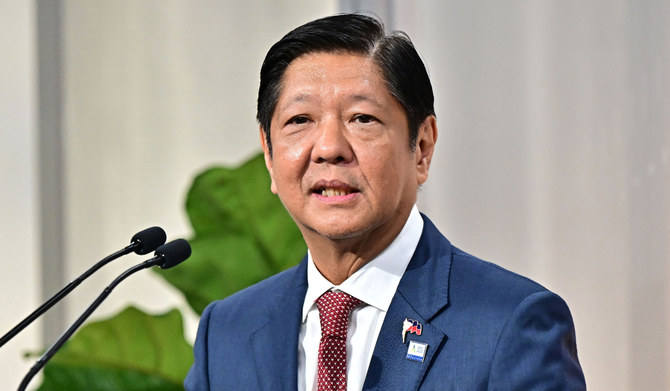
Philippines Presdient Ferdinand Marcos Jr delivers remarks during the Philippines 123 Signing Ceremony during the Asia-Pacific Economic Cooperation (APEC) Leaders' Week in San Francisco, California, on November 16, 2023. (AFP)
Short Url
Updated 20 November 2023
Follow

Philippines’ Marcos says Myanmar a difficult problem for ASEAN

  • The United Nations says more than a million people have been displaced since Myanmar’s military staged a coup in 2021, upending a decade of tentative democracy and plunging the country into conflict and economic ruin

MANILA: The conflict in military-ruled Myanmar has been a difficult issue for the Southeast Asian bloc ASEAN to address, with little progress made toward a resolution and intensifying fighting, Philippines President Ferdinand Marcos said.
Speaking at a forum in Hawaii streamed live in the Philippines on Monday, Marcos said there was commitment from the Association of Southeast Asian Nations (ASEAN), but the issue was complex, including the humanitarian impact.
The United Nations says more than a million people have been displaced since Myanmar’s military staged a coup in 2021, upending a decade of tentative democracy and plunging the country into conflict and economic ruin.
“There is a great deal of impetus for ASEAN to solve this problem. But it is a very, very difficult problem,” Marcos said.
The junta’s post-coup crackdown on opponents gave rise to a resistance movement that has been growing in strength. ASEAN has barred the top generals from attending its meeting until they commit to the bloc’s two-year-old peace roadmap.
The Philippines will chair ASEAN in 2026 after it replaced Myanmar as host that year.
Tens of thousands more people have been displaced since last month as the military battles a coordinated offensive by an alliance of three ethnic-minority groups and pro-democracy fighters.
Marcos, citing analyzes of the recent escalation, said the junta had already lost support from its own military.
He said the humanitarian cost of conflict had “grown exponentially” in recent years, with the Philippines also impacted with its citizens among victims of human trafficking there.


Russia diverts its naphtha from Oman due to Middle Eastern crisis, data shows​

Updated 5 sec ago
Follow

Russia diverts its naphtha from Oman due to Middle Eastern crisis, data shows​

  • Strikes have disrupted energy production and shipping, including naphtha loadings and discharges
  • Since the European Union’s full embargo on Russian oil products took effect in February 2023, most Russian naphtha has been directed to the Middle East and Asia

MOSCOW: Russia has diverted its naphtha cargoes from Oman amid the Middle East crisis as it looks for new buyers, traders said and LSEG data showed, with at least one tanker now heading for Singapore.
Iran’s strikes on Gulf countries in retaliation for Israeli and US strikes against it have disrupted energy production and shipping, including naphtha loadings and discharges.
Since the European Union’s full embargo on Russian oil products took effect in February 2023, most Russian naphtha has been directed to the Middle East and Asia.
Middle Eastern countries are also the top ⁠supplier to Asia ⁠with the recent disruption forcing Asia’s naphtha margin to four-year highs, while at least one South Korean naphtha cracker operator was considering declaring force majeure and another has cut its operating rate by around a fifth.
The Liberia-flagged tanker, Amfitrion, which loaded in February in the Russian Black Sea ⁠port of Novorossiysk destined for Oman, last week halted navigation near the Gulf of Masira and on Tuesday turned for Singapore, according to LSEG data.
Five middle-sized tankers carrying a total 180,000 metric tons of naphtha in January departed Russian ports for an offshore STS (ship-to-ship) berth near Oman’s Shinas, shipping data showed. The final destination of these cargoes remains unknown.
According to data from LSEG and traders, Russia also sent two cargoes to Oman’s Sohar in November-December, ⁠carrying a total ⁠of 190,000 tons of naphtha as its other markets dried up.
India and Taiwan were among the main Asian buyers of Russian naphtha, but recent US sanctions have prompted both countries to pull back. Exports to Venezuela have also fallen to zero this year after US President Donald Trump in December ordered a blockade on all sanctioned oil tankers entering or leaving the Latin American country.
Though Asian buyers face naphtha shortages, Western sanctions could force traders to shun Russian cargoes. The long navigation from Russia’s Baltic ports to Asia also prevents prompt shipments, market sources said.