

Biden says ‘revitalized Palestinian Authority’ should eventually govern Gaza and the West Bank

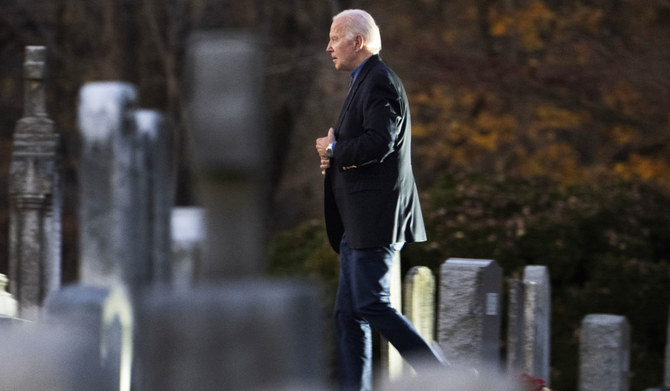
President Joe Biden walks between tombstones as he arrives at St. Joseph on the Brandywine Catholic Church in Wilmington, Del., to attend Mass, Saturday, Nov. 18, 2023. (AP)
Short Url
Updated 19 November 2023
Follow

Biden says ‘revitalized Palestinian Authority’ should eventually govern Gaza and the West Bank

  • The US is providing weapons and intelligence support to Israel as it mounts an offensive into Gaza with the goal of rooting out Hamas following its Oct
  • Demonstrators calling for a cease-fire in Gaza have staged protests around the country, including clashing this week with police outside the headquarters of the Democratic National Committee

WILMINGTON, Delaware: President Joe Biden says that achieving a cease-fire amid Israel’s war with Hamas “is not peace” and that an important key to lasting stability is a reunited Gaza Strip and West Bank that can be governed under “a revitalized Palestinian Authority.”
In an op-ed published Saturday in the Washington Post, Biden reiterated his position of recent weeks that a temporary halt to the fighting wasn’t a real possibility and wouldn’t ultimately advance greater US objectives. The president and top US officials have instead revived talk of working toward a two-state solution for the governance of Gaza.
Biden used the op-ed to offer more details on what the process of working toward that larger goal might look like.
“As we strive for peace, Gaza and the West Bank should be reunited under a single governance structure, ultimately under a revitalized Palestinian Authority, as we all work toward a two-state solution,” Biden wrote. “I have been emphatic with Israel’s leaders that extremist violence against Palestinians in the West Bank must stop, and that those committing the violence must be held accountable.”
He added, “The United States is prepared to take our own steps, including issuing visa bans against extremists attacking civilians in the West Bank.”
The US is providing weapons and intelligence support to Israel as it mounts an offensive into Gaza with the goal of rooting out Hamas following its Oct. 7 attack, which killed more than 1,200 people. Biden has spoken repeatedly with Israeli Prime Minister Benjamin Netanyahu and says he’s working for the release of Hamas-held hostages, including some Americans.
At least 11,400 Palestinians have been killed since the war began, according to the Health Ministry in Hamas-ruled Gaza, which does not differentiate between civilian and militant deaths.
Demonstrators calling for a cease-fire in Gaza have staged protests around the country, including clashing this week with police outside the headquarters of the Democratic National Committee. Former campaign staffers who helped elect Biden in 2020, as well as current members of his administration, have signed letters urging a cease-fire. In the op-ed, Biden explained why he opposes the idea.
“As long as Hamas clings to its ideology of destruction, a cease-fire is not peace,” he wrote. “To Hamas’ members, every cease-fire is time they exploit to rebuild their stockpile of rockets, reposition fighters and restart the killing by attacking innocents again.”
Biden also noted that “an outcome that leaves Hamas in control of Gaza would once more perpetuate its hate and deny Palestinian civilians the chance to build something better for themselves.”
The president further argued that working to achieve longer-range goals that can rise above the current unrest would ultimately make the United States more secure.
“We must never forget the lesson learned time and again throughout our history: Out of great tragedy and upheaval, enormous progress can come,” he wrote. “More hope. More freedom. Less rage. Less grievance. Less war. We must not lose our resolve to pursue those goals, because now is when clear vision, big ideas and political courage are needed most.”


Geoeconomic confrontation tops global risks in 2026: WEF report

Updated 4 sec ago
Follow

Geoeconomic confrontation tops global risks in 2026: WEF report

  • Also armed conflict, extreme climate, public polarization, AI
  • None ‘a foregone conclusion,’ says WEF’s MD Saadia Zahidi

DUBAI: Geoeconomic confrontation has emerged as the top global risk this year, followed by state-based armed conflict, according to a new World Economic Forum report.

The Global Risks Report 2026, released on Wednesday, found that both risks climbed eight places year-on-year, underscoring a sharp deterioration in the global outlook amid increased international competition.

The top five risks are geoeconomic confrontation (18 percent of respondents), state-based armed conflict (14 percent), extreme weather events (8 percent), societal polarization (7 percent) and misinformation and disinformation (7 percent).

The WEF’s Managing Director Saadia Zahidi said the report “offers an early warning system as the age of competition compounds global risks — from geoeconomic confrontation to unchecked technology to rising debt — and changes our collective capacity to address them.

“But none of these risks are a foregone conclusion.”

The report assesses risks across three timeframes: immediate (2026); short-to-medium term (next two years); and long term (next 10 years).

Economic risks show the largest overall increase in the two-year outlook, with both economic downturn and inflation jumping eight positions.

Misinformation and disinformation rank fifth this year but rise to second place in the two-year outlook and fourth over the 10-year horizon.

The report suggests this reflects growing anxiety around the rapid adoption of artificial intelligence, with adverse outcomes linked to AI surging from 30th place in the two-year timeframe to fifth in the 10-year outlook.

Uncertainty dominates the global risk outlook, according to the report.

Surveyed leaders and experts view both the short- and long-term outlook negatively, with 50 percent expecting a turbulent or stormy global environment over the next two years, rising to 57 percent over the next decade.

A further 40 percent and 32 percent, respectively, describe the outlook as unsettled across the two- and 10-year timeframes, while just 1 percent anticipate a calm global outlook in either period.

Environmental risks ease slightly in the short-term rankings. Extreme weather fell from second to fourth place and pollution from sixth to ninth. Meanwhile, critical changes to Earth systems and biodiversity loss dropped seven and five positions, respectively.

However, over the next decade, environmental threats re-emerge as the most severe, with extreme weather, biodiversity loss, and critical changes to Earth systems topping the global risk rankings.

Looking ahead over the next decade, around 75 percent of respondents anticipate a turbulent or stormy environmental outlook, making it the most pessimistic assessment across all risk categories.

Zahidi said that “the challenges highlighted in the report underscore both the scale of the potential perils we face and our shared responsibility to shape what comes next.”

Despite the gloomy outlook, Zahidi signaled a positive shift in global cooperation.

 “It is also clear that new forms of global cooperation are already unfolding even amid competition, and the global economy is demonstrating resilience in the face of uncertainty.”

Now in its 21st year, the Global Risks Report highlights a core message: global risks cannot be managed without cooperation.

As competition intensifies, rebuilding trust and new forms of collaboration will be critical, with the report stressing that today’s decisions will shape future outcomes.

The report was released ahead of WEF’s annual meeting, which will be held in Davos from Jan. 19 to 23.