Video of Israeli soldier hurling grenade in West Bank village mosque goes viral

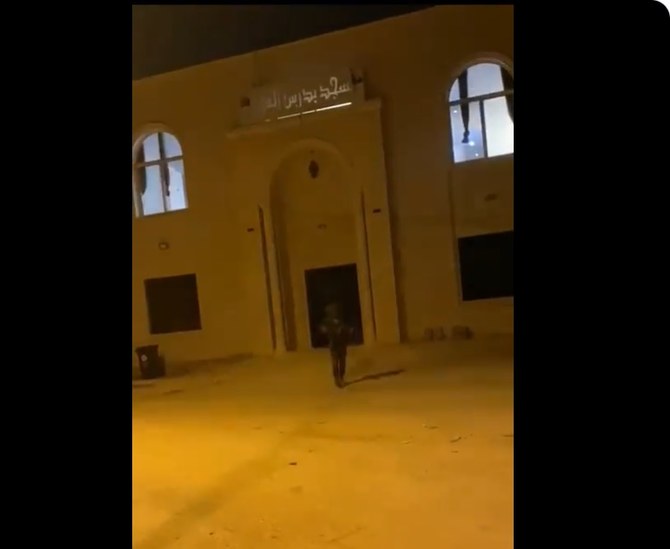
A screengrab taken from a video that shows an IDF soldier asking someone to film him tossing a stun grenade inside the Budrus Grand Mosque in a village in the occupied West Bank. (X/@mobeid)
Short Url
Updated 18 November 2023
Follow

Video of Israeli soldier hurling grenade in West Bank village mosque goes viral

  • Media claims he was suspended over ‘serious incident that goes against the values of the IDF’
  • Village official describes incident as ‘blatant violation’ of building’s sanctity

BEIRUT: An Israeli soldier who was viewed by millions on social media hurling a stun grenade in a village mosque in the West Bank has been reportedly suspended by the Israel Defense Forces.
In an 18-second video that went viral across thousands of social media handles, the IDF soldier was seen asking someone to film him tossing the stun grenade inside Budrus’ Grand Mosque.
The call for Fajr (sunrise) prayer can be heard in the background of the video while the soldier walks toward the mosque’s entrance. He then hurls the grenade that can be heard exploding.
Israeli media reported that the IDF had published a statement confirming the soldier’s suspension.
“This is a serious incident that goes against the values of the IDF,” the military was reported as saying in a statement.
“Upon learning of the incident, the soldier was suspended from his post. He will be thoroughly investigated and (disciplined) accordingly.”
It was assumed that the undated incident happened in Budrus village in the West Bank, based on the mosque’s name seen in the video.
Some Israeli media said that the incident happened two Fridays ago but that could not be independently verified.
The soldier is seen heading back toward the camera at the end of the video, while the call for prayer goes silent and filming finishes.
Al-Quds Al-Arabi website quoted Nasser Marar, the village’s council chairman, as saying: “The incident happened at Fajr prayer on a Friday at Budrus Grand Mosque.
“The soldier tossed the grenade during the call for prayer, shortly before worshippers started arriving at the mosque, in blatant violation of its sanctity.”
Marar added that no one had been injured in the incident.
Palestinian journalist Mohammed Abu Obeid reposted the video on X, and said: “How will the Israeli Representative to the United Nations Gilad Erdan explain this behavior?”


Lebanon approves financial gap draft law despite opposition from Hezbollah and Lebanese Forces

Lebanon's Prime Minister Nawaf Salam speaking during a press conference after a cabinet session in Beirut on December 26, 2025.
Updated 21 min 28 sec ago
Follow

Lebanon approves financial gap draft law despite opposition from Hezbollah and Lebanese Forces

  • Legislation aims to address the fate of billions of dollars in deposits that have been inaccessible to Lebanese citizens during the country’s financial meltdown

BEIRUT: Lebanon’s Cabinet on Friday approved a controversial draft law to regulate financial recovery and return frozen bank deposits to citizens. The move is seen as a key step in long-delayed economic reforms demanded by the International Monetary Fund.

The decision, which passed with 13 ministers voting in favor and nine against, came after marathon discussions over the so-called “financial gap” or deposit recovery bill, stalled for years since the banking crisis erupted in 2019. The ministers of culture and foreign affairs were absent from the session.

The legislation aims to address the fate of billions of dollars in deposits that have been inaccessible to Lebanese citizens during the country’s financial meltdown.

The vote was opposed by three ministers from the Lebanese Forces Party, three ministers from Hezbollah and the Amal Movement, as well as the minister of youth and sports, Nora Bayrakdarian, the minister of communications, Charles Al-Hajj, and the minister of justice, Adel Nassar.

Finance Minister Yassin Jaber broke ranks with his Hezbollah and Amal allies, voting in favor of the bill. He described his decision as being in line with “Lebanon’s supreme financial interest and its obligations to the IMF and the international community.”

The draft law triggered fierce backlash from depositors who reject any suggestion they shoulder responsibility for the financial collapse. It has also drawn strong criticism from the Association of Banks and parliamentary blocs, fueling fears the law will face intense political wrangling in Parliament ahead of elections scheduled in six months.

Prime Minister Nawaf Salam confirmed the Cabinet had approved the bill and referred it to Parliament for debate and amendments before final ratification. Addressing public concerns, he emphasized that the law includes provisions for forensic auditing and accountability.

“Depositors with accounts under $100,000 will be repaid in full with interest and without any deductions,” Salam said. “Large depositors will also receive their first $100,000 in full, and the remainder will be issued as negotiable bonds backed by the assets of the Central Bank, valued at around $50 billion.”

He said further that bondholders will receive an initial 2 percent payout after the first tranche of repayments is completed.

The law also includes a clause requiring criminal accountability. “Anyone who smuggled funds abroad or benefited from unjustified profits will be fined 30 percent,” Salam said.

He emphasized that Lebanon’s gold reserves will remain untouched. “A clear provision reaffirms the 1986 law barring the sale or mortgaging of gold without parliamentary approval,” he said, dismissing speculation about using the reserves to cover financial losses.

Salam admitted that the law was not perfect but called it “a fair step toward restoring rights.”

“The banking sector’s credibility has been severely damaged. This law aims to revive it by valuing assets, recapitalizing banks, and ending Lebanon’s dangerous reliance on a cash economy,” he said. “Each day of delay further erodes people’s rights.”

While the Association of Banks did not release an immediate response after the vote, it previously argued during discussions that the law would destroy remaining deposits. Bank representatives said lenders would struggle to secure more than $20 billion to cover the initial repayment tier and accused the state of absolving itself of responsibility while effectively granting amnesty for decades of financial mismanagement and corruption.

The law’s fate now rests with Parliament, where political competition ahead of the 2025 elections could complicate or delay its passage.

Lebanon’s banking sector has been at the heart of the country’s economic collapse, with informal capital controls locking depositors out of their savings and trust in state institutions plunging. International donors, including the IMF, have made reforms to the sector a key condition for any financial assistance.