Israel must stop using water as a ‘weapon of war,’ UN expert warns

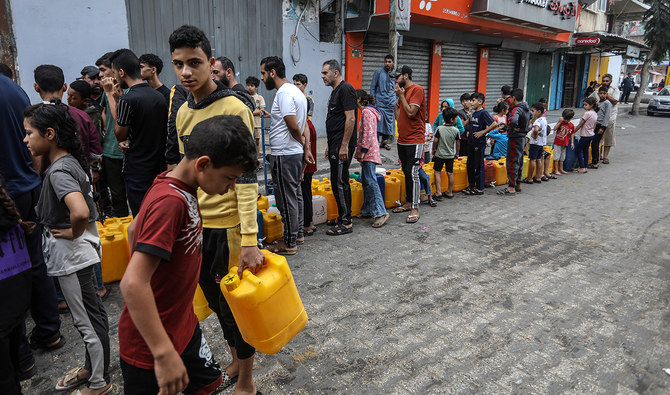
Palestinians, including children, waiting to get clean water from mobile tanks as the Israeli attacks continue in Rafah, Gaza on November 13, 2023. (Reuters)
Short Url
Updated 18 November 2023
Follow

Israel must stop using water as a ‘weapon of war,’ UN expert warns

NEW YORK CITY: Israel must allow clean water and fuel supplies into Gaza “before it is too late,” a UN expert warned on Friday, as he called on Israeli authorities to stop using water as a “weapon of war.”

Under international law, intentionally depriving the civilian population of the conditions required to sustain life with the aim of bringing about their destruction is classified as an act of extermination and a crime against humanity, said Pedro Arrojo-Agudo, the UN’s special rapporteur on the human rights to safe drinking water and sanitation.

“Every hour that passes with Israel preventing the provision of safe drinking water in the Gaza Strip, in brazen breach of international law, puts Gazans at risk of dying of thirst and diseases related to the lack of safe drinking water,” he said.

The UN Relief and Works Agency for Palestine Refugees in the Near East has said that the total exhaustion of fuel supplies in Gaza, and the resulting lack of power, is having devastating effects, including the complete breakdown of water supplies, sewage-management systems, sanitation services, communications networks and healthcare facilities.

“I want to remind Israel that consciously preventing supplies needed for safe water from entering the Gaza Strip violates both international humanitarian and human rights law,” Arrojo-Agudo said.

“The impact on public health and hygiene will be unimaginable and could result in more civilian deaths than the already colossal death toll from the bombardment of Gaza.”

He cautioned that children, especially those under the age of five, and women are suffering the most as a result of the water and sanitation emergency.

“These frequently invisible casualties of war are preventable and Israel must prevent them,” he said. “Israel must stop using water as a weapon of war.”

According to UNRWA, about 70 percent of Gazans are having to drink contaminated water or salt water to survive. Many water-related facilities throughout the besieged territory have ceased operating, including: two of the main public sewage-pumping stations in the south, plus several others; 60 wells in southern Gaza; two main desalination plants, in Rafah and the central Strip; and the Rafah wastewater treatment plant.

“People are already suffering from dehydration and waterborne diseases due to salinated and polluted water consumption from unsafe sources,” Arrojo-Agudo said.

“Coupled with the massive displacement of thousands of people in recent days, this is the perfect scenario for an epidemic that will only punish innocents, once again.”

UNRWA has warned that humanitarian operations will begin to collapse this week as a result of lack of fuel. It is required to power numerous facets of the aid effort, including desalination processes, electricity generation, healthcare equipment, and the trucks used to deliver the crucial aid that arrives at the Rafah border crossing to the people of Gaza.

“The deaths of children from thirst and disease are less visible and more silent than those caused by bombs but are equally, or more, lethal,” Arrojo-Agudo said, as he urged the international community to ensure that Israel meets its obligations under international law.

“The fate of Palestinians in Gaza is in Israel’s hands.”

Special rapporteurs are part of what is known as the special procedures of the UN Human Rights Council. They are independent experts who work on a voluntary basis, are not members of UN staff and are not paid for their work


Israel bars some aid workers from Gaza as groups face suspension

Updated 4 sec ago
Follow

Israel bars some aid workers from Gaza as groups face suspension

  • NGOs ordered to cease operations unless they give employee details to Israel
  • MSF and others denied entry, impacting key medical services in Gaza
GENEVA/CAIRO/JERUSALEM: Israel said on Thursday it had barred entry to Gaza of foreign medical and humanitarian staff whose organizations ​were ordered to cease operations unless they register employee details with Israeli authorities and meet other new rules.
Fearing a renewed humanitarian crisis if medical and aid services can suddenly no longer access war-shattered Gaza, some of the 37 international nongovernmental organizations that were ordered to halt work are weighing whether to submit staff names to Israeli authorities, two aid sources told Reuters.
Three of the aid groups said their foreign staff were told by Israeli authorities this week they could not enter Gaza.
Israel’s diaspora ministry, which manages the registration process, says the measures are meant to prevent diversions of aid by Palestinian armed groups. NGOs say sharing staff details poses too much of a risk, pointing to the hundreds of aid workers who were killed or injured ‌during the two-year ‌Gaza war.
Israel has shared little evidence of aid being diverted in the Palestinian enclave, ‌an ⁠allegation ​that was ‌disputed in a US government analysis.
The diaspora ministry said that while the NGOs had been granted 60 days to conclude operations, “the entry of foreign personnel into Gaza is not approved.” It said international staff with “approved organizations” including the United Nations could continue work as usual.
Three prominent global NGOs — Medecins Sans Frontieres (MSF), Medecins du Monde Suisse and the Danish Refugee Council — said their international staff were refused entry to Gaza this week. Foreign aid staff had generally been permitted to rotate in and out of Gaza since the start of the war.
“If we don’t have somebody in a key position, such as the emergency coordinator in charge of operations, then we either have to ⁠compensate, or we have a gap” in aid service, said Anna Halford, Gaza emergency coordinator at MSF.

'System breaks down'

Israel’s government said some 23 aid groups ‌had agreed to the new registration rules, meaning humanitarian goods will continue to get ‍into Gaza.
But a UN-led coordination body has said the ‍international groups that have registered could meet only a fraction of the required humanitarian response in the devastated Gaza Strip, where ‍homelessness and hunger remain rife.
Some of the 37 banned groups operate specialized services like field hospitals, aid officials say. MSF bolsters six Gaza health ministry hospitals and runs two field hospitals. The Medicos del Mundo NGO screens Gaza residents for malnutrition and provides mental health services.
“Without nutritional staff doing the screening and primary health care centers doing the therapeutic feeding and referral of patients with severe malnutrition to in-patient care — the whole system ​breaks down,” an aid source told Reuters.
Fearing the loss of those essential services for Gaza’s two million residents, some aid groups are considering reversing course and agreeing to the new registration rules.
“The essence of ⁠the debate (for aid groups) is how to safeguard their principles, humanitarian standards, and the safety of the local staff while being able to continue the services,” a senior aid source said.
COGAT, the Israeli defense ministry unit that controls access to Gaza, said the NGOs’ conduct “raises suspicion regarding the parties with whom they operate” in Gaza, but they remained free to register with the diaspora ministry.

'Everything is missing'

Samira Al-Ashqar, 40, who fled her Beit Lahia home to Al-Ansar camp in north Gaza with her disabled husband and nine others during the war, depends on Oxfam — one of the aid groups facing an Israeli ban — for food and financial support.
“Now, after the war, everything is missing, and things have become dire ... If these institutions were to stop, the people of Gaza would face complete devastation,” Al-Ashqar said.
Mohamed Abu Selmia, head of Gaza’s Al Shifa Hospital, told Reuters the banning of groups like MSF could affect hundreds of thousands of people.
“The Israeli occupation’s decision comes at a time of unprecedented deterioration in health conditions. We suffer acute shortages of medication that ‌reach 100 percent in some areas, and 55 percent overall,” he said.
MSF said an Israeli ban could also mean that foreign aid groups would no longer be able to pay local staff in Gaza because Israel could block bank transfers.