

Pakistan prepares to launch digital platform to attract investors with online-only broker licenses

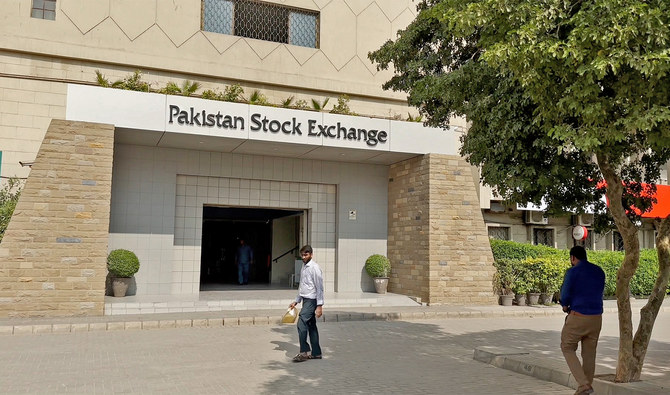
A man walks past the building of Pakistan Stock Exchange in Karachi, Pakistan on November 17, 2023. (AN photo)
Short Url
Updated 17 November 2023
Follow

Pakistan prepares to launch digital platform to attract investors with online-only broker licenses

  • The plan to rely on electronic means to encourage investment comes as PSX witnesses 80% account opening online
  • PSX will soon begin to auction government debt securities like treasury bills, making it easier for the public to invest

KARACHI: Pakistan’s equity market and securities watchdog are all set to launch a one-window digital platform to issue online-only broker licenses in a bid to attract new investors, including venture capitalists (VCs), fintechs, and other startups, said a senior stock exchange official on Thursday.

The Securities and Exchange Commission of Pakistan (SECP) approved a regulatory framework for online-only brokers earlier this year in May by amending the Pakistan Stock Exchange (PSX) Rulebook.

The platform, named Online-Only Broker License, is designed to ensure customer onboarding, trade execution and provision of support services through electronic means only.

“This is an opportunity to set up a unique and different business model for the brokerage industry,” Raeda Latif, head of marketing and business development at PSX, told Arab News on the sidelines of an event to comprehensively explain the initiative.


Pakisan Stock Exchange's managing director, Farrukh Khan (left), and head of marketing and business development, Raeda Latif, chair a meeting in Karachi, Pakistan on November 17, 2023. (AN photo)

Latif explained that investors interested in fintechs providing payment solutions and looking to expand their presence in Pakistan’s domestic investment environment can opt for this license.

“They can set up their own businesses,” she added. “Even VCs can invest in potential startups or [fund] entrepreneurs who are looking to establish their business in the brokerage industry.”

The PSX official remarked that the platform would be “very agile” and provide a lean model, allowing companies to conduct their entire business digitally, including reaching out to investors, placing orders, executing trades and closing accounts.

The online brokers would require a PSX Trading Right Entitlement Certificate (TRE) by submitting a fee of Rs1.25 million and demonstrating a minimum net worth of Rs7.50 million.

They will also have to pay Rs50,000 to secure a license from the SECP.

Latif noted that recently, over 80 percent of investor accounts at PSX had been opened online, with 60 percent from various small cities in the country.

Speaking at the occasion, PSX managing director Farrukh H. Khan said the stock exchange would also facilitate the auction of government debt securities like treasury bills and Pakistan Investment Bonds (PIBs), allowing the general public to invest in them by using small amounts.

“With the auction of the government debt securities, the common man will be able to invest and trade in the securities with small investments,” he told the media.

Khan informed the PSX and the State Bank of Pakistan (SBP) would jointly float debt securities soon.

Currently, the government debt securities are only auctioned by the SBP through a network of about 10 banks working as primary dealers, which the SBP also regulates.

The PSX chief said that all 200 stockbrokers and some 40 Pakistani banks would participate in the buying and selling of government debt securities at the bourse after the initiative was implemented.

Khan also maintained that Pakistan’s equity market was performing well, trading at new all-time highs following recent policy measures taken by the government to fulfill the International Monetary Fund’s conditions and an expected fall in interest rates.


Arab food and beverage sector draws $22bn in foreign investment over 2 decades: Dhaman 

Updated 28 December 2025
Follow

Arab food and beverage sector draws $22bn in foreign investment over 2 decades: Dhaman 

JEDDAH: Foreign investors committed about $22 billion to the Arab region’s food and beverage sector over the past two decades, backing 516 projects that generated roughly 93,000 jobs, according to a new sectoral report. 

In its third food and beverage industry study for 2025, the Arab Investment and Export Credit Guarantee Corp., known as Dhaman, said the bulk of investment flowed to a handful of markets. Egypt, Saudi Arabia, the UAE, Morocco and Qatar attracted 421 projects — about 82 percent of the total — with capital expenditure exceeding $17 billion, or nearly four-fifths of overall investment. 

Projects in those five countries accounted for around 71,000 jobs, representing 76 percent of total employment created by foreign direct investment in the sector over the 2003–2024 period, the report said, according to figures carried by the Kuwait News Agency. 

“The US has been the region's top food and beverage investor over the past 22 years with 74 projects or 14 projects of the total, and Capex of approximately $4 billion or 18 percent of the total, creating more than 14,000 jobs,” KUNA reported. 

Investment was also concentrated among a small group of multinational players. The sector’s top 10 foreign investors accounted for roughly 15 percent of projects, 32 percent of capital expenditure and 29 percent of newly created jobs.  

Swiss food group Nestlé led in project count with 14 initiatives, while Ukrainian agribusiness firm NIBULON topped capital spending and job creation, investing $2 billion and generating around 6,000 jobs. 

At the inter-Arab investment level, the report noted that 12 Arab countries invested in 108 projects, accounting for about 21 percent of total FDI projects in the sector over the past 22 years. These initiatives, carried out by 65 companies, involved $6.5 billion in capital expenditure, representing 30 percent of total FDI, and generated nearly 28,000 jobs. 

The UAE led inter-Arab investments, accounting for 45 percent of total projects and 58 percent of total capital expenditure, the report added, according to KUNA. 

The report also noted that the UAE, Saudi Arabia, Egypt, and Qatar topped the Arab ranking as the most attractive countries for investment in the sector in 2024, followed by Oman, Bahrain, Algeria, Morocco, and Kuwait. 

Looking ahead, Dhaman expects consumer demand to continue rising. Food and non-alcoholic beverage sales across 16 Arab countries are projected to increase 8.6 percent to more than $430 billion by the end of 2025, equivalent to 4.2 percent of global sales, before exceeding $560 billion by 2029. 

Sales are expected to remain highly concentrated geographically, with Egypt, Saudi Arabia, Algeria, the UAE and Iraq accounting for about 77 percent of the regional total. By product category, meat and poultry are forecast to lead with sales of about $106 billion, followed by cereals, pasta and baked goods at roughly $63 billion. 

Average annual per capita spending on food and non-alcoholic beverages in the region is projected to rise 7.2 percent to more than $1,845 by the end of 2025, approaching the global average, and to reach about $2,255 by 2029. Household spending on these products is expected to represent 25.8 percent of total expenditure in 13 Arab countries, above the global average of 24.2 percent. 

Arab external trade in food and beverages grew more than 15 percent in 2024 to $195 billion, with exports rising 18 percent to $56 billion and imports increasing 14 percent to $139 billion. Brazil was the largest foreign supplier to the region, exporting $16.5 billion worth of products, while Saudi Arabia ranked as the top Arab exporter at $6.6 billion.