

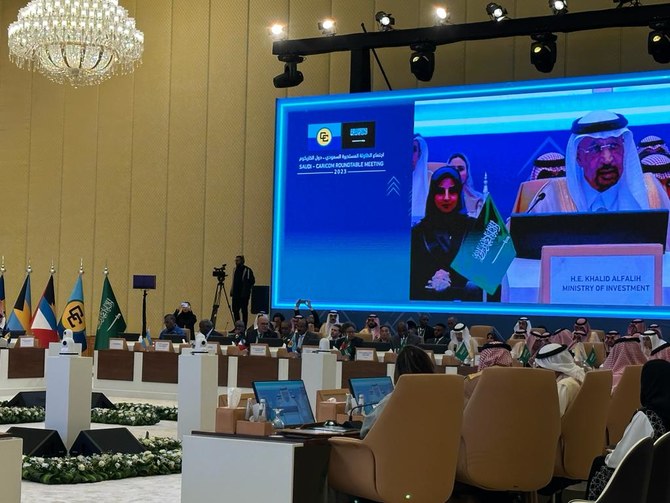

RIYADH: Saudi Arabia is keeping a “keen eye” on investment opportunities in the Caribbean, one of the Kingdom’s leading ministers told a conference in Riyadh.
Tourism Minister Ahmed Al-Khateeb was one of a number of officials, heads of state and key players from the private sector at the event, which focused on deepening bilateral relations and facilitating new partnerships between the Kingdom and the 15-member Caribbean Community organization.
Among the attendees were prominent Saudi private sector entities, including the Public Investment Fund, Aramco, Saudi National Bank, SABIC and the Saudi Fund for Development.
Addressing the event, Al-Khateeb said: “We want to build steps by connecting you with Saudi investors ... with a keen eye on investing in your region.”
SFD has already employed $670 million in the CARICOM region, with $200 billion worth of projects currently under discussion, said Saudi Minister of State for Foreign Affairs Adel Al-Jubeir at the summit.
“The Caribbean is a high-priority economic investment and business opportunity for Saudi Arabia,” said Saudi Investment Minister Khalid Al-Falih while inaugurating the summit.
He added: “The partnership between the Kingdom and CARICOM is marked by a new and exciting chapter with the historic and important inaugural Saudi-CARICOM Roundtable Meeting.”
The event came as SFD CEO Sultan Al-Marshad signed two developmental memoranda of understanding with Saint Vincent and the Grenadines and St. Kitts and Nevis.
The deal signed with Saint Vincent and the Grenadines involves providing $50 million to finance the rehabilitation projects of several buildings and facilities affected by natural disasters.
The fund added that financing this project will restore essential infrastructure and enhance the nation’s economic resilience.
Under the second deal, the fund will allocate $40 million to the Needsmust Power Plant expansion project in Saint Kitts and Nevis. This initiative is focused on bolstering the energy sector, improving energy quality and access to its people.
During the forum, Al-Marshad noted that the Saudi Fund has been working with and giving long-term loans to CARICOM nations for over four decades, with over 25 projects in different sectors spanning education, health, and energy to logistics services.
Looking to the future, he added that the body is ready to prioritize CARICOM’s development priorities as it has technical teams ready to be mobilized to the respective countries to evaluate their development projects and help aid the preparation needed for the required loan approval.
Tourism has played a critical role in the Caribbean economy and has attracted many investors. According to the financial services group BDA Aruba, the sector accounts for about 20 percent of the gross domestic product of all 34 countries in the region.
The Caribbean is also dependent on tourism for foreign exchange and is responsible for about 10 percent of exports to Ecuador and Peru.
To further boost the ties between countries in the region and Saudi Arabia, the Minister of Investment said the country will discuss implementing a direct flight from the Kingdom to Caribbean nations through its newly established airline, Riyadh Air.
The chairman of CARICOM, Roosevelt Skerrit, added that a direct 12-hour flight between Saudi Arabia and the Caribbean was successfully tested on Nov. 15 to serve as a potential “gateway” to South America.
“The Caribbean, though we are small island developing states, we have tremendous opportunities for significant investments (as) where we are located we have great logistics opportunities for shipping and for air connectivity,” said the Prime Minister of Jamaica, Andrew Holness.
He added that the countries have “incredible opportunities in tourism” as they have a multitude of undiscovered gems that they hope will serve as a hub for Saudi investment.
“If we are to focus on investment as the strategic direction for development, our investors can rest assured that the entire region has made commitments for strengthening and deepening our institutional frameworks to protect investment,” said Holness.
In the presence of major players in the renewable energy field, the minister of state utilized the forum to call for collaboration between the states in the lead-up to COP 28 and beyond.
Saudi Arabia’s ACWA Power Chairman and founder Mohammad Abunayyan took to the forum to note that as the world’s most competitive and biggest storage of renewable energy, the company is “more than happy” to share its technology, capacity and expertise with Caribbean countries.
He added that ACWA Power is the world’s largest desalination company, producing 7.6 million cubic meters daily.
It was further noted that it has invested in 14 countries in renewable desalination and, most recently, green hydrogen, with $78 billion in assets under management and over 50 gigawatts of power produced.
Adel Al-Jubeir, who serves as the Saudi climate envoy, used his address to the forum to insist the Kingdom remains committed to the Paris Agreement, which ensures climate change equity and access to renewable energy for developing countries most susceptible to the adverse effects of global warming.
“We share a very strong bond with your nations and we also believe in providing assistance and support to countries that have been affected by climate change. And we have done so in a really lateral basis. We believe that that is the most efficient way of moving forward,” he said.
“When it comes to the agenda of global climate change. We believe that the system needs to be fair. We don’t believe in hypocrisy. We don’t believe in contradictions. And we don’t believe in scoring political points. We believe in tackling the problem and solving it. And we believe in science,” Al-Jubeir added.
Saudi Arabia has committed $1 billion to establish a company aimed at fostering support for emerging nations. This initiative is set to become operational within “a few months,” the minister said.
The Kingdom is one of the “very few countries” in the world that adhered and lived up to the commitments set “decades ago” by the UN to provide 0.7 percent of GDP for foreign assistance, Al-Jubeir said.
The minister of investment revealed plans to facilitate one-on-one meetings among Saudi Arabia private sector companies with delegates from Caribbean countries. These sessions will provide a platform for in-depth discussions on potential investment opportunities.
Aramco Trading has already established relationships with the CARICOM countries as they hold storage in these regions and are looking to expand to help supply various products to the area.
“We have evaluated and we’re currently also evaluating some processing deals with the existing oil refineries in (the CARICOM), where we can supply and manage all the off-take and supply of crude oil feedstocks and refined products to CARICOM,” Aramco trading’s representative at the forum said.
As the Kingdom moves to embark on a “tremendous transformation” in the form of its Vision 2030, Al-Jubeir said: “We need partnerships. We need to engage with the world. We want the world to engage with us.”


