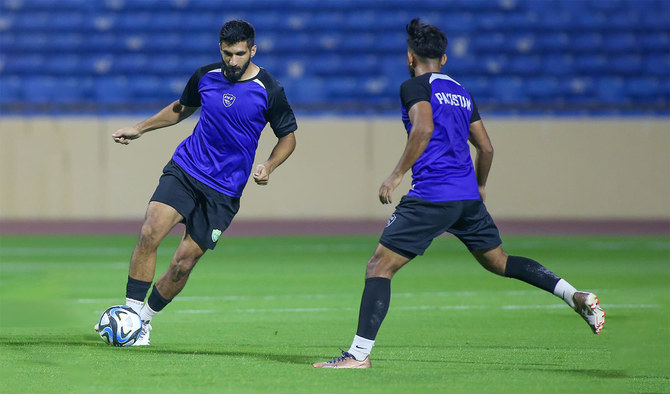
Pakistan to face Saudi Arabia in historic FIFA World Cup qualifier in Al Ahsa today

Pakistani football players during a training session in Al-Hasa, Saudi Arabia on November 12, 2023. (Photo courtesy: @pakistanffofficial/Instagram)
Short Url
Updated 16 November 2023
Follow

Pakistan to face Saudi Arabia in historic FIFA World Cup qualifier in Al Ahsa today

  • Pakistani football players have never advanced so far in World Cup qualifiers in the past
  • They are part of Group G in the second qualifying round and will also face Jordan and Tajikistan

ISLAMABAD: History is in the making as Pakistan take on Saudi Arabia in the FIFA World Cup qualifier in the kingdom on Thursday after getting into the group stage for Asian teams for the first time in over two decades.
Last month, Pakistan men’s football team beat Cambodia 1-0 to win their first ever World Cup qualifier at the Jinnah Stadium in Islamabad after midfielder Harun Hamid scored a stellar goal against the rival squad.
The victory propelled Pakistan to the next level where they would face impressive football teams like Saudi Arabia, Tajikistan and Jordan in Group G of the second round of the World Cup qualifiers. A total of 36 football squads have been split into nine groups with four teams each. The winners and runners-up from each group would progressing through to the third round of the World Cup qualifiers.
“The national football team has been practicing in Al Ahsa,” the Pakistan Football Federation said in a brief statement on Sunday. “They will play their first match of the second round on November 16 against Saudi Arabia.”
Thursday’s World Cup qualifier is expected to be tough for Pakistan since the Saudi Arabia have already played in the last World Cup organized in Qatar.
They also secured a stunning victory against Argentina that ultimately won the tournament, following an impressive goal by Salem Mohammed Shafi Al-Dawsari.


Pakistan launches double-decker buses in Karachi after 65 years to tackle transport woes

Updated 31 December 2025
Follow

Pakistan launches double-decker buses in Karachi after 65 years to tackle transport woes

  • Karachi citizens will be able to travel in double-decker buses from Jan. 1, says Sindh government
  • City faces mounting transport challenges such as lack of buses, traffic congestion, poorly built roads

ISLAMABAD: The government in Sindh province on Wednesday launched double-decker buses in the provincial capital of Karachi after a gap of 65 years, vowing to improve public transport facilities in the metropolis. 

Double-decker buses are designed to carry more passengers than single-deck vehicles without taking up extra road space. The development takes place amid increasing criticism against the Sindh government regarding Karachi’s mounting public transport challenges and poor infrastructural problems. 

Pakistan’s largest city by population faces severe transportation challenges due to overcrowding in buses, traffic congestion and limited bus options. Commuters, as a result, rely on private vehicles or unregulated transport options that are often unsafe and expensive.

“Double-decker buses have once again been introduced for the people of Karachi after 65 years,” a statement issued by the Sindh information ministry said. 

Sindh Transportation Minister Sharjeel Inam Memon and Local Government Minister Syed Nasir Hussain Shah inaugurated the bus service. The ministry said the facility will be available to the public starting Jan. 1. 

The statement highlighted that new electric bus routes will also be launched across the entire province starting next week. It added that the aim of introducing air-conditioned buses, low-fare services, and fare subsidies is to make public transport more accessible to the people.

The ministry noted that approximately 1.5 million people travel daily in Karachi using the People’s Bus Service, while around 75,000 passengers use the Orange Line and Green Line BRT services.

“With the integration of these routes, efforts are being made to benefit up to 100,000 additional people,” the ministry said.