KYIV: A top Ukrainian official said its troops have established a beachhead on the eastern bank of the Dnieper River near Kherson, an important advance in bridging one of Russia’s most significant strategic barriers in the war.
Andriy Yermak, head of the president’s office, provided no details but confirmed the development that has been widely discussed in military forums over the past month.
“Against all odds, Ukraine’s defense forces have gained a foothold on the left bank of the Dnieper,” Yermak told the Hudson Institute, a conservative Washington think tank, in a speech Monday.
Ever since Russian forces left the city of Kherson and the territory around it in November 2022, the only area they controlled on the west bank of the Dnieper, the river became a natural dividing line along the southern battlefront, preventing Ukrainian troops from advancing further into the Kherson region and toward Russian-annexed Crimea.
The barrier also allowed Russia to concentrate more troops in the heavily mined and fortified Zaporizhzhia region and eastern Ukraine.
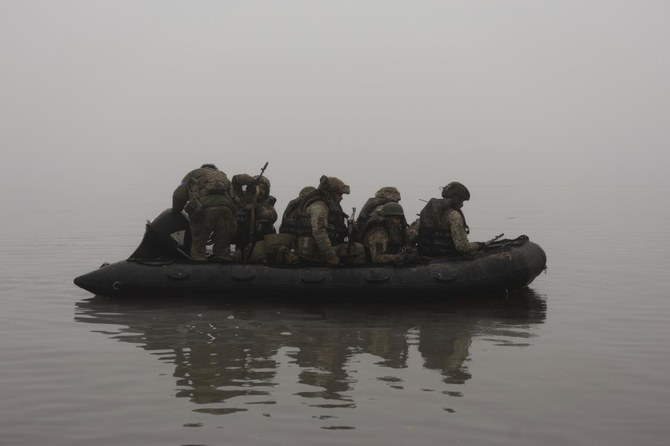
Since the summer, Ukrainian forces have crossed the Dnieper in small groups to create a foothold near the Kherson bridge and more recently sought to expand their presence in nearby villages on the east bank, including Krynky.
The Institute for the Study of War in Washington said Yermak’s comments confirm its own assessments over the past month that Ukraine was conducting larger-than-usual ground operations on the eastern bank of the river and appeared to be holding its positions and supplying troops in the Russian-controlled Kherson region.
Satellite imagery from Monday showed forces advancing on Krynky, one of the areas on the eastern bank of the Dnieper about 22 miles (35 kilometers) northeast of the city of Kherson, the ISW said.
Russian military bloggers have reported intense fighting near Krynky.
The Moscow-appointed governor for the Russia-occupied part of the Kherson region, Vladimir Saldo, said Ukrainian forces lost up to two battalions crossing the Dnieper and trying to maintain their foothold on the left bank.
On his Telegram channel, he claimed that Ukrainian forces holed up in Krynky were facing a “fiery hell” of intense bombardment and were being destroyed “on a large scale.”
He said that the Russian soldiers were surprised “to what extent the Ukrainian command doesn’t care about personnel lives, sending dozens and hundreds to their death.”
The Ukrainian forces have long established positions in several areas on the eastern bank of the Dnieper and sought to expand them, using boats to ferry supplies.
Ukraine lost control over almost the entire Kherson region, including the city of Kherson, in March 2022, right after the full-scale invasion started.
Russian troops advanced from the Crimean Peninsula, which Moscow illegally annexed from Ukraine in 2014, facing almost no resistance even though the Ukraine border was supposed to be heavily guarded.
Crossing the Dnieper could allow Ukraine to outflank Russia without having to break through the heavily mined and fortified front line in the Zaporizhzhia region.
It would also provide the most direct land route to Crimea, where Armiansk, one of the two gateways to the peninsula, lies about 80 kilometers (50 miles) to the south without any significant fortifications in the way.


![]()

Ukraine says it now has a foothold on the eastern bank of Dnieper River near Kherson
Short Url
https://arab.news/96qtg
Ukraine says it now has a foothold on the eastern bank of Dnieper River near Kherson
- “Against all odds, Ukraine’s defense forces have gained a foothold on the left bank of the Dnieper,” Yermak told the Hudson Institute
- The barrier also allowed Russia to concentrate more troops in the heavily mined and fortified Zaporizhzhia region and eastern Ukraine


Latest updates




Recommended


© 2026 SAUDI RESEARCH & PUBLISHING COMPANY, All Rights Reserved And subject to Terms of Use Agreement.