

‘Stop this horror’, UNICEF chief says on visit to Gaza

Catherine Russell, head of the UN children’s agency, decried the ‘devastating’ scenes she witnessed during a visit to war-ravaged Gaza. (AP)
Short Url
Updated 15 November 2023
Follow

‘Stop this horror’, UNICEF chief says on visit to Gaza

  • UN, Red Cross also voice alarm, demand that patients and civilians at Al-Shifa hospital be protected

The head of the UN children’s agency decried Wednesday the “devastating” scenes she witnessed during a visit to war-ravaged Gaza, urging the parties to the conflict to “stop this horror.”

“What I saw and heard was devastating. They have endured repeated bombardment, loss and displacement. Inside the Strip, there is nowhere safe for Gaza’s one million children to turn,” UNICEF chief Catherine Russell said in a statement after visiting among other things a hospital in the south of the Palestinian territory.

The United Nations and the Red Cross also voiced alarm, demanding that thousands of patients and civilians there be protected.

“I’m appalled by reports of military raids in Al-Shifa hospital in Gaza,” UN humanitarian chief Martin Griffiths said on X, formerly Twitter.

“The protection of newborns, patients, medical staff and all civilians must override all other concerns,” he said.

“Hospitals are not battlegrounds.”

World Health Organization chief Tedros Adhanom Ghebreyesus agreed.

“Reports of military incursion into Al-Shifa hospital are deeply concerning,” he wrote on X, warning that the UN health agency had “lost touch again with health personnel at the hospital.”

“We’re extremely worried for their and their patients’ safety.”

The International Committee of the Red Cross said in a statement that it was “extremely concerned about the impact on sick and wounded people, medical staff, and civilians.”

“All measures to avoid any consequences on them must be taken,” it said, insisting that “patients, medical staff, and civilians must be at all times protected.”

The ICRC added that it was “in contact with all concerned authorities and we continue to closely monitor the situation.”

Israel vowed to crush Hamas after the Palestinian militant group launched unprecedented cross-border attacks that Israel says left 1,200 people dead with another 239 taken hostage.

The Hamas-run health ministry in Gaza says Israel’s ensuing air and ground offensive have killed 11,320 people, mostly civilians, including thousands of children.

Al-Shifa is a key target in Israel’s campaign.

The United Nations has said it estimates that at least 2,300 people — patients, staff and displaced civilians — are inside and may be unable to escape because of fierce fighting.

Witnesses have described horrific conditions inside the hospital, with medical procedures taking place without anesthetic, families with scant food or water living in corridors and the stench of decomposing corpses filling the air.


Iran says can fight intense war for months

Updated 58 min 29 sec ago
Follow

Iran says can fight intense war for months

  • Iran’s security chief accuses Trump administration of seeking to replicate a scenario similar to Venezuela
  • Analysts warn there is still no clear path to ending a conflict that could last a month or longer

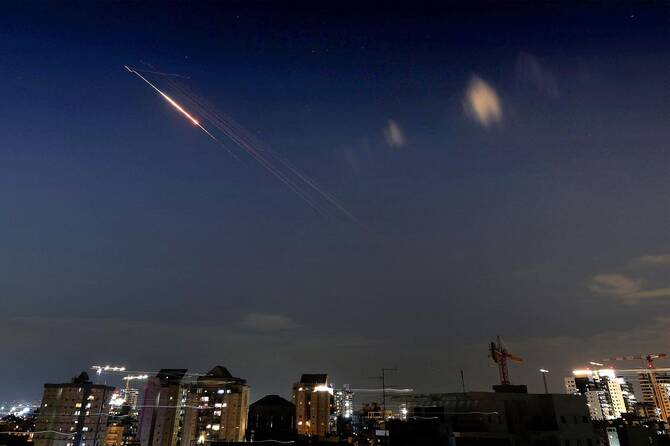
TEHRAN: Iran’s Revolutionary Guards said Sunday that the country’s forces could fight an intense war for six months against the United States and Israel.
Israeli Prime Minister Benjamin Netanyahu has vowed to press on with the war against Iran “with all our force,” with a plan to eradicate the country’s leadership after joint US-Israeli raids killed supreme leader Ayatollah Ali Khamenei last week, sparking the regional conflict.
Despite the threat, the Revolutionary Guards said Sunday that the Islamic republic’s forces could wage an “intense war” for six months at the current speed of fighting.
Guards spokesman Ali Mohammad Naini said Iran had so far used “first and second generation” missiles, but will use “advanced and less-used long-range missiles” in the coming days.
‘Trapped’
The widening reach of the war and Iran’s ability to inflict damage and harm were underscored by US President Donald Trump attending the return of six American service members killed in a drone strike on a US base in Kuwait last Sunday.
Iran’s security chief Ali Larijani accused the Trump administration of seeking to replicate a scenario similar to Venezuela where it ousted leader Nicolas Maduro.
“Their perception was that it would be like Venezuela — they would strike, take control and it would be over — but now they are trapped,” he said in a pre-recorded interview broadcast on state TV on Saturday.
Iran’s hardline judiciary chief Gholamhossein Mohseni Ejei also warned Middle East neighbors which are “openly and covertly at the disposal of the enemy” that “the heavy attacks on these targets will continue.”
Iranian President Masoud Pezeshkian said Sunday that Tehran “will be forced to respond” if a neighboring country were to be used as a launchpad for any attack or invasion attempt.
Tehran had vowed to go after US assets in the region, and Saudi Arabia, Qatar, the United Arab Emirates and Kuwait on Sunday all reported new attacks.
No clear way out
Analysts warn there is still no clear path to ending a conflict that US and Israeli officials say could last a month or longer.
Trump has suggested Iran’s economy could be rebuilt if a leader “acceptable” to Washington replaces the late supreme leader, which Tehran has rejected.
China and Russia have largely stayed on the sidelines despite close ties with Tehran.
China’s top diplomat Wang Yi said on Sunday that the war in the Middle East should “never have happened.”
“This is a war that should never have happened,” he told a press conference in Beijing, adding that “a strong fist does not mean strong reason. The world cannot return to the law of the jungle.”