

Hawkish Israeli minister calls for voluntary emigration of Gazans

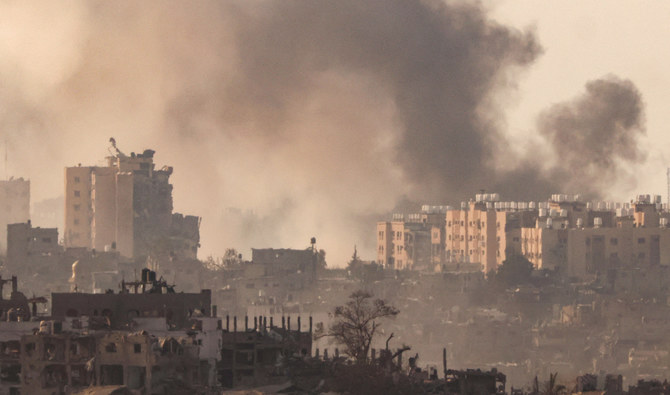
This picture taken on November 13, 2023 from a position along the border with the Gaza Strip in southern Israel shows smoke erupting amid ongoing battles between Israel and the Palestinian Hamas movement. (AFP)
Short Url
Updated 14 November 2023
Follow

Hawkish Israeli minister calls for voluntary emigration of Gazans

  • Smotrich: Israel ‘will no longer be able to accept the existence of an independent entity in Gaza’

JERUSALEM: A senior far-right member of Israeli Prime Minister Benjamin Netanyahu’s government said on Tuesday Gaza could not survive as an independent entity and it would be better for Palestinians there to leave for other countries.

Finance Minister Bezalel Smotrich, who heads one of the religious nationalist parties in Netanyahu’s coalition, said he supported a call by two members of the Israeli parliament who wrote in a Wall Street Journal editorial that Western countries should accept Gazan families who expressed a desire to relocate.

The comments underscore fears in much of the Arab world that Israel wants to drive Palestinians out of land where they want to build a future state, repeating the mass dispossession of Palestinians when Israel was created in 1948.

“I welcome the initiative of the voluntary emigration of Gaza Arabs to countries around the world,” Smotrich said in a statement. “This is the right humanitarian solution for the residents of Gaza and the entire region after 75 years of refugees, poverty and danger.”

He said an area as small as the Gaza Strip without natural resources could not survive alone, and added: “The State of Israel will no longer be able to accept the existence of an independent entity in Gaza.”

Smotrich spoke during Israel’s invasion of the Gaza Strip, a blockaded coastal enclave ruled by Hamas that is home to some 2.3 million people, most of them refugees after earlier wars.

Palestinians and leaders of Arab countries have accused Israel of seeking a new “Nakba” (catastrophe), the name given to the displacement of hundreds of thousands of Palestinians who fled or were driven from their homes in the wake of the 1948 war that accompanied the founding of the state of Israel.

Most ended up in neighboring Arab states, and Arab leaders have said any latter-day move to displace Palestinians would be unacceptable.

Israel withdrew its military and settlers from Gaza in 2005 after a 38-year occupation, and Netanyahu has said it does not intend to maintain a permanent presence again, but that Israel would maintain security control for an indefinite period.

However there has been little clarity about Israel’s longer term intentions, and countries including the US have said that Gaza should be governed by Palestinians.

Meanwhile, when Hamas gunmen stormed southern Israel on Oct. 7 and rocket sirens pierced the early morning quiet across the country, Israel’s premier museums went into war mode, rushing to protect their most precious artwork and artefacts.

The Dead Sea Scrolls. Ancient dedication plaques on loan from the Louvre. A 1916 masterpiece by Austrian painter Gustav Klimt. These and other treasures were quickly taken off display and brought to special bunkers to ensure they are not damaged during the war.

“To take off an exhibition is something that usually is not done because we trust the building, we trust the safety of the showcases. But this is a different situation so we have to act accordingly,” said Hagit Maoz, curator of the Shrine of the Book at Jerusalem’s Israel Museum.

The iconic building, shaped like the lids of the jars in which the Dead Sea Scrolls were found, is usually packed with visitors eager to glimpse the collection of ancient religious texts. Today the eight display cases lining the walls have paper notes saying “temporarily removed.”

The last time the museum removed the display, Maoz said, was during the 1991 Gulf War when Iraq fired missiles at Israel.

Nurith Goshen, curator of Chalcolithic and Bronze Age archaeology, was cleaning up broken glass from a rocket strike near her home outside Jerusalem on Oct. 7 when the museum called announcing the war protocol and asking to confirm her list.

“You really have to choose the finest or the most fragile artefacts,” she said.

Her list included items on loan from the Louvre and the British Museum, and she said they got permission from those museums before taking them down.

“You really understand the meaning of what we are holding here, and what we have under our custodianship for Israel, but also for the world,” said Goshen.

The Tel Aviv Museum of Art took similar precautions.

Gustav Kimt’s Portrait of Friedericke Maria Beer, painted two years before his death, is now stored on a rack in a fortified underground bunker with other works. The paintings left behind blank spaces on the gallery’s wall.

“These works of art have experienced war, some of them survived World War Two,” said museum director Tania Coen-Uzzielli. “We are custodians for a short time, and we needed to protect them. To protect them for posterity and for history.” 


Egyptian woman faces death threats for filming alleged harasser

Updated 47 min 48 sec ago
Follow

Egyptian woman faces death threats for filming alleged harasser

  • Case revives longstanding national debate in Egypt over harassment and violence against women
  • A 2013 UN study found that 99.3 percent of Egyptian women reported experiencing harassment

CAIRO: A young Egyptian woman is facing death threats after posting a video showing the face of a man she says repeatedly harassed her, reviving debate over how victims are treated in the country.
Mariam Shawky, an actress in her twenties, filmed the man aboard a crowded Cairo bus earlier this week, accusing him of stalking and harassing her near her workplace on multiple occasions.
“This time, he followed me on the bus,” Shawky, who has been dubbed “the bus girl” by local media, said in a clip posted on TikTok.
“He kept harassing me,” added the woman, who did not respond to an AFP request for comment.
Hoping other passengers would intervene, Shawky instead found herself isolated. The video shows several men at the back of the bus staring at her coldly as she confronts her alleged harasser.
The man mocks her appearance, calls her “trash,” questions her clothing and moves toward her in what appears to be a threatening manner.
No one steps in to help. One male passenger, holding prayer beads, orders her to sit down and be quiet, while another gently restrains the man but does not defend Shawky.
Death threats
As the video spread across social media, the woman received a brief flurry of support, but it was quickly overwhelmed by a torrent of abuse.
Some high-profile public figures fueled the backlash.
Singer Hassan Shakosh suggested she had provoked the situation by wearing a piercing, saying it was “obvious what she was looking for.”
Online, the comments were more extreme. “I’ll be the first to kill you,” one user wrote. “If you were killed, no one would mourn you,” said another.
The case has revived a longstanding national debate in Egypt over harassment and violence against women.
A 2013 UN study found that 99.3 percent of Egyptian women reported experiencing harassment, with more than 80 percent saying they faced it regularly on public transport.
That same year, widespread protests against sexual violence rocked the Egyptian capital.
In 2014, a law criminalizing street harassment was passed. However, progress since then has been limited. Enforcement remains inconsistent and authorities have never released figures on the number of convictions.
Public concern spiked after previous high-profile incidents, including the 2022 killing of university student Nayera Ashraf, stabbed to death by a man whose advances she had rejected.
The perpetrator was executed, yet at the time “some asked for his release,” said prominent Egyptian feminist activist Nadeen Ashraf, whose social-media campaigning helped spark Egypt’s MeToo movement in 2020.
Denials
In the latest case, the authorities moved to act even though the bus company denied any incident had taken place in a statement later reissued by the Ministry of Transport.
The Interior Ministry said that the man seen in the video had been “identified and arrested” the day after the clip went viral.
Confronted with the footage, he denied both the harassment and ever having met the woman before, according to the ministry.
Local media reported he was later released on bail of 1,000 Egyptian pounds (around $20), before being detained again over a pre-existing loan case.
His lawyer has called for a psychiatric evaluation of Shawky, accusing her of damaging Egypt’s reputation.
These images tell “the whole world that there are harassers in Egypt and that Egyptian men encourage harassment, defend it and remain silent,” said lawyer Ali Fayez on Facebook.
Ashraf told AFP that the case revealed above all “a systemic and structural problem.”
She said such incidents were “never taken seriously” and that blame was almost always shifted onto women’s appearance.
“If the woman is veiled, they’ll say her clothes are tight. And if her hair is uncovered, they’ll look at her hair. And even if she wears a niqab, they’ll say she’s wearing makeup.”
“There will always be something.”