GENEVA: The Red Cross has not met any hostage held by Hamas in the Gaza Strip, Israeli Foreign Minister Eli Cohen said Tuesday after meeting the organization’s head in Geneva.
“Until today, none of our hostages met the Red Cross,” Cohen told reporters. “We don’t have any proof of life.”
Cohen and Israel’s Health Minister Uriel Menachem Buso met with Mirjana Spoljaric, the president of the International Committee of the Red Cross (ICRC) to discuss the war that erupted after the October 7 Hamas attacks.
“We asked for information... about the whereabouts of the hostages,” Buso said.
“The wounded ones, the babies, any information that they can give us regarding proof of life.”
Israel says that 1,200 people were killed and 239 people taken hostage by Hamas fighters who crossed the border to stage the deadliest attack in Israeli history.
The Hamas health ministry in Gaza says that at least 11,240 people have been killed in Israel’s military onslaught since October 7.
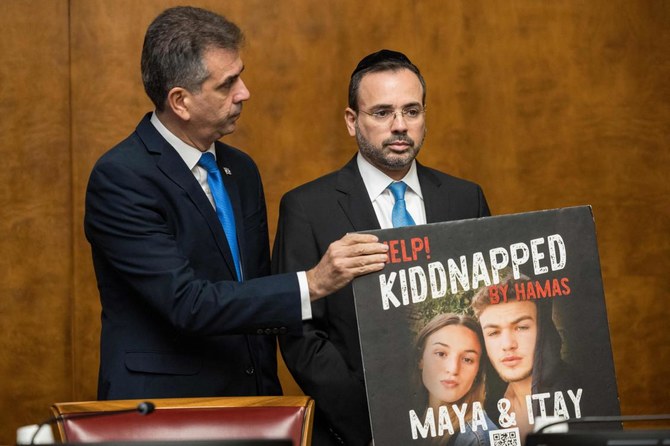
Family members of some of the hostages held by Hamas in Gaza also attended that meeting, as well as the press conference afterwards at the United Nations.
They held up pictures of their missing loved ones, and played audio and video gathered at the time several were taken.
“We are here to shout for them and we need to bring them justice,” said Ofri Bibas Levy, holding up a picture of her nephew Kfir Bibas — the youngest of the hostages, who was nine months old when he was seized with his parents and four-year-old brother.
“We need to bring them home as soon as possible,” she told reporters.
Before Tuesday’s meeting, Spoljaric issued a statement highlighting that “families of hostages are living through an incredibly heart-wrenching time and I want to underscore how hard we are advocating on behalf of their loved ones.”
“This is a key priority for me,” she said, stressing that the ICRC had persistently been advocating on behalf of the hostages held in Gaza, including through direct contacts with Hamas and with others holding influence over the parties.
Qatar, the United States and Egypt have been involved in attempts to release hostages. Hamas have released four women following Qatari mediation, while the Israeli army freed one captured soldier.
“Hostage-taking is prohibited under international humanitarian law. We continue to insist on the hostages’ release and are doing everything in our power to gain access to them,” Spoljaric said.
The organization, which also helped facilitate the release of the four women, stood ready to facilitate the release of the others, she said.
She insisted though that “we cannot do this alone; agreements must be reached that allow the ICRC to safely carry out this work.”
“ICRC cannot force its way in to where hostages are held. We can only visit them when agreements, including safe access, are in place.”
But Cohen said this was not enough, insisting that the ICRC “should be more loud and clear with their statements and with the pressure.”
He vowed that Israel would “continue this war until we eliminate Hamas and until we receive all our hostages back.”
He also strengthened his already harsh criticism of UN chief Antonio Guterres, who has called for a “humanitarian cease-fire” in Gaza and condemned “clear violations of international humanitarian law that we are witnessing in Gaza,” without naming either side.
“Guterres does not deserve to be the head of the United Nations,” Cohen said Tuesday.
“Guterres did not promote any peace process in the region.”


![]()

Red Cross has not met Israeli hostages, no proof of life: Israeli minister
Short Url
https://arab.news/yesuz
Red Cross has not met Israeli hostages, no proof of life: Israeli minister
- “Until today, none of our hostages met the Red Cross,” Cohen told reporters
- “We are here to shout for them and we need to bring them justice,” said Ofri Bibas Levy, holding up a picture of her nephew Kfir Bibas


Latest updates


© 2026 SAUDI RESEARCH & PUBLISHING COMPANY, All Rights Reserved And subject to Terms of Use Agreement.