

Kabul urges Islamabad to release 3,000 containers stuck at port after transnational cargo clampdown

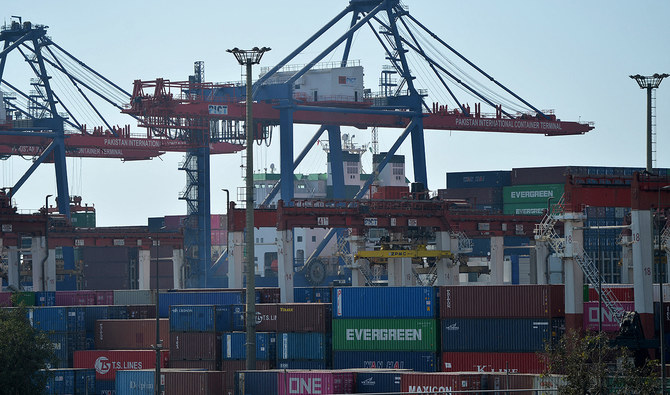
In this picture taken on January 11, 2023, shipping containers are seen placed under cranes at the Karachi sea port. (AFP/File)
Short Url
Updated 15 November 2023
Follow

Kabul urges Islamabad to release 3,000 containers stuck at port after transnational cargo clampdown

  • Pakistan says it has lost millions of dollars because goods are being sent duty-free from its ports to Afghanistan, then smuggled back across the border
  • Afghan authorities say Pakistan has stopped more than 3,000 Afghanistan-bound containers at Karachi port while demanding more tax and duty payments

ISLAMABAD: The Taliban administration in Kabul on Tuesday urged Islamabad to find ways for tens of thousands of Afghan citizens being expelled from Pakistan to take cash and other assets back to their homeland and called for the release of thousands of containers of imports it said were stuck at the Karachi port.

The demands came during a meeting between Pakistani Foreign Minister Jalil Abbas Jilani and Afghan commerce minister Hajji Nooruddin Azizi who is leading a delegation to Islamabad for a tripartite meeting co-chaired by the commerce ministers of Pakistan and Afghanistan, and the deputy prime minister of Uzbekistan.

Pakistan has imposed a transnational cargo clampdown in recent weeks, saying it has lost millions of dollars in taxes because goods are being sent duty-free from its ports to land-locked Afghanistan, and then being smuggled back across the border.

Afghan authorities say Pakistan has stopped more than 3,000 Afghanistan-bound containers at the Karachi port while demanding more tax and duty payments, causing millions of dollars in losses to traders.

“During the meeting, challenges of transit between the two countries, the halt of more than 3,000 containers of Afghan traders' assets at the Karachi port, the imposed restrictions on Afghan transit goods from Pakistan, and related matters were discussed in detail,” the Afghan embassy in Islamabad said in a statement to Arab News.

Azizi also spoke to Jilani about challenges for Afghan citizens Pakistan is expelling.

Pakistan had set a Nov 1. deadline for all illegal immigrants, including some 1.73 million undocumented Afghans, to leave the country or face forcible expulsion. Since the passing of the deadline, tens of thousands of Afghans have left the country, which has hosted over 4 million Afghan refugees since the Soviet invasion of Kabul in 1979.

About 600,000 Afghans have also crossed over into Pakistan since the Taliban took over Kabul in 2021 after the hasty pullout of US and its NATO allies that ended America’s longest war.

Afghan citizens returning to Afghanistan have said there are restrictions on the transfer of cash and property to Afghanistan from Pakistan, where many had built businesses and homes for decades. Others including those who used to work for the US and NATO allies and fled Afghanistan fearing retribution at the hands of the new government, as well as former translators, journalists, women activists and other professionals, fear for their lives in Afghanistan.

“Bilateral trade, especially the stranded goods of (Afghan) traders in Karachi port, smooth transfer of (Afghan) refugees’ properties to (Afghanistan) and related issues were discussed,” Afghanistan’s embassy said in a separate statement, after Azizi’s meeting with Jilani.

Pakistan’s foreign office said Jilani conveyed the message that “full potential for regional trade and connectivity can be harnessed with collective action against terrorism.”


‘Fully stand with Bangladesh’: Pakistan PM backs decision to boycott India match

Updated 04 February 2026
Follow

‘Fully stand with Bangladesh’: Pakistan PM backs decision to boycott India match

  • Pakistan’s government have not allowed the national cricket team to play its World Cup match against India on Feb. 15
  • Pakistan has accused India of influencing ICC decisions, criticized global cricket body for replacing Bangladesh in World Cup

ISLAMABAD: Prime Minister Shehbaz Sharif on Wednesday backed his government’s decision to bar the national men’s cricket team from playing against India in the upcoming T20 World Cup tournament, reaffirming support for Bangladesh. 

Pakistan’s government announced on social media platform X last week that it has allowed its national team to travel to Sri Lanka for the World Cup. However, it said the Green Shirts will not take the field against India on their scheduled match on Feb. 15. 

Pakistan’s participation in the tournament was thrown into doubt after Pakistan Cricket Board (PCB) Chairman Mohsin Naqvi criticized the International Cricket Council (ICC) for replacing Bangladesh with Scotland. The decision was taken after Bangladesh said it would not let its team travel to India out of security concerns. 

During a meeting of the federal cabinet, Sharif highlighted that Pakistan has said that politics should be kept away from sports. 

“We have taken this stand after careful consideration and in this regard, we should stand fully with Bangladesh,” Sharif said in televised remarks. 

“And I believe this is a very reasonable decision.”

Pakistan has blamed India for influencing the ICC’s decisions. The global cricket governing body is currently led by Jay Shah, the head of the Board of Control for Cricket in India. Shah is the son of Indian Home Minister Amit Shah. 

Pakistan’s boycott announcement has triggered media frenzy worldwide, with several Indian cricket experts and analysts criticizing Islamabad for the decision. An India-Pakistan cricket contest is by far the most lucrative and eagerly watched match of any ICC tournament. 

The ICC has ensured that the two rivals and Asian cricket giants are always in the same group of any ICC event since 2012 to capitalize on the high-stakes game. 

The two teams have played each other at neutral venues over the past several years, as bilateral cricket remains suspended between them since 2013 due to political tensions. 

Those tensions have persisted since the two nuclear-armed nations engaged in the worst fighting between them since 1999 in May 2025, after India blamed Pakistan for an attack in Indian-administered Kashmir that killed tourists. 

Pakistan denied India’s allegations that it was involved in the attack, calling for a credible probe into the incident.