

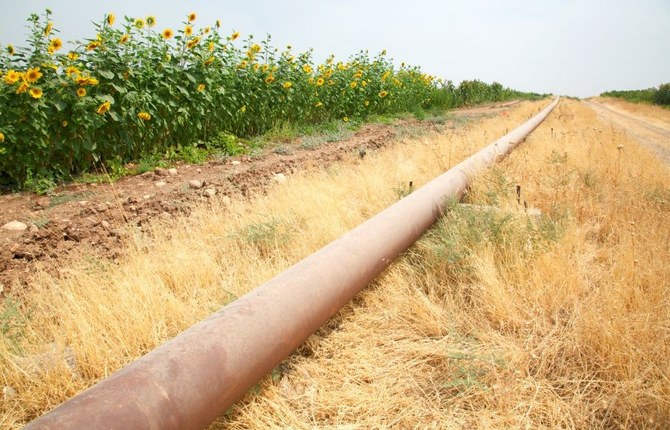

ANKARA: A protracted dispute that halted northern oil exports through the Iraq-Turkiye pipeline may be resolved within days after a major diplomatic initiative.
Iraqi Oil Minister Hayan Abdel-Ghani said on Sunday that an accord had been struck with the Kurdistan Regional Government and international oil companies, signaling the resumption of production from the Kurdish region’s oilfields, possibly within three days.
The agreement, which comes after months of deadlock, will focus attention on diplomatic relations between Ankara and Baghdad.
The impasse began on March 25 when Turkiye halted the northern export of 450,000 barrels of oil per day through the pipeline following an arbitration ruling by the Paris-based International Chamber of Commerce in favor of Baghdad and against Ankara.
Turkiye then began maintenance work on the pipeline, which contributes around 0.5 percent of global crude supply.
Foreign oil companies operating in the region were forced to store their crude output in tanks rather than allowing it to flow to the pipeline.
The chamber ruled that Ankara pay Baghdad about $1.5 billion damages for unauthorized exports between 2014 and 2018.
Turkiye has yet to pay the sum and is pushing for a reduction in the figure.
During a visit to Irbil, the capital of Iraq’s semi-autonomous Kurdistan, Abdel-Ghani said that Baghdad and Ankara had reached an understanding on the resumption of oil exports.
However, Rich Outzen, a senior fellow at the Atlantic Council, said this is not the first time Iraq’s oil ministry has announced a breakthrough without resolving underlying issues with the pipeline agreement.
Any shipments through the pipeline that fail to conform to the agreement risk incurring further penalties for Turkiye following the recent arbitration decision, he told Arab News.
“That decision and the ITP agreement state that the Iraqi Ministry of Oil needs to provide loading instructions and approvals for the sales to be valid and not violate the ITP agreement. The ministry has not done that yet, according to my information,” he added.
Although the months-long dispute had little affect on global oil markets, it dealt a massive blow to the KRG economy, with oil exports accounting for at least 80 percent of KRG revenues last year.
According to Outzen, the KRG and international oil companies, or IOCs, are pressing Baghdad, especially the Iraqi oil ministry, to respect previous agreements regarding production sharing and costs.
“As far as I know, this also has not been done,” he said.
“So, unless there was literally a breakthrough in the last 48 hours despite no high-level contacts between the IOCs and the Ministry of Oil, or Ankara and Baghdad, this could well be more posturing by Baghdad to make it look like they are solving a problem when they have not actually changed their position,” Outzen said.
However, if there has been a change, Outzen believes that it will be a big step forward for Ankara-Baghdad and Irbil-Baghdad relations.
“Turkiye’s expectation will, of course, be that if more oil starts to flow through the ITP, there is an explicit agreement from Baghdad not to pursue further arbitration damages. The IOCs, similarly, will seek to ensure current contracts are honored.
“I am highly skeptical those two assurances have been given and thus skeptical of the statement,” he added.
Mehmet Alaca, research fellow at ORSAM, a think tank in Ankara, said that there have been several statements in the past indicating an agreement with Ankara and the resumption of oil exports to Turkiye through the Kirkuk-Ceyhan pipeline, but numerous challenges remain.
“I don’t expect real progress until these are overcome, or expectations are met. Iraq and the KRG have incurred losses of over $6 billion so far,” he said.
Turkiye is also experiencing a relative loss, but holds a strong position in bringing the parties to the table. Ankara is seeking a waiver from the second lawsuit related to KRG oil exports between 2018 to April 2023. It appears Iraq is not sufficiently eager in this regard,” Alaca told Arab News.
Regarding payment of the compensation amount, Alaca said that although Turkiye approved the first arbitration decision, there are uncertainties about the payment.
“There are claims that installment payments are requested or that Irbil should take the initiative on payment,” he said.
“Furthermore, after the arbitration decision, oil trade will be less profitable for Ankara compared to the past because the KRG now has to sell its oil at OPEC price standards,” he said.
“In this case, Turkiye may have an expectation of being more active in the processing of Kurdish oil in the new equation to increase profitability. Ankara does not want to make an agreement without progress on such issues.”
Therefore, even if an agreement is reached between Irbil and Baghdad, Alaca thinks that the flow will start when Turkiye’s expectations are met.
Baghdad and Irbil signed a temporary deal to restart northern oil exports through Turkiye in April. But pipeline flows have yet to begin. Accordingly, crude export revenues would be deposited in an account at the Iraqi Central Bank under Irbil’s control.
“From Abdel-Ghani’s statements, they seem to hold a consensus between Ankara and Baghdad to reach an agreement,” Alaca said.
In the meantime, Turkiye also wants the Baghdad and Irbil administrations to hold a common position before dealing with the details of an agreement with Ankara.
In August, Turkish Foreign Minister Hakan Fidan visited Baghdad and Irbil. However, this visit did not achieve the expected clear roadmap to resolve the halted oil exports.
The impasse on resolving the issue may be behind the postponement of a planned visit by President Recep Tayyip Erdogan in August just after Fidan’s meetings in the region, sources say.
During a televised interview in early October, Turkish Energy Minister Alparslan Bayraktar said the suspended crude oil pipeline from Iraq through Turkiye was ready to resume operations and that Ankara was about to begin shipments.
About 500,000 barrels per day of oil is expected to be pumped to global markets, Bayraktar said.
Ankara accords high political and economic value to its ties with Baghdad, with bilateral trade exceeding $24 billion last year.


