

Two killed in attack on private company’s vehicles in northwest Pakistan — police

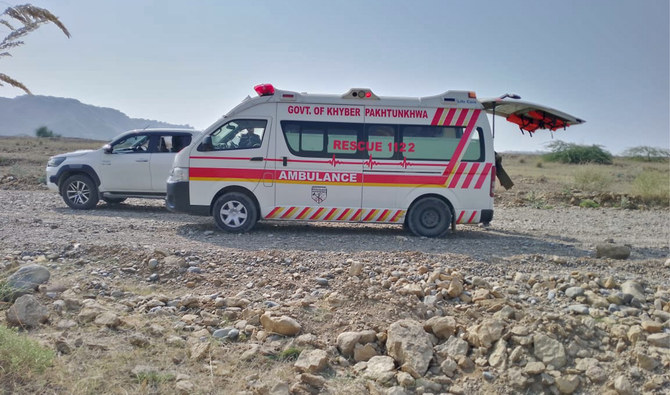
An ambulance is parked at the attack site in which two people were killed and 11 injured when militants attacked vehicles carrying the employees of a Pakistani conglomerate in Dera Ismail Khan, Pakistan, on November 13, 2023. (Photo courtesy: Rescue 1122)
Short Url
Updated 13 November 2023
Follow

Two killed in attack on private company’s vehicles in northwest Pakistan — police

  • Police say ‘militants’ fired rockets at three vehicles transporting employees of Al-Haj Group
  • A surge in militant attacks in Pakistan in recent months has mostly targeted security officials

PESHAWAR: Police said on Monday militants had fired rockets at three vehicles ferrying employees of a Pakistani conglomerate, killing two people and injuring 11 on the outskirts of the northwestern Dera Ismail Khan district.

This is the second attack in six days targeting Al-Haj Group, an emerging Pakistani conglomerate with an operational footprint spanning from oil and gas exploration to textiles, metals, automobile manufacturing and supply chain and procurement. In the last attack on the company last Tuesday, two policemen were killed and three were injured in a pre-dawn assault on the conglomerate’s offices in Dera Ismail Khan district. Police said the attack was carried out by “terrorists” but it was unclear why a private Pakistani company is being targeted by militants.

Al-Haj group did not respond to requests for comment.

A surge in militant attacks in Pakistan’s western provinces has cast a shadow on election preparations in the run-up to February’s national election, but until now the attacks had mostly targeted security forces.

Hidayat Khan, a district police official in Dera Ismail Khan, said militants fired rockets at three vehicles of the Al-Haj Group near Kot Falak village in Darazinda town on Monday morning. One of the three vehicles was hit, he said. The conglomerate’s facility is located at a distance of 12 kilometers from the mountainous area of Darazinda.

“Militants started firing rockets when three vehicles of the company were coming to fetch water near Kot Falak, a village near Darazinda,” Khan told Arab News. “One employee of the company died on the spot while another died of injuries at a hospital.”

Khan said 11 employees injured in the attack were being treated at different hospitals in Dera Ismail Khan. He said Darazinda is close to Kulachi, a rundown village in Dera Ismail Khan, where militants often stage attacks on police checkposts and police stations.

“Two of the injured, who were in critical condition, have been shifted to the District Headquarters Hospital for treatment,” said Aizaz Mehmood Dotani, a district spokesperson of the Rescue 1122 service. He said Faisal Khattak, the driver of the vehicle, was immediately killed.

This is the sixth attack to take place in Dera Ismail Khan in the last two weeks. On Nov. 5, heavily armed gunmen attacked police checkpoints in the district, injuring one policeman. On Nov. 3, seven people, including a security personnel, were killed while 23 others were injured in two separate attacks in the district.

Pakistani officials have frequently said militants targeting their country operate from neighboring Afghanistan. The Taliban administration rejects accusations it harbors militants.

Last week, in an unusually strongly-worded press conference, Pakistani Prime Minister Anwaar-ul-Haq Kakar demanded the Afghan Taliban hand over Pakistani militants belonging to the TTP group and dismantle their training centers and hideouts in Afghanistan.

Since the Taliban takeover of Kabul, “unfortunately there has been a 60 percent increase in terrorist attacks and a 500 percent rise in suicide attacks in Pakistan,” Kakar said, expressing regret over the lack of a “positive response” from the Taliban administration.


Pakistani minister urges universal rights, dialogue at UN civilizations forum in Riyadh

Updated 14 sec ago
Follow

Pakistani minister urges universal rights, dialogue at UN civilizations forum in Riyadh

  • Musadik Malik warns selective application of human rights and weakening multilateralism risk deepening global divisions
  • The minister also mentions water rights and urges equitable sharing by upper riparian states to support regional stability

ISLAMABAD: Pakistan’s climate change minister said principles of justice and human rights must be applied universally, according to an official statement released on Monday, warning against selective enforcement as he addressed a United Nations forum in Saudi Arabia focused on dialogue among civilizations.

The remarks came at the 11th Global Forum of the United Nations Alliance of Civilizations (UNAOC), held in Riyadh to mark the body’s 20th anniversary. The forum brings together political leaders, policymakers, and civil society groups to promote dialogue, mutual understanding, and cooperation across cultures and religions.

Its latest edition comes at a time of growing geopolitical fragmentation and conflict.

“I am firmly committed to women’s rights, minority rights, environmental rights, and children’s rights,” Musadik Malik said while addressing the gathering. “These rights are fundamental and non-negotiable.”

He said the global order was increasingly marked by weakening multilateralism, rising conflicts, and declining international funding for development and environmental priorities, cautioning that unilateral actions were replacing collective approaches with consequences for global peace and justice.

Malik questioned what he described as the selective application of human rights principles, drawing attention to the situations in Palestine and Kashmir, and said the rights of people in those regions must be recognized and protected in line with international norms.

The minister also highlighted water rights as a growing source of regional tension, emphasizing the responsibility of upper riparian states to ensure equitable and just sharing of water resources with downstream countries to support stability and sustainable development.

His statement comes months after India said unilaterally it was holding the Indus Waters Treaty “in abeyance,” a move described as illegal by the administration in Islamabad and as “an act of war.”

The 1960 agreement between India and Pakistan, brokered by the World Bank, divides the rivers of the Indus basin between the two countries and sets rules for how they can use and manage shared water resources to avoid conflict.

Malik said the UNAOC’s 20th anniversary was a timely reminder of the need to recommit to dialogue, peace, and mutual respect in an increasingly divided world.