

Why is South Asia the global hotspot of pollution?

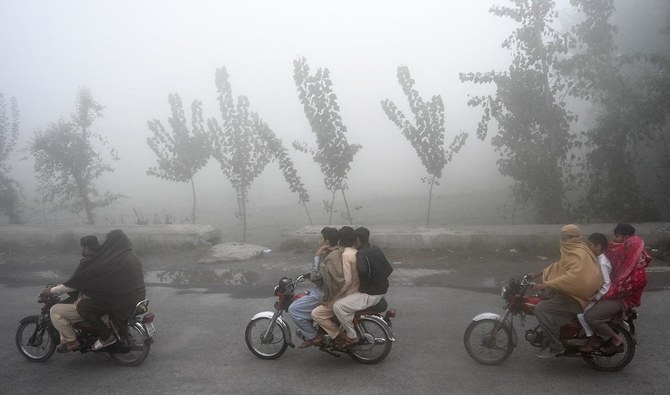
Men ride on bikes along a street amid smog conditions in Peshawar on November 11, 2023. (AFP)
Short Url
Updated 13 November 2023
Follow

Why is South Asia the global hotspot of pollution?

  • Four of the world's most polluted countries and nine of the 10 most polluted cities are in the region
  • Countries across South Asia will have to coordinate efforts if region's pollution problem is to be solved

NEW DELHI: Toxic levels of air pollution are disrupting the lives of millions of people in South Asia forcing closure of schools, impacting sporting events and leaving governments urging people to stay in doors to avoid health problems.

The worsening air pollution is an annual problem for South Asian nations as winter approaches and cold, heavy air traps pollution in a thick layer of smog.

South Asia has become the global hotspot for air pollution, with studies finding four of the world's most polluted countries and nine of the 10 most polluted cities in the region.

WHY IS POLLUTION IN SOUTH ASIA WORSE THAN OTHER PLACES?

Countries in South Asia have seen a marked increased in industrialisation, economic development, and population growth over the past two decades, leading to increased demand for energy and fossil fuels.

While sources like industries and vehicles affect most countries, there are certain major contributors that are unique to South Asia, including solid fuel combustion for cooking and heating, human cremation, and burning of agricultural waste.

About 38% of the pollution in New Delhi this year, for example, has been caused by stubble burning - a practice where stubble left after harvesting rice is burnt to clear fields - in the neighbouring states of Punjab and Haryana.

An increase in the number of vehicles on roads as the region has developed has also exacerbated the pollution problem. In India and Pakistan, for example, the number of vehicles has increased four-fold since the early 2000s.

New Delhi, ranked the world's most polluted capital for four years in a row by Swiss Group IQAir, has 472 vehicles per thousand population, according to government data, with almost eight million vehicles plying on its roads as of 2022.

WHY ARE EFFORTS TO REDUCE POLLUTION NOT WORKING?

Although South Asian countries have started trying to curb pollution, putting together air quality management plans, installing more pollution monitors, and pushing for a switch to cleaner fuels, these are yet to yield significant results.

Experts say that the problem lies in a lack of coordination on pollution control efforts between the countries.

Dust particles can travel hundreds of kilometres, studies say, transcending national boundaries and impacting countries other than those in which they originate.

About 30% of the pollution in Bangladesh's largest cities, for example, originates in India and is transported to the country by the wind moving from northwest to southeast.

Country-wide or city-wide measures to curb toxic air, hence, have limited effectiveness.

WHAT IS THE SOLUTION?

Countries across South Asia will have to coordinate efforts if the region's pollution problem is to be solved, collaborating to enhance monitoring and make policy decisions. At the same time, these region-wide efforts will have to be balanced by moulding solutions to suit local conditions where needed.

In addition, the focus will also have to be broadened to include sectors that have received limited attention so far, such as agriculture and waste management.

To curb stubble burning, for example, governments can offer subsidies on better harvesting machines. Countries like India have already started offering such incentives but demand for such machines has been limited due to their high purchase cost and high waiting time for those who want to rent them.


At OIC meeting, Pakistan calls on world to halt Israel’s annexation of West Bank

Updated 8 sec ago
Follow

At OIC meeting, Pakistan calls on world to halt Israel’s annexation of West Bank

  • Israel this month decided to approve land registration procedures in parts of the West Bank for the first time since 1967
  • FM Ishaq Dar demands end to Palestinian displacement, reconstruction of Gaza, pathway to independent Palestinian state

ISLAMABAD: Pakistan on Friday called on the international community to stop Israel from annexing the occupied West Bank, demanding a “political pathway” toward an independent Palestinian state.
Israel decided this month to approve land registration procedures in parts of the West Bank for the first time since 1967, drawing sharp criticism from Muslim nations along with several European countries, which described it as a move to ease the path for settlement expansion and annexation.

Speaking at an extraordinary ministerial session of the Organization of Islamic Cooperation (OIC), Pakistani Foreign Minister Ishaq Dar said the development carries profound implications not only for the Palestinian people but also for the credibility of international law, United Nations charter and the integrity of the multilateral system.

“Israel continues with impunity to expand illegal settlements and enforce de facto annexation in the Occupied West Bank. These actions, flagrantly violate international law including UN Charter, UN Security Council Resolution 2803 [endorsing President Donald Trump’s peace plan for Gaza], undermine all diplomatic efforts and threaten the very foundation of a just and lasting peace,” Dar said.

“These violations embolden further aggression, erode regional stability and trample on the rights and dignity of the Palestinian people. The international community must decisively act and act now to halt these violations, uphold international law and ensure delivery of the assurances made in good faith to the group of eight Arab-Islamic countries, including Pakistan.”

The West Bank is among the territories that the Palestinians seek for a future independent state. Much of it is under Israeli military control, with limited Palestinian self-rule in some areas run by the Western-backed Palestinian Authority (PA). More than 500,000 Israelis live in settlements and outposts in the West Bank, excluding Israeli-annexed East Jerusalem, alongside nearly three million Palestinians.

Dar recalled that leaders and the foreign ministers of the group of eight Arab-Islamic countries, including Pakistan, engaged with United States President Donald Trump on the sidelines of the UN General Assembly on Sept. 25 to help end the bloodshed in Gaza, ensure unimpeded humanitarian access, secure a permanent and sustainable ceasefire and advance a comprehensive peace process for the Palestinian brothers and sisters.

“During these consultations, we, the group of eight, ensured that the non-annexation of the Occupied West Bank remained firmly on the agenda and assurances were given to us in New York that the annexation of West Bank would not take place,” he said.
“In view of the serious gravity of the situation, we need to collectively ensure, first, an immediate reversal of all Israeli measures aimed at de-facto annexation of the Occupied Palestinian Territory, including West Bank, which constitutes a red line for any just resolution of the issue of Palestine.”

Pakistan is among the Group of Eight Arab Islamic countries, which also includes Saudi Arabia, Jordan, the United Arab Emirates, Qatar, Indonesia, Egypt and Türkiye. Islamabad does not have diplomatic relations with Israel and maintains a firm policy of non-recognition, rooted in its support for an independent Palestinian state in the Middle East with Al-Quds Al-Sharif as its capital.

Speaking at the meeting, Dar called for an immediate end to all “forms of displacement, democratic manipulation and collective punishment” of the Palestinians, a ceasefire in and reconstruction of Gaza as well as “a credible, irreversible and time-bound political horizon” leading to the establishment of a Palestinian state.