

‘What is happening in Saudi Arabia is extraordinary, and we want to be a part of it’: Stella Amae architectural firm

1 / 2
The Congress Center of Alicante: A project that explores the relationship between culture/entertainment, the sea, and the civilizations of the Mediterranean. (Supplied)
2 / 2
Above, a co-living residential building in Bordeaux, France. (Supplied)
Short Url
Updated 13 November 2023
Follow

‘What is happening in Saudi Arabia is extraordinary, and we want to be a part of it’: Stella Amae architectural firm

  • Company working on ongoing megaprojects in Kingdom
  • Alexandre Stella, Ryuta Amae have channelled art, architecture so work becomes vehicle for culture, ‘very French way of practicing architecture’

RIYADH: Through a longstanding relationship with Asia, Stella Amae blends architecture and art, spanning from Europe to Asia, through the Middle East.

Founded in 2020 by Alexandre Stella and Ryuta Amae, the architecture firm bearing the same name is a symbol of exchange between the East and West.

Stella told Arab News: “Stella Amae is composed of two distant poles drawn together by a unique vision. France and Japan, architecture and fine arts, two cultures, two disciplines, distant yet complementary.”

Having worked as an architect in Asia for more than eight years, Stella forged connections with the continent. In France, his international career kept him in touch with Asian culture, working with Japanese agencies and later meeting Amae, his future business partner.

“We started working together when I was working for (Japanese architect) Sou Fujimoto. We worked in Asia, in France, but what united us was Saudi Arabia,” Stella said.
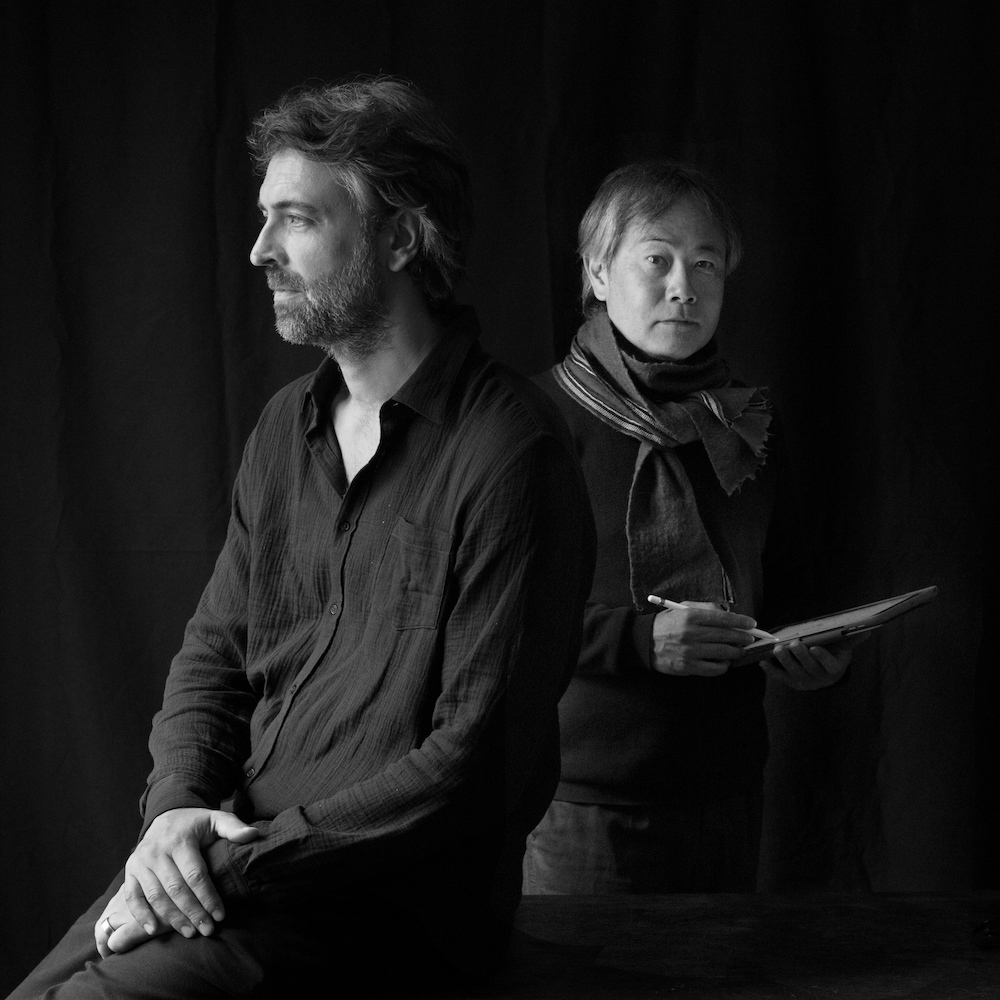


Stella Amae was founded in 2020 by Alexandre Stella, left, and Ryuta Amae. (Supplied)

Today, the architecture firm is working on ongoing megaprojects in Saudi Arabia, leisure schemes in NEOM, and resorts on Shusha Island in the Red Sea.

Stella Amae has also worked on urban sculptures such as the gates of Riyadh.

“This is where the artistic specificity of our agency can bring something more to urban space. It is not just architecture; we also intervene in the field of art.

“For Riyadh, we envisioned a grand gate with an optical effect that gives the idea of passage and access to the city,” Stella added.

Stella Amae focuses on large cities, but not exclusively. The agency also works on second-tier cities, villages, and natural contexts.

A project in Taif, in the Hijaz mountains, is an example of an initiative for rural development and agri-tourism.

Stella said: “It’s a very rich agricultural region. And we wanted tourism development to go hand in hand with ecological development and sustainable agriculture.

“It was a kind of route where you can explore the countryside and nature while simultaneously having a new rural and economic activity with the locals. All of this is connected to Saudi history and heritage.”

Stella Amae has established partnerships with agencies in France and several other countries, notably on neighborhood development projects such as Diriyah II, where they are working on mixed-use neighborhoods (residential, office, commercial), and on the mosque of Diriyah II.

“We have the feeling that something extraordinary is happening in Saudi Arabia. And naturally, as architects, we want to be part of it.

“Today, we are actively seeking to collaborate on projects with the new generation of Saudi architects. We are looking for this possibility of exchanges, and not just as a business prospect,” Stella added.

Participating in missions between France and Saudi Arabia, such as AFEX-Riyadh (French Architecture Days), strengthens the possibility of exchanges with local decision-makers and architects.

For two decades, the expertise of the agency’s co-founders has evolved in tandem with cultural and urban challenges around the world. Stella and Amae have channeled art and architecture so that their work serves as a vehicle for culture, something Stella described as “a very French way of practicing architecture.”

He said: “In France, buildings have often been collaborative efforts with sculptors, painters, and craftsmen. People who were in the fields of art and artisanry, and today we want to highlight this complementarity.”

In terms of expertise, the duo has worked on cultural projects in Asia, particularly in China, including buildings for museums dedicated to traditional Chinese painting, buildings for residents, and multifunctional theaters to animate neighborhoods.

In France, they have worked on projects in line with metropolitan development policies that have marked the last 20 years in the country.

“Urban policy has driven us to create innovative buildings that change the urban relationship by mixing functions — office, housing, and sports or buildings for the younger generations,” Stella said.

This is evident in their work on buildings where nature and communal spaces play a significant role.

Stella noted that the idea was to address issues related to the needs of the new generation — access to housing and the relationships that can be created in the city.

“For us, the development of the city experience is very important in our work,” he added.

One of the challenges in the industry is the number of projects produced compared to those that materialize, especially as some projects do not go through due to validation processes.

Stella Amae presents innovative architectural solutions, supported by experience in managing global projects.


Motherhood during Ramadan 

Updated 06 March 2026
Follow

Motherhood during Ramadan 

  • Planning ahead, flexibility, and family support helps mothers make it through the holy month 

JEDDAH: For mothers — new, working or stay-at-home, Ramadan comes with its own set of demands as they strive to balance work, house, and children of different age groups, all while fasting. 

As routines shift and energy levels fluctuate, Arab News spoke to mothers on how they manage to keep their world together. 

Elaf Trabulsi, founder and creative at Ctrl C Agency and a full-time employee, is a mother to an 18-month-old daughter. For Trabulsi, Ramadan is “controlled chaos, honestly. It’s my favorite month but it’s also the one that tests every system I’ve built — work, home, health, sleep. There’s something about fasting while managing a full schedule that forces you to be very deliberate about where your energy goes. I’ve come to appreciate that pressure.” 

Planning is a vital strategy during Ramadan, mothers said, because without a clear structure in place, the household ends up in a state of disarray. A lot of decisions have to be made professionally and domestically to hold the house together. 

“I juggle a full-time job alongside the agency, so Ramadan is really about protecting the hours that matter most and being honest about what can wait,” Trabulsi said. 

Baraa Hifni, a physical education teacher at Jeddah Campus International School, echoed similar sentiments. “I rely on planning ahead, distributing household responsibilities, and organizing my children’s time. I also make sure to take some time for myself so that I can stay in a good mood throughout the day. Balance requires calmness and clear priorities,” the mother of two young daughters said. 

Even with a schedule planned, juggling motherhood and work can often be challenging because newborns and toddlers function on their own timeline, and it is the sleep schedule that takes a hit. 

“Ramadan flips your schedule naturally — late gatherings, suhoor, staying up — and then you have a toddler operating on her own timeline regardless. That gap between when you slept and when she’s ready to start her day is where it gets hard. You learn to function on less and find energy where you can,” Trabulsi told Arab News. 

Finding pockets of peace or solitude during Ramadan for worship is also quite difficult for mothers because they cannot set or follow a rigid schedule.

For Hifni, it is usually after the chaos around iftar settles after maghrib prayer “even if it’s just a few minutes to regain my calmness and draw closer to God.”  

For Trabulsi it is “whenever and wherever I can find it … sometimes it’s the quiet after she sleeps, sometimes it’s during the drive home from a gathering.” 

Hana Barakat, an occupational therapist and mompreneur productivity coach, shares similar thoughts. 

“Allow worship to be brief and spread throughout the day. Measure productivity by consistency, not quantity. Accept fluctuating energy from day to day. Recognize that a quieter Ramadan can still be deeply spiritual,” she said.

“Achieving balance — or harmony, as I prefer — does not mean pushing the body to match spiritual intentions but adjusting expectations and practices so that the body supports the experience rather than resists it,” she said. “Realism supports well-being and allows space to experience the month with calm.”

She advises new mothers to reset their expectations by prioritizing recovery and infant care over productivity. For a new mother, this shift can feel especially intense because she is already adapting to life after childbirth — “caring for an infant whose needs are unpredictable.”

Fasting can also influence emotional regulation, particularly when combined with sleep deprivation.

“When hunger combines with lack of sleep and fatigue, the nervous system becomes more sensitive; the crying baby may make mothers feel more overwhelmed than usual,” Barakat said.

“Emotional reactions may occur more quickly, and the mother needs extra effort to calm herself. These are normal physiological responses, not a sign of being an impatient or inadequate mother.”

Barakat outlined several strategies to help new mothers navigate the month with greater ease. Reducing nonessential tasks is not neglect, it preserves the strength needed to move steadily through the month, she said. 

Choosing one meaningful task per day prevents energy from being drained by trying to accomplish everything. Waiting for an uninterrupted stretch may lead to frustration. Brief quiet moments can become restorative spiritual pauses, she added. 

Even a few minutes of true rest can help regulate the nervous system, improving patience and emotional balance. Less complexity in meals, social obligations, and routines leaves more room for spiritual presence.

Meaningful support, Barakat said, must be practical rather than merely verbal, for all mothers. 

Spouses and family members should help by taking responsibility for specific daily tasks, giving mothers uninterrupted time to rest, reducing social expectations placed upon her, and understanding fluctuations in her energy and mood.

“When responsibility is shared, the mother can experience Ramadan with greater calm, ease, and presence,” she said.