

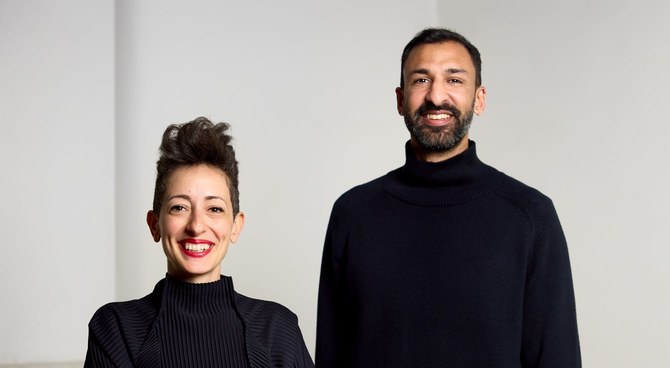

VENICE: Saudi Arabia’s Royal Commission for AlUla has announced Paris-based, Beirut-born Lina Ghotmeh and British talent Asif Khan as the architects for two upcoming museums to be situated in the ancient oasis city.
Ghotmeh will design the Contemporary Art Museum and Khan the Museum of the Incense Road as part of a growing constellation of cultural assets reflecting the region’s ambitious plans.
They were chosen by an international competition jury comprised of key stakeholders and specialists in architecture, landscape, and museology, supported by a technical panel, and chaired by Dr. Khaled Azzam, the man behind AlUla’s Journey Through Time Masterplan.
Azzam said: “We are excited to announce the appointed architects to these two significant museums – the first of 15 cultural assets being developed as part of AlUla’s Journey Through Time Masterplan.
“AlUla is a spectacular landscape of discovery, where heritage, works of nature and humankind combine to reveal a long and intimate relationship between people and their environment.
“This masterplan will guide the reinvigoration of AlUla establishing a new cultural legacy including the implementation of a circular economy expected to create 38,000 new jobs,” he added.
Khan was awarded a British MBE honor for his services to architecture and is currently working on the renewal of the Barbican Center in London and the new London Museum. He is known for his unique approach to architecture, which merges history and heritage with the future through thought-provoking incorporations of materials.
Khan said: “AlUla resonated with me deeply as did the local community members I met. The design takes the form of a public space, not a museum within walls, situated in Al-Jadidah village with galleries and spaces for sensory experiences and learning.
“The mountains are a constant background, whose sand dunes reach down to greet the edges of the museum, while stepped terraces of gardens act as a new interface between the village and the oasis.
“I am excited about how the Museum of the Incense Road can be brought into the collective memory of the world and become a transformative asset for the local community,” he added.
Ghotmeh designed London’s Serpentine Pavilion and is known for her ability to merge the realms of art, architecture, and design.
She said: “The architecture of the Contemporary Art Museum in AlUla immerses visitors in a creative journey from the desert expanse to the lush cultural oasis of AlUla, interweaving the natural environment, agriculture, and art to reveal the heart of contemporary culture.
“Through a series of garden pavilions, the museum presents a constant interplay between art and nature, capturing the essence of this unique place.
“The galleries offer surprising and anchored perspectives on the many facets of AlUla, from the microclimates of the oasis to the expanse of the desert, evoking a deep sense of attachment to the land and its heritage,” Ghotmeh added.
The Contemporary Art Museum will boast a core collection of works by artists from regions adjoining the Red Sea, the Arabian Sea, and the Eastern Mediterranean, and will constitute the primary art museum in AlUla.
Sustainability will also form a large part of its structure and program. The museum will include an adjoining series of artist-designed gardens. Integrated into the distinctive AlUla oasis, set among vegetable gardens, palm groves, mountain ranges, and an ancient settlement, the museum will explore sensitive environmental design and function as a catalyst for environmental renewal and regeneration of the oasis.
The Museum of the Incense Road will be the world’s first museum dedicated to the epic millennia-old network of major land and sea trading routes.
It aims to bring to life the ancient and modern histories that saw AlUla as a crossroads for trade, culture, and knowledge exchange, while offering a dynamic presentation of ongoing excavations in AlUla through findings among its various archaeological sites and the cultural importance of the Incense Road.


