

Constituency demarcation being finalized for official release on Nov. 30 — Election Commission of Pakistan

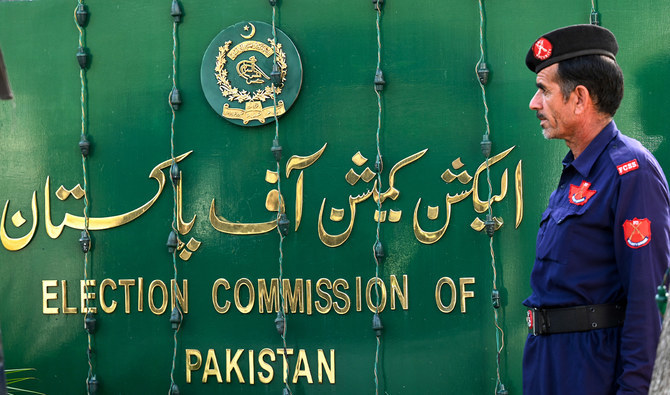
A security personnel stands guard at the headquarters of Election Commission of Pakistan in Islamabad, Pakistan on September 21, 2023. (AFP/File)
Short Url
Updated 13 November 2023
Follow

Constituency demarcation being finalized for official release on Nov. 30 — Election Commission of Pakistan

  • Elections were due in November but were delayed due to fresh demarcation of constituencies under a new census
  • Election results are rarely accepted across the board in Pakistan, perceptions of bias could cast shadow over latest polls

ISLAMABAD: Pakistan’s election oversight body has said it will announce fresh demarcation of constituencies by Nov. 30 as the South Asian country heads to the general elections in February.

Elections in the politically and economically beleaguered South Asian nation were due to be held in November but were delayed after the Election Commission of Pakistan said it had to freshly draw up hundreds of constituencies under a new census.

On Nov. 2, the regulator said the balloting would be held on Feb. 8, a date chosen following consultations with the country’s President Dr. Arif Alvi that were requested by the country’s Supreme Court. 

“Delimitation of constituencies is being finalized for official release on 30th of this month,” state-run APP reported on Sunday, quoting the ECP.

“ECP was also set to enlist over one million individuals for the polling process as a list of Presiding Officers, Assistant Presiding Officers and polling staff is being finalized for nationwide deployment.”

Pakistan is currently being run by a caretaker government under interim Prime Minister Anwaar ul Haq Kakar that is meant to oversee a general election. Originally, elections were to be held within 90 days of the dissolution of the lower house of parliament in August.

Independent analysts have already questioned the transparency of the upcoming election which former premier Imran Khan, the main opposition leader, cannot fight after he was barred from public office for five years after a corruption investigation. Ahead of his conviction and imprisonment, Khan and his Pakistan Tehreek-e-Insaf party had voiced fears the vote could be delayed indefinitely or would skewed in favor of the opponents of the ex-PM.

Election results are rarely accepted across the board in Pakistan and perceptions of bias could further taint over the credibility of the process.

Despite the delay, the announcement that elections would be in February have eased some political uncertainty as the country struggles to stay on a narrow stabilization path under a $3 billion bailout plan by International Monetary Fund (IMF).


Pakistan, ADB sign $730 loan agreements to boost SOE reforms, energy infrastructure

Updated 25 December 2025
Follow

Pakistan, ADB sign $730 loan agreements to boost SOE reforms, energy infrastructure

  • Both sign $330 million Power Transmission Strengthening Project and $400 million SOE Transformation Program loan agreements
  • Economic Affairs Division official says Transmission Project will secure Pakistan’s energy future by strengthening national grid’s backbone

KARACHI: Pakistan and the Asian Development Bank (ADB) on Thursday signed two loan agreements totaling $730 million to boost reforms in state-owned enterprises (SOEs) and energy infrastructure in the country, the bank said.

The first of the two agreements pertains to the SOE Transformation Program worth $400 million while the second loan, worth $330 million, is for a Power Transmission Strengthening Project, the lender said. 

The agreements were signed by ADB Country Director for Pakistan Emma Fan and Pakistan’s Secretary of Economic Affairs Division Humair Karim. 

“The agreements demonstrate ADB’s enduring commitment to supporting sustainable and inclusive economic growth in Pakistan,” the ADB said. 

Pakistan’s SOEs have incurred losses worth billions of dollars over the years due to financial mismanagement and corruption. These entities, including the country’s national airline Pakistan International Airlines, which was sold to a private group this week, have relied on subsequent government bailouts over the years to operate.

The ADB approved the $400 million loan for SOE reforms on Dec. 12. It said the program seeks to improve governance and optimize the performance of Pakistan’s commercial SOEs. 

Karim highlighted that the Power Transmission Strengthening Project will enable reliable evacuation of 2,300 MW from Pakistan’s upcoming hydropower projects, relieve overloading of existing transmission lines and enhance resilience under contingency conditions, the Press Information Department (PID) said. 

“The Secretary emphasized that both initiatives are transformative in nature as the Transmission Project will secure Pakistan’s energy future by strengthening the backbone of the national grid whereas the SOE Program will enhance transparency, efficiency and sustainability of state-owned enterprises nationwide,” the PID said. 

The ADB has supported reforms by Pakistan to strengthen its public finance and social protection systems. It has also undertaken programs in the country to help with post-flood reconstruction, improve food security and social and human capital. 

To date, ADB says it has committed 764 public sector loans, grants and technical assistance totaling $43.4 billion to Pakistan.